I’ve often said that I’m a reform agnostic.
It’s not that I don’t believe in good government. I do. Fervently. And I most certainly don’t believe as some do that voters should be given the sole responsibility to weed out the crooks and con artists.
“Let the buyer beware” just isn’t good enough. Rod Blagojevich’s two consecutive gubernatorial campaign wins and George Ryan’s earlier win proves beyond a shadow of a doubt that voters simply aren’t able to handle this task. So, we do need some “consumer protection” laws in Illinois. But we should also keep some important points in mind. For instance, campaign contribution caps are now being pushed hard by good government groups and Gov. Pat Quinn’s independent reform commission. Most want a federalstyle program that would cap contributions at about $2,500 for individuals and $5,000 for political action committees.
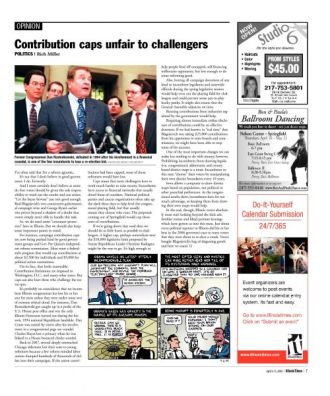
On its face, that looks reasonable. Contribution limitations are imposed in Washington, D.C., and many other states. But caps can also hurt those who challenge the status quo. It’s probably no coincidence that no incumbent Illinois congressman has lost his or her seat for years unless they were under some sort of extreme ethical cloud. For instance, Dan Rostenkowski got caught up in a probe of the U.S. House post office and was the only Illinois Democrat turned out during the historic 1994 national Republican landslide. Dan Crane was ousted by voters after his involvement in a congressional page sex scandal.
Charles Hayes lost a primary when he was linked to a House bounced checks scandal. Back in 2007, several deeply entrenched Chicago aldermen lost their seats to young reformers because a few reform-minded labor unions dumped hundreds of thousands of dollars into their campaigns. If the union contri butions had been capped, most of those reformers would have lost. Caps mean that most challengers have to work much harder to raise money. Incumbents have access to financial networks that usually dwarf those of outsiders. National political parties and caucus organizations often take up the slack these days to help level the congressional playing field, but that usually means they choose who runs. The proposals coming out of Springfield would cap those sorts of contributions.
If we’re going down that road then we should do as little harm as possible to challengers. A higher cap, perhaps somewhere near the $10,000 legislative limit proposed by Senate Republican Leader Christine Radogno, might be the way to go. It’s high enough to help people fend off uncapped, self-financing millionaire opponents, but low enough to do some reforming good. Also, barring all campaign donations of any kind to incumbent legislators and statewide officials during the spring legislative session would help even out the playing field for challengers and could prevent some pay-to-play hanky panky. It might also ensure that the General Assembly adjourns on time. Banning contributions from industries regulated by the government would help. Requiring almost immediate online disclosure of contributions could be an effective deterrent. If we had known in “real time” that Blagojevich was taking $25,000 contributions from his appointees to state boards and commissions, we might have been able to stop some of his excesses.
One of the most important changes we can make has nothing to do with money, however. Prohibiting incumbents from drawing legislative, congressional, aldermanic and county board district maps is a must. Incumbents in this state “choose” their voters by manipulating their own district boundaries every 10 years.
Iowa allows a computer to draw district maps based on population, not political or other parochial preferences. As the congressional results show, incumbents have far too much advantage, so keeping them from drawing their own maps would help. In the end, though, Illinois voters absolutely must start looking beyond the slick ads, familiar names and blind partisan leanings which have gotten us into this mess. Just about every political reporter in Illinois did his or her best in the 2006 governor’s race to warn voters that they were about to re-elect a crook. Voters bought Blagojevich’s bag of disgusting goods and here we stand. |