The medical argument
continued from page 11
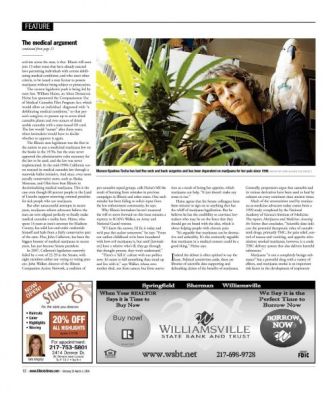
activists across the state, is that Illinois will soon join 13 other states that have already enacted laws permitting individuals with certain debilitating medical conditions, and who meet other criteria, to be issued a state license to possess marijuana without being subject to prosecution.
The current legislative push is being led by state Sen. William Haine, an Alton Democrat. Haine has sponsored the Compassionate Use of Medical Cannabis Pilot Program Act, which would allow an individual diagnosed with “a debilitating medical condition,” or that person’s caregiver, to possess up to seven dried cannabis plants and two ounces of dried usable cannabis with a state-issued ID card. The law would “sunset” after three years, when lawmakers would have to decide whether to approve it again.
The Illinois state legislature was the first in the nation to put a medicinal marijuana law on the books in the 1970s, but the state never approved the administrative rules necessary for the law to be used, and the law was never implemented. In the mid-1990s California voters enacted its medical cannabis law through a statewide ballot initiative. And since, even more socially conservative states, such as Alaska, Montana, and Ohio have beat Illinois in decriminalizing medical marijuana. This is the case even though 68 percent people in the Land of Lincoln support removing criminal penalties for sick people who use marijuana.
But after unsuccessful attempts in recent years, marijuana reform advocates believe the stars are now aligned perfectly to finally make medical cannabis a reality here. Haine, who spent 14 years as state’s attorney for Madison County, has solid law-and-order credentials himself and hails from a fairly conservative part of the state. Plus, John Cullerton, has been the biggest booster of medical marijuana in recent years, has just become Senate president.
In 2007, Cullerton’s legislation narrowly failed by a vote of 22-29 in the Senate, with eight members either not voting or voting present. John Walker, director of the Illinois Compassion Action Network, a coalition of pro-cannabis repeal groups, calls Haine’s bill the result of learning from mistakes in previous campaigns in Illinois and other states. One such mistake has been failing to solicit input from the law enforcement community, he says. Why Illinois lawmakers haven’t mustered the will to move forward on this issue remains a mystery to ICAN’s Walker, an Army and National Guard veteran.
“If I knew the answer, I’d fix it today and we’d pass this sucker tomorrow,” he says. “From our earliest childhood we’re been inundated with how evil marijuana is, but until [lawmakers] have a relative who’s ill, they go through that thought process, they won’t understand.”
“There’s a ‘kill it’ culture with our politics now. It’s easier to kill something than stand up and live with it,” says Walker, whose own mother died, not from cancer, but from starvation as a result of losing her appetite, which marijuana can help. “It just doesn’t make any sense to me.” Haine agrees that his Senate colleagues have been reticent to sign on to anything that has the whiff of marijuana legalization. But he believes he has the credibility to convince lawmakers who may be on the fence that they should get on board with the idea, which is about helping people with chronic pain. “It’s arguable that marijuana can be destructive and unhealthy. It’s also eminently arguable that marijuana in a medical context could be a good thing,” Haine says.
Indeed
the debate is often spirited to say the least. Political sensitivities aside, there are libraries of scientific data supporting and debunking claims of the benefits of marijuana. Generally, proponents argue that cannabis and its various derivatives have been used to heal by cultures on every continent since ancient times.
Much of the ammunition used by marijuana-as-medicine advocates today comes from a 1999 study completed by the National Academy of Science’s Institute of Medicine.
The report, Marijuana and Medicine: Assessing the Science Base concludes, “Scientific data indicate the potential therapeutic value of cannabinoid drugs, primarily THC, for pain relief, control of nausea and vomiting, and appetite stimulation; smoked marijuana, however, is a crude THC delivery system that also delivers harmful substances.”
Marijuana “is not a completely benign substance” but a powerful drug with a variety of effects, and marijuana smoke is an important risk factor in the development of respiratory