FAST TRAINS
After previous derailments, Illinois’ plans for high-speed rail are back on track
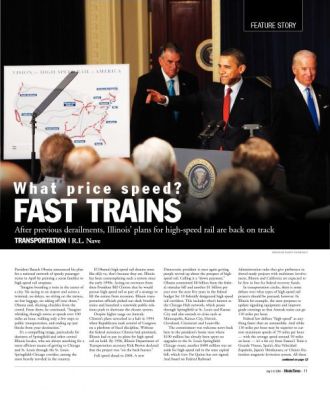
President Barack Obama announced his plan for a national network of speedy passenger trains in April by painting a scene familiar to high-speed rail utopians.
“Imagine boarding a train in the center of a city. No racing to an airport and across a terminal, no delays, no sitting on the tarmac, no lost luggage, no taking off your shoes,” Obama said, eliciting chuckles from the crowd. From there, he continued, “Imagine whisking through towns at speeds over 100 miles an hour, walking only a few steps to public transportation, and ending up just blocks from your destination.”
It’s a compelling image, particularly for denizens of Springfield and other central Illinois locales, who are always searching for a more efficient means of getting to Chicago and St. Louis through the St. Louis- Springfield-Chicago corridor, among the most heavily traveled in the country.
If Obama’s high-speed rail dreams seem like déjà vu, that’s because they are. Illinois has been contemplating such a system since the early 1990s. Acting on overtures from then-President Bill Clinton that he would pursue high-speed rail as part of a strategy to lift the nation from recession, Illinois transportation officials picked out sleek Swedish trains and launched a statewide public-relations push to showcase the chosen system.
Despite higher usage on Amtrak, Clinton’s plans screeched to a halt in 1994 when Republicans took control of Congress on a platform of fiscal discipline. Without the federal assistance Clinton had promised, Illinois had to put its plans for high-speed rail on hold. By 1996, Illinois Department of Transportation secretary Kirk Brown declared that the project was “on the back burner.”
Full speed ahead to 2008. A new Democratic president is once again getting people revved up about the prospect of highspeed rail. Calling it a “down payment,” Obama committed $8 billion from the federal stimulus bill and another $1 billion per year over the next five years in the federal budget for 10 federally designated high-speed rail corridors. This includes what’s known as the Chicago Hub network, which passes through Springfield to St. Louis and Kansas City and also extends to cities such as Minneapolis, Kansas City, Detroit, Cleveland, Cincinnati and Louisville.
The commitment was welcome news back here in the president’s home state where $100 million has already been spent on upgrades to the St. Louis-Springfield- Chicago route; another $400 million was set aside for high-speed rail in the state capital bill, which Gov. Pat Quinn has not signed.
And based on Federal Railroad Administration rules that give preference to shovel-ready projects with multistate involvement, Illinois and California are expected to be first in line for federal recovery funds.
In transportation circles, there is some debate over what types of high-speed rail projects should be pursued, however. In Illinois for example, the state proposes to update signaling equipment and improve grade crossings so that Amtrak trains can go 110 miles per hour. Federal law defines “high-speed” as anything faster than an automobile. And while 110 miles per hour may be superior to current maximum speeds of 79 miles per hour — with the average speed around 59 miles an hour — it’s a far cry from France’s Train à Grande Vitesse, Spain’s Alta Velocidad Española, Japan’s Shinkansen, or China’s frictionless magnetic-levitation system. All these
continued on page 12