Page 11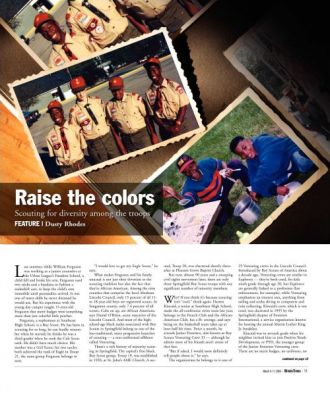 Loading... Tips: Click on articles from page |
  Scouting for diversity among the troops Scouting for diversity among the troops Last summer, while William Ferguson was working as a junior counselor at the Urban League’s Freedom School, a child fell and broke his arm. Ferguson used two sticks and a bandana to fashion a makeshift cast, to keep the child’s arm immobile until paramedics arrived. It was one of many skills he never dreamed he would use. But his experience with the young day camper taught 15-year-old Ferguson that merit badges were something more than just colorful little patches.
Ferguson, a sophomore at Southeast High School, is a Boy Scout. He has been in scouting for so long, he can hardly remember when he started; he thinks he was a third-grader when he took the Cub Scout oath. He didn’t have much choice: His mother was a Girl Scout; his two uncles both achieved the rank of Eagle in Troop 21, the same group Ferguson belongs to now. “I would love to get my Eagle Scout,” he says. What makes Ferguson and his family unusual is not just their devotion to the scouting tradition but also the fact that they’re African American. Among the nine counties that comprise the local Abraham Lincoln Council, only 15 percent of all 11to 18-year-old boys are registered scouts. In Sangamon county, only 7.4 percent of all scouts, Cubs on up, are African American, says Daniel O’Brien, scout executive of the Lincoln Council. And most of the highschool-age black males associated with Boy Scouts in Springfield belong to one of the less-traditional, more progressive branches of scouting — a non-uniformed offshoot called Venturing.
There’s a rich history of minority scouting in Springfield. The capital’s first black Boy Scout group, Troop 19, was established in 1920, at St. John’s AME Church. A second, Troop 20, was chartered shortly thereafter at Pleasant Grove Baptist Church.
But now, almost 90 years and a sweeping civil rights movement later, there are only three Springfield Boy Scout troops with any significant number of minority members.
Why? If you think it’s because scouting isn’t “cool,” think again. Darren Kincaid, a senior at Southeast High School, made the all-conference swim team last year, belongs to the French Club and the African- American Club, has a B average, and says being on the basketball team takes up at least half his time. Twice a month, he attends Junior Frontiers, also known as Boy Scouts Venturing Crew 33 — although he admits most of his friends aren’t aware of that fact. “But if asked, I would most definitely tell people about it,” he says. The organization he belongs to is one of 25 Venturing crews in the Lincoln Council.
Introduced by Boy Scouts of America about a decade ago, Venturing crews are similar to Explorers — they’re both coed, for kids ninth grade through age 20, but Explorers are generally linked to a profession (law enforcement, for example), while Venturing emphasizes an interest area, anything from sailing and scuba diving to computers and coin collecting. Kincaid’s crew, which is not coed, was chartered in 1995 by the Springfield chapter of Frontiers International, a service organization known for hosting the annual Martin Luther King Jr. breakfast.
Kincaid was in seventh grade when his neighbor invited him to join Positive Youth Development, or PYD, the younger group of the Junior Frontiers Venturing crew. There are no merit badges, no uniforms, no continued on page 12
|


