Shielded from the worst of the chaos, they ride out the recession with confidence
 As America looks around for someone to blame for the current economic mess, bankers are the easiest target in sight. “No one wants to hug a banker,” reads a recent Newsweek headline, and no wonder. Bankers made the loans that went bad, causing the house of cards to tumble. Then they accepted government bailout money but spent it on their own salaries and parties, refusing to make new loans that would get the economy moving again.
But I know a few bankers, and they hardly seem like the arrogant, clueless guys we see on TV testifying before Congress. So I went to visit a couple of them, to learn more about where our local banks are in the financial food chain and to ask, “How’s business?” There are many more banks I could have talked to, and I don’t presume that all our local banks are in the same situation. But I did get the impression many of them share the outlook that Springfield is a good place to ride out a recession. “We’re totally isolated from the chaos you see in the media,” says Richard McCord, president and CEO of Illinois National Bank. McCord explained that community commercial banks like INB and United Community Bank are in a third tier of bank sizes, below the regional commercial banks. At the top are investment banks, brokerage firms and international conglomerates like Citigroup. At the top is where the trouble began, not only with the failure of subprime loans, but also with the declining value of securities backed by mortgages.
“There is a huge difference between large national banks and community banks like ours,” said Todd Wise. Wise is president and chief operating office of United Community Bank, headquartered in Chatham. “The large banks are hampered by low asset quality related to subprime mortgages. They have suffered from loan losses, write-downs and operating losses. Community banks didn’t participate in subprime lending. There is just not that big a market for it in Chatham, Illinois.”
The mortgage loans made by community banks are sold to the Federal National Mortgage Association (Fannie Mae) and the Federal Home Loan Mortgage Association (Freddie Mac). “We don’t hold mortgages on our balance sheets,” McCord says. While the community banks have been spared from the worst effects of the housing crisis, they can’t escape recession and the slow economy. There are fewer new home loans, business loans and car loans that normally are bread and butter for banks. “But now the drop in interest rates has caused a huge rush in mortgage refinancing over the last 60 days,” says Wise of UCB, which so far in 2009 is writing three times its normal volume of mortgages.
INB also has had “record levels of activity” in mortgage refinancing, McCord says, and he expects mortgage interest rates to remain low through most of this year. “It wouldn’t surprise me to see it go lower,” he says. Refinancing isn’t a high-profit category for banks, considering the labor that goes into each loan, but it’s welcome business while banking is slow in other areas.
Agricultural lending, a strong suit for UCB, is a question mark this year. “Our ag business is coming off three of the best years we’ve ever posted,” says Wise. “Grain prices were at record levels. Now we have high input [fertilizer and herbicide] costs and low grain prices, but that could change.” Even if grain prices return to reasonable levels, most farmers have already bought the new equipment they need for awhile, so bankers don’t expect much new ag business in 2009. McCord says INB has been active in construction lending, and has had to foreclose on some commercial loans used to build spec houses. “We’ve had a few bankrupt builders,” he says. Other bank clients have suffered losses with vacant commercial real estate. These setbacks are “not catastrophic,” he says. The community banks are eager to see confidence return, so they can get back to commercial lending. “There are still those folks who have the ability to borrow who are sitting on the sidelines,” Wise says. An upturn in the stock market would help. “If people can open up their 401(k)s and they’re up, that’s a confidence builder.”
McCord notes that confusion and dysfunction in state government have added insult to the national economic injury. Service providers, like nursing homes waiting for late Medicaid payments, or landlords not getting timely payments for leased office space, are
continued on page 6
Editor’s note
Ted Rall, the nationally syndicated editorial cartoonist, impressed
Springfield audiences last week with his message that it is the duty of
cartoonists to criticize the powers that be, even when they be Obama.
He was equally sharp on the decline of the daily newspaper industry,
and the consequent decimation of the ranks of cartoonists. Rall lost
his spot in IT during our redesign last December, but we are pleased to
welcome him back [see page 7]. His work is on display through March 23
in the Visual Arts Gallery at the University of Illinois at
Springfield.
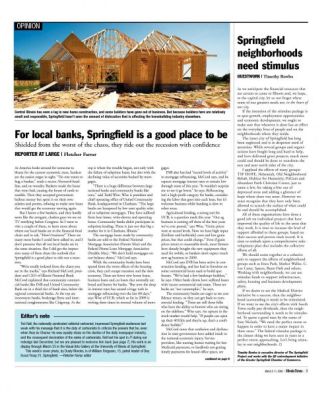
This week’s cover photo, by Dusty Rhodes, is of
William Ferguson, 15, patrol leader of Boy Scout Troop 21, Springfield.
—Fletcher Farrar, editor