A town of enduring character at the crossroads of history
Rearing up nearly 800 feet above sea level, above the flat land all around, Elkhart Hill stands guardian over a place where geography, nature and human history converge.
It was here, on her wooded slopes, that an early white settler stood on the lawn of the house he’d built and had a vision of a town laid out before him below.
According to local history, John Shockey journeyed from Pennsylvania to central Illinois in 1848 to buy cattle. He fell so in love with Elkhart Hill’s beauty that he relocated with his wife and their then-15 children (two more were born here) in 1850, eventually buying up nearly 5,000 acres of land that included The Hill (as the locals casually refer to it today).
Shockey had the land surveyed and platted and his dream was fulfilled on April 11, 1855, the day Elkhart City was founded. Later “City” was dropped by village board decree. His attorney for much of his business? Abraham Lincoln of nearby Springfield.
Tragically, a devastating crop failure in 1856 wiped out much of his fortune and Shockey would die three years later at age 53. Financially ruined by the land he loved so well, Shockey nonetheless left in his will property to be used for churches, schools, businesses and homes.
Elkhart Hill itself is ancient, observed Elkhart history buff Gillette Ransom, a descendent of another early Elkhart resident, John Dean Gillett. The Hill’s birth dates back hundreds of thousands of years to an age when glaciers marched then retreated, again and again over the span of eons, grinding down the terrain of the future state of Illinois. During one of these periods of geologic upheaval, the massive chunk of earth was left behind. As the tallest of natural formations between St. Louis and Chicago, Elkhart Hill covers almost 700 acres. To travelers on I-55, 20 miles north of Springfield, it stands out.
“The Hill is something special,” Ransom contends. “To have a village nestled at the bottom of a hill is very picturesque, very New England-y, especially in an area as flat as Illinois.”
Heart of the elk Elkhart Hill bristles with old-growth hardwood timber like the quills on a fat porcupine. The state’s conservation department recognizes Elkhart Hill for its broad selection of prairie woodland flora and fauna.
Several endangered species of plants thrive here and, in the spring, the slopes of Elkhart Hill are a breathtaking splash of color painted by prairie wildflowers.
The Hill was first home to Kickapoo Indians around 1763, and to the white men who came after. Although the American Indians are gone, they left behind the remains of a village, with its artifacts and burial mounds — as well as a name for The Hill. Tradition has it that during an annual hunting trip, an Indian chief’s daughter, White Blossom, was forced to choose between two competing suitors. White Blossom decided that the warrior whose arrow could pierce the heart of an elk that happened to be passing by would win her hand. The suitor from White Blossom’s own tribe, the Illinois, and his rival from the Ohio Shawnee, both took aim at the elk, and the Illini’s arrow hit its mark in the animal’s heart. From that day forward, the warrior and his young wife took the elk heart as their totem and The Hill was forever known as Elkhart Hill. Today, The Hill easily dwarfs the three church spires, towering grain elevators, homes and businesses of the tiny farming community at its feet. Still the center of a solid, successful farming region, Elkhart’s population remained steady at 400 to 500 people for most of the 20th and into the 21st centuries.
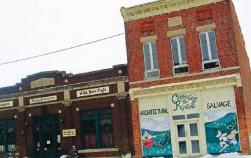
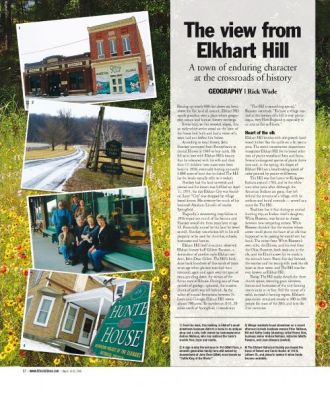
1) Once the bank, this building in Elkhart's small
downtown business district is home to an antique
shop and a cafe, both owned by businesswoman
Andrea Niehaus, who has restored the bank's
marble floor, foyer and vaults.
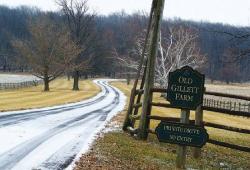
2) A sign marks the entrance to Old Gillett Farm, a
seventh-generation family farm still owned by
descendents of John Dean Gillett, once known as
"Cattle King of the World."
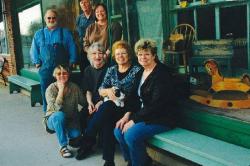
3) Village residents found downtown on a recent
afternoon include business owners Peter Neihaus,
Bill and Kathy Cosby (standing); artist Renee Sisk,
business owner Andrea Neihaus, historian Gillette
Ransom, and Linda Gleason (seated).
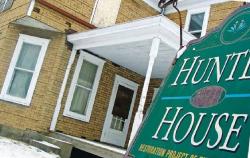
4) The Elkhart Historical Society purchased the
home of Robert and Carrie Hunter at 116 N. Latham St., and plans to restore it when funds become available.