Page 11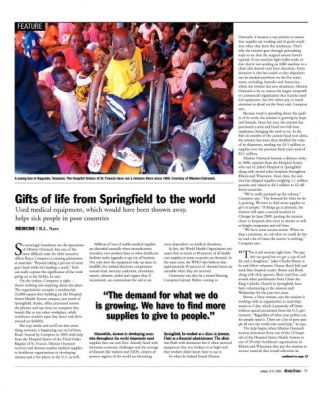 Loading... Tips: Click on articles from page |
 Gifts of life
continued from page 11  thrown away. When it arrives, volunteers sort through the tracheostomy bags, anesthesia machines, warming tables, scalpels, catheters, hospital beds, adult diapers and metal intibators. If necessary, the items are tested, packed, logged into a computer database and warehoused until an order in placed. thrown away. When it arrives, volunteers sort through the tracheostomy bags, anesthesia machines, warming tables, scalpels, catheters, hospital beds, adult diapers and metal intibators. If necessary, the items are tested, packed, logged into a computer database and warehoused until an order in placed.
“As a former hospital administrator, it bugs me to see how wasteful we are,” says volunteer Al Laabs, a former executive with St. John’s Hospital.
Not everything that comes in the front door can be shipped, however. Of the 630,000 pounds of materials that came into the mission last year, roughly 8 percent had to be discarded for various reasons. Laabs describes the exercise as akin to a treasure hunt. Somehow, a pair of colorful swimming trunks wound up in a shipment of hospital gowns. Another time, volunteers encountered a pair of silicon breast implants. Other items that can’t be shipped include pharmaceuticals, baby formula and hazardous liquids such as acetone.
The Christ the King group, made up of mostly retirees, enjoys the camaraderie, but volunteers also take the work seriously.
Whenever one of the volunteers come across a garment so tattered or stained that it must go into the reject pile, the group expresses collective disappointment.
End users, as the recipients are called, can view and order from the online inventory after completing a five-page application.
“With first-time users, we mostly stick to beds and gowns,” says mission employee Vicki Detmers, who’s in charge of maintaining the mission’s inventory database.
After a more solid relationship is established, however, users can order whatever they want free of charge except for a handling fee of $8,000 to $10,000 per shipping container. They’re also responsible for finalizing arrangements with customs agents as well as transportation from the port once it arrives in the receiving country.
Some employees have had the opportunity to take mission trips with shipments. “It was an eye-opener to see the end result of this,” says logistics and warehouse manager Brad Walton, who’s been to Haiti and is planning to accompany a shipment to El Salvador in June. Adorning the walls are certificates of appreciation and plaques from churches and appreciative end users in Haiti, Argentina, Costa Rica, Kenya and Cameroon.
Beneficiaries have also been known to drop in from time to time to express their gratitude in person. From Jan. 1, 2007 to Jan. 1, 2009 Mission Outreach shipped 550,000 tons of medical supplies worth an estimated $8.3 million to the following countries: Afghanistan, Belize, Bolivia Burundi, Cambodia. Cameroon. China. Colombia. Costa Rica, Cuba, Dominican republic, Ecuador, Ghana, Guatemala, Haiti, Honduras, India, Jamaica, Kazakstan, Kenya, Liberia, Macau, Mali, Mexico, Mongolia, Mozambique, Nicaragua, Paraguay, Philippines, Russian Federation, Serbia, Somalia, South Africa, Tanzania, Trinidad and Tobago, Ukraine, United States, Uruguay and Vietnam. “That’s always touching when recipients stop by and say hello,” Detmers says. Last week the mission shipped a cargo container to the town of Jinja in southeast Uganda. Six young men from the University of Notre Dame, who were in Springfield on a retreat, pack the container with, among other things, mattresses, lamps, wheelchairs and steel bed frames each weighing 215 pounds. Compton maintains a watchful eye, intermittently stretching out his measuring tape. “We’re gonna get it all but just barely,” he announces. “We’ll probably have a little extra space — anybody want to go to Uganda?” It takes less than an hour for the 1,062 pounds of college students to load up 13,000 pounds of supplies, after which the group joins hands in the customary prayer for the people in Springfield who prepared the shipment as well as for the Ugandan recipients.
Indeed the mission has been a godsend for organizations like the Springfield-based Haitian Development Fund, which operates a clinic in the capital of Port Au Prince.
“They’ve been exceedingly helpful,” says HDF director H. Brent De Land. HDF began operating a 700-square-foot clinic in 1996 with an annual budget of $5,000, which paid for all of the organization’s expenses, including medical supplies.
The group’s operating budget has grown to $33,790 today. De Land estimates that Mission Outreach supplies 85 percent of the items used at HDF’s clinic — the rest pays the organization’s administrative costs and buys medicine.
Thanks to the mission, HDF has a steady supply of items such as tongue depressors, beds and wheelchairs for sick patients who typically arrive at the clinic in wheelbarrows.
Simply put, De Land says, “I don’t know how we would survive without them.” Contact R.L. Nave at [email protected]
|


