Page 11 Loading... Tips: Click on articles from page |
 Gifts of life from Springfield to the world Used medical equipment, which would have been thrown away, helps sick people in poor countries 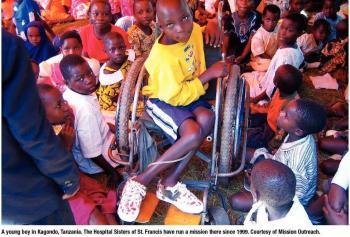 So seemingly humdrum are the operations of Mission Outreach that one of the most difficult tasks for chief executive officer Bruce Compton is creating promotional materials. “Beyond taking a picture of some guy’s back while he’s loading a truck,” little can really capture the significance of the work going on at the facility, he says. On the surface, Compton is right — there’s nothing awe-inspiring about the place.
The organization occupies a nondescript 23,000-square-foot building on the Hospital Sisters Health System campus, just north of Springfield. Inside, office personnel answer the phones and tap away on computer keyboards like at any other workplace, while warehouse workers open bay doors and drive around on forklifts.
But step inside and you’ll see that something awesome is happening out on LaVerna Road. Started by Compton in 2002 with help from the Hospital Sisters of the Third Order Regular of St. Francis, Mission Outreach recovers and donates surplus medical supplies to healthcare organizations in developing nations and a few places in the U.S. as well. Millions of tons of usable medical supplies are discarded annually when manufacturers introduce new product lines or when healthcare facilities make upgrades or go out of business.
Not only does the equipment take up space in landfills, the trashed electronic components contain lead, mercury, cadmium, chromium, arsenic, asbestos, nickel and copper that, if incinerated, can contaminate the soil or air. Meanwhile, doctors in developing countries throughout the world desperately need supplies that can save lives. Already faced with immense economic challenges and the scourge of diseases like malaria and AIDS, citizens of poorest regions of the world are becoming more dependent on medical donations.
In fact, the World Health Organization estimates that as much as 80 percent of all healthcare supplies in some countries are donated. At the same time, the WHO also believes that approximately 40 percent of donated items are unusable when they are received.
Generosity can also be a mixed blessing, Compton learned. Before coming to Springfield, he worked at a clinic in Jeremie, Haiti as a financial
administrator. The clinic was flush with donations but it often
received equipment that was broken or so high-tech that workers didn’t
know how to use it. So when he helped found Mission Outreach,
it became a top priority to ensure that supplies are working and in
good condition when they leave the warehouse. That’s why the mission
goes through painstaking steps to see that the surgical sutures haven’t
expired, X-ray machine light bulbs work, or that they’re not sending an
MRI machine to a clinic that doesn’t even have electricity. “The demand for what we do is growing. We have to find more supplies to give to people.” Every donation is also bar-coded so that shipments can be tracked anywhere on the five continents, excluding Australia and Antarctica, where the mission has sent donations. Mission Outreach is by no means the largest nonprofit or commercial organization that recycles medical equipment, but few others pay as much attention to detail on the front end, Compton says. Because word is spreading about the quality of its work, the mission is growing by leaps and bounds. Since last year, the mission has purchased a semi and hired two full-time employees, bringing the total to six. In the first six months of the current fiscal year alone, the mission has more than doubled the value of its shipments, sending out $3.5 million in supplies over the previous fiscal year’s total of $3.1 million.
Mission Outreach became a distinct entity in 2006, separate from the Hospital Sisters, who run St. John’s Hospital in Springfield along with several other hospitals throughout Illinois and Wisconsin. Since then, the mission has shipped supplies weighing 1.1 million pounds and valued at $8.2 million to 43 different countries.
“We’ve really pumped up the volume,” Compton says. “The demand for what we do is growing. We have to find more supplies to give to people.” If things go as planned, the mission will open a second location in Chicago by June 2009, putting the mission closer to hospitals that want to donate as well as freight companies and rail lines.
“We have some success stories. When we ship a container, we ask what we could do better and a lot of times the answer is nothing,” Compton says. his is job security right here. The pay “Tisn’t too good but we get a cup of coffee and a doughnut,” jokes Charles Breese as he and fellow volunteer Donna Boyd fold and stack blue hospital scrubs. Breese and Boyd, along with their spouses, Betty and Don, and several other parishioners from Christ the King Catholic Church in Springfield, have been volunteering at the mission each Wednesday for the past two years.
Breese, a Navy veteran, says the mission is working with an organization to send shipments to Cuba, which is presently off limits without special permission from the U.S. government.
“Regardless of what your politics are, the people need it. There are a lot of poor people all over the world who need help,” he says. The help begins when Mission Outreach receives donations from one of the 13 hospitals of the Hospital Sisters Health System or one of 20 other healthcare organizations in Illinois and Wisconsin that pay the mission to recover material that would otherwise be
continued on page 12
|


