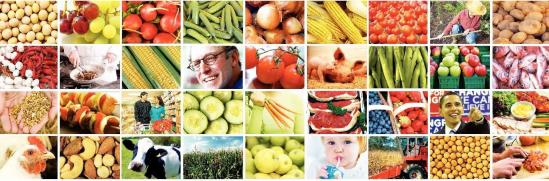
A better food agenda
A letter to Barack Obama, the Farmer in Chief, about what needs to change in U.S. food policy
 Dear President Obama, Congratulations on your election and inauguration! Though condolences seem almost as much in order as kudos. Just thinking about the challenges you face makes me want to brew a cup of tea, curl up in a chair and watch cheerful ’60s sitcoms. (Like your wife, Michelle, I love the “Dick Van Dyke Show.”) So it’s reluctantly that I raise another issue, and only because it’s something that affects many of the biggest items on your agenda: energy, the environment, healthcare, job creation, the economy, education and even national security. It’s food. You’ve called for change. Changing the ways in which America produces, processes, transports, markets and consumes its food is a critical component in achieving many of your goals; not changing them may well put those goals out of reach.
Take energy. Our industrialized, mechanized food system uses more fossil fuel than any other economic sector except cars. In 1940, a calorie of fossil fuel energy produced 2.3 calories of food. Today 10 calories of fossil fuels produce just one food calorie. Most of the fuel is used for machinery and transport. Food travels an average of between 1,500 and 2,500 miles to get to the plate from its production site, a more accurate term than “farm” for industrial agriculture and “confined animal feeding operations,” or CAFOs.
Fossil fuels are also used in processing and packaging, chemical fertilizers made from natural gas, and pesticides made from petroleum. As Michael Pollan, author of The Omnivore’s Dilemma and In Defense of Food: An Eater’s Manifesto writes, “. . . when we eat from the industrial-food system we are eating oil and spewing greenhouse gases. This state of affairs appears all the more absurd [because] every calorie we eat is ultimately the product of photosynthesis — a process based on making food energy from sunshine.”
Then there’s the environment. Greenhouse gases aren’t just produced in our food system by fossil fuels. All farm animals produce methane gas, but the situation is exacerbated in CAFOs, some the size of small cities — not least because the government doesn’t require CAFOs to treat wastes as it does for similarly-sized human cities; consequently CAFOs create vast lakes of polluting excrement. Our food system is the single biggest contributor to greenhouse gas production in America — estimates range as high as 37 percent of total greenhouse gases.
There are other environmental problems in modern large-scale food production. Conventional farming has created serious concerns about soil erosion and water conservation. Those chemical fertilizers and pesticides are problematic for the environment, too, as well as for the health of wildlife and humans.
Healthcare spending has skyrocketed. One of the principle reasons jobs are being lost and businesses outsourcing to other countries, or being in danger of bankruptcy, is the cost of healthcare. While there are many reasons that healthcare’s costs have been on such a steep trajectory, one is the parallel growth of preventable chronic diseases. Four of America’s top 10 killers are chronic diseases with links to diet: heart disease, stroke, Type 2 diabetes and cancer.
Then there’s the use of prophylactic (preventive) antibiotics in CAFOs. The biggest American consumer of antibiotics is agriculture, not primarily to treat sick animals, but because conditions in CAFOs are so hellishly crowded and unsanitary that without antibiotics, animals inevitably become diseased. Addressing, as Pollan puts it, “the public-health catastrophe that is the modern American diet” is essential to controlling healthcare costs — something that must be done if coverage is expanded.
It’s well established that children need a nourishing diet to learn. That’s why programs provide breakfasts as well as lunches. There’s been some progress in this area — soda and candy machines are being eliminated in schools.
But more needs to be done. Estimates are that two out of three children eat fast food every day. Unfortunately, too many school lunches have adopted the fast-food model, offering fries, chicken fries and stars (processed chicken molded into shapes, breaded, and fried) greasy tacos and pizzas. Lunches from home aren’t necessarily better. My kids were teased because their lunchboxes contained sandwiches on whole wheat bread, carrot sticks, a piece of fruit and juice. The cool kids had “Lunchables” — little pieces of processed cheese and meat, cut to exactly fit the enclosed crackers, all in a fun box. The amount of food in proportion to packaging was miniscule.
Then there were beverages. As a parenthelper at my daughter Ashley’s middle school, I was to bring two bottles of non-brown soda (The “non-brown” was to avoid staining carpets) for an end-of-year party. I brought 7-UP, but the kids didn’t want it. They headed for Mountain Dew and Surge, something new to me. Some became upset when both quickly ran out. “They want the caffeine,” explained Ashley. Mountain Dew has high caffeine levels; Surge has — and is marketed for having — even more. “Lots of kids bring two cans of Surge for lunch every day,” she said matter-offactly.
What?!! How could kids hyped-up on sugar and caffeine learn — and how could a


