How much water does Springfield need? Hunter Lake opponents say water conservation should be considered. CWLP says it already has been. 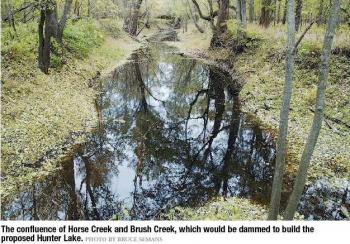 The proposal to build Hunter Lake has been around for so long that its opponents have come up with plenty of reasons why Springfield can live without it. At a recent hearing held by the Illinois Environmental Protection Agency, they blasted the proposed 3,010-acre reservoir — conceived in 1965 as a way to buttress Lake Springfield during severe drought — for its threat to water quality, historic preservation and land, flora, and fauna conservation.
They requested answers to a variety of questions, such as how will City Water, Light and Power prevent shoreline erosion? How will Hunter Lake meet standards for phosphorous and other pollutants? What impact will it have on the sewage treatment system that serves the surrounding communities of Pawnee, Virden and Divernon? Even though most of these issues probably won’t be addressed for a couple of months, when the IEPA either issues or denies water quality certification for Hunter Lake, there’s one question residents can mull over in the meantime: how much water does Springfield really need? Tom Skelly, the water division manager for City Water, Light and Power, sums it up with simple mathematics.
“It’s a demand and yield analysis,” Skelly says. “The demand being, what are the needs for drinking water in the community? And then you literally subtract the yield of your resources.
“Lake Springfield is the resource, and we can supplement it from the south fork of the Sangamon River by pumping some of that water into Lake Springfield.”
Using this method, the latest CWLP data from 2007 registers Springfield’s demand at 38.7 million gallons of water per day and its yield at 29.6 mgd, showing a 9.1 mgd deficit in the city’s current water supply.
CWLP estimates both the demand and the yield based on the premise that by the year 2025, Springfield will suffer from another drought similar to the severe drought in the 1950s that lasted 18 months. The utility incorporates in its calculations dry weather conditions and reduced inflow from the Sangamon River and other smaller creeks, as well as increased evaporation from Lake Springfield and increased demands of water users.
“That is what we are calling the ‘drought of record’ — meaning we have seen it, it can really happen,” Skelly says. “We also know that more severe droughts can and do occur.”
Based on probabilities provided by the Illinois State Water Survey, Skelly says, there’s a reasonable risk that the next severe drought will occur within 100 years of the previous one. Although, he adds, Springfield should also be prepared for back-to-back severe droughts, as well as less severe droughts — such as periods from the 1970s through the 1990s when Lake Springfield dropped six feet below full pool. The estimated 9.1 mgd deficit has changed
continued on page 10
|