
Is the county jail responsible?
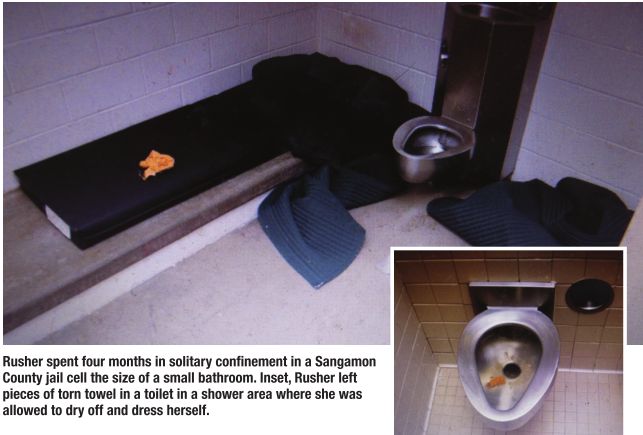
Tiffany Rusher spent four months in a cell the size of a small bathroom.
Then, she killed herself. The list of Rusher’s diagnoses over the years was long. Depression. Antisocial personality disorder. Post-traumatic stress disorder. Bipolar disorder. Schizoaffective disorder. Borderline personality disorder.
With a history of self harm dating as far back as 2014, Rusher was serious about suicide. In 2017, she succeeded while in the custody of the Sangamon County jail. Now, her mother, in separate federal lawsuits, is suing the county and the state, claiming that her daughter’s death was preventable and that the lack of treatment for mental illness amounted to unconstitutional torture.
It is, already, a big-money case for the county, which has spent six figures on legal fees. With trial set for next year, there have been no serious settlement talks. “I don’t think we did anything wrong,” says Sangamon County Board member Craig Hall, who chairs the board’s civil liabilities committee that receives monthly reports on lawsuits and reviews legal strategy. “We have good attorneys. I listen to good attorneys. They’re saying it’s an unfortunate thing that happened, but we are going to keep pursuing the case, and it will probably go to trial.”
Alan Mills, an attorney for Rusher’s mother, says that the plaintiffs, also, are prepared to go to trial. He declined to ballpark what a fair damage award might be.
“That’s what we pay juries and judges for,” he says.
“Descent into madness”
Sometimes, Rusher scared herself.
In 2014, while an inmate at Logan Correctional Center in Lincoln, Rusher, saying that she wanted to hurt herself, asked to be placed in restraints, according to her mother’s lawsuit against the state. She spent more than three years in prison. By the end of her stay, she was living alone in a cell, with guards watching her 24/7 to prevent her from killing herself.
According to her mother’s lawsuit, Rusher hadn’t been diagnosed with a mental illness before she became a state inmate in 2013. She had been a crack-addicted prostitute who performed oral sex on three boys for money in a Decatur basement, which earned her a five-year sentence for aggravated sexual abuse of a minor and a spot on the state sex offender registry.
Rusher served every day of her sentence. The longer she stayed in prison, the worse she got, according to her mother’s lawsuit. She swallowed batteries. Then a pen. She tried to strangle herself. She was provided therapy, but each time she tried hurting herself, she was placed in solitary confinement, which undermined whatever therapy she’d gotten, according to the lawsuit.
More than two years into her prison stint, after another suicide attempt, Rusher was placed under constant watch. She had become so dangerous to herself that she needed to be kept in isolation, with a guard assigned to watch her every minute.
“It is an accepted tool for mental health treatment, but it is meant for short periods of confinement only – typically for a few hours – so that a person in a
mental health crisis can be evaluated, a treatment plan can be
developed, and the person can thereafter be hospitalized or returned to
some form of residential or outpatient care,” lawyers for Rusher’s
mother write in their lawsuit against the state. “In the most extreme
circumstances, it is acceptable to keep a person in ‘crisis’ confinement
for a few days, at most.”
Rusher
spent the remaining eight months of her sentence in a Logan isolation
cell under constant watch, stripped naked except for a suicide-proof
smock – a turtle suit, in jail lingo – made from heavy tear-proof nylon
with fasteners, typically Velcro, that can’t be swallowed or otherwise
used to cause harm. She was restricted to soft foods and had no books or
other possessions, according to her mother’s lawyers, who say that cell
lighting was always on. When she defecated, she had to ask for toilet
paper and let a guard watch while she wiped herself, the plaintiffs say,
and guards also observed when she changed sanitary napkins. Each week,
she was interviewed for 30 minutes by a psychiatrist to determine
whether dosages of psychotropic drugs should be adjusted. Occasionally,
according to court documents, she was allowed to attend 30-minute group
therapy sessions, but no more than once a week, and if she tried harming
herself, sessions would be canceled as punishment.
“The
short sessions amounted to an infrequent and irregular interruption to
the days and weeks on end that Tiffany was forced to spend alone in a
bare cell, and to make matters worse, when she was allowed to attend the
sessions, she was rarely, if ever, allowed to speak,” attorneys for her
mother write in the lawsuit against the state. “Instead of providing
her with the treatment she desperately needed, defendants chose to keep
her in isolation and monitor her condition, carefully documenting her
descent into madness.”
The
Logan medical staff knew that Rusher’s was a special case. Shortly
after she was placed under constant watch, the staff concluded that she
suffered from an acute mental health crisis, her mother’s lawyers say,
and was “at severe risk” of harming herself. “They also identified her
as one of only a few dozen patients within the entire (Illinois
Department of Corrections) whose mental illnesses were so acute and
dangerous that they required full inpatient-level mental health care,”
the lawyers write. Rusher belonged in a mental institution, not a
prison, lawyers say, and the state’s failure to provide proper treatment
amounted to torture and a violation of her constitutional rights.
Rusher’s
condition deteriorated while in solitary confinement, according to her
mother’s lawsuit. She cut herself. She bit herself. She banged her head
against her cell walls and attempted suicide. She didn’t object when her
sentence expired and the state sought involuntary commitment to Andrew
McFarland Mental Health Center and so she was considered a voluntary
patient at the
Springfield mental health facility, where lawyers for her mother say her
condition improved. She received therapy and wasn’t kept in isolation.
“In
short, Tiffany received the treatment that the defendants should have
provided for her, instead of placing her in solitary confinement for
over eight months and causing the injuries and damages described
herein,” lawyers wrote.
Allegations
in the Rusher lawsuit against the state parallel claims in a
class-action lawsuit filed on behalf of mentally ill inmates who say
they’ve been housed in solitary confinement, put in restraints and
denied treatment for serious mental illness. In 2018, a federal judge
issued an injunction, finding that the lack of treatment for mentally
ill inmates was unconstitutional. He ordered improvement and assigned a
monitor to produce progress reports.
“High risk”
After
seven months at McFarland, Rusher was arrested and sent to the Sangamon
County jail after altercations with fellow residents and staff at the
mental health facility.
In
a memo sent to the jail after Rusher’s 2016 arrest, McFarland employees
summarized her history both at the mental health facility and Logan.
At
least 10 times during an 18-month period in prison, McFarland staff
wrote in the memo to county jail staff, Rusher had attempted suicide.
The attempts had included self-strangulation with a towel. More than two
dozen times, she had otherwise attempted to harm herself by swallowing
pens, toilet paper, eating utensils and toothbrushes, McFarland staff
wrote.
While at
McFarland, the mental health center’s staff told jail personnel, Rusher
twice had tried to strangle herself and also had swallowed large objects
that were removed from her body by medical
personnel. The day after Rusher was booked into the jail, a McFarland
nurse followed up with a phone call, according to the lawsuit against
the county, telling jail staff that Rusher had a history of
self-asphyxiation attempts and that she’d received one-on-one care at
the state mental health center.
Jailers posted a paper notice on Rusher’s cell:
“HIGH
RISK. Tiffany Rusher. Hard Tray/Cup. 7-10 squares of toilet paper at a
time. Subject will ingest foreign objects. High risk uniform/ blanket
only. Do not be alone with subject.” As at Logan, she was stripped
naked, given a blanket and kept in solitary confinement, with no
possessions, social contact or meaningful treatment, according to her
mother’s lawsuit. A jail doctor detected bipolar disorder and
schizoaffective disorder.
Solitary confinement worsens mental illness, according to lawyers for the plaintiff who refer to standards promulgated by
the American Correctional Association, the Association of State
Correctional Administrators, the American Bar Association and the
National Commission on Correctional Health Care Standards for Mental
Health Services in Correctional Facilities.
“The
defendants’ policies, and their conduct, flatly ignored and
contradicted this accepted knowledge,” lawyers for Rusher’s mother write
in the lawsuit against the county, several employees and Advanced
Correctional Healthcare, which held the contract to provide medical care
to county inmates. “It was the policy of the Sangamon County Sheriff’s
Office to place persons suffering from mental illness or in danger of
suicide in solitary confinement for indefinite periods.”
According
to the lawsuit, the sheriff’s office had an agreement with an unnamed
outside entity to allow transfer of mentally ill inmates to appropriate
settings if their needs could not be adequately addressed
at the jail, but no transfer to a mental health facility outside the
jail was considered for Rusher. “(I)nstead, these defendants arranged
for Tiffany to be placed in solitary confinement, where they knew she
would be harmed instead of helped, from December 2016 through March 18,”
lawyers for the plaintiff write in their lawsuit.
Mills
said he didn’t know the name of the entity that could have taken Rusher
from the jail. A state mental facility, he said, should have been an
obvious choice.
An orange towel
County jailers soon encountered the same challenges with Rusher as their counterparts in state prison, the plaintiffs allege.
Less
than a month after she was booked into the jail, Rusher swallowed a
plastic spoon, necessitating a trip to Memorial Medical Center. A week
later, she tried strangling herself with a strap from a protective boot
she wore over an injured foot. Ten days later, she was returned to
Memorial after swallowing a toothbrush. Less than a week later, she
tried swallowing an apple core. One week later, she was placed in
restraints after she chewed on one of her hands until it bled. The day
after she got out of restraints, she swallowed mattress stuffing. Then
she stuffed toilet paper up her nose and said that she couldn’t breathe.
She also scratched her arms on the underside of a concrete bunk until
they bled, prompting another stint in restraints.
Three
days after swallowing a plastic bag, Rusher asked guards if she could
take a shower. A sergeant granted approval. She was on the cusp of
freedom. The day before, the public defender had reached a deal with
prosecutors: Rusher would plead guilty to battery, be granted probation
and then be released to a friend who had promised her a place to live.
Two
guards escorted Rusher to a shower room down the hall from her cell and
behind a closed door, according to the lawsuit. Rusher showered alone,
out of sight of guards. Guards gave her an orange towel to dry herself
behind a closed door. Without supervision, she put on turtle suit. She
was then returned to her cell, which was not in direct sightline of jail
staff. Guards were supposed to check on her every 15 minutes.
If
there is a smoking gun in the case, it might be torn bits of orange
towel that Rusher left behind where she’d been allowed to dry off and
dress without anyone watching. “Photos taken by investigators in the
shower area show that anyone who inspected the shower area after Tiffany
dressed unsupervised would have seen the bright orange threads and
realized that Tiffany tore the towel in some way while she was alone,”
her mother’s lawyers write in the lawsuit.
A
guard, the lawyers say, noticed that the towel Rusher had left behind
in the shower was torn, but did not determine how it had happened or
check the dressing area where orange pieces of torn towel were in the
toilet.
“Instead of conducting any
sort of sweep or inspection [the guard] simply escorted Tiffany back to
her cell,” lawyers write. “There was then a prolonged period, lasting
approximately 15 minutes, during which Tiffany was unsupervised. None of
the defendants responsible for monitoring Tiffany…checked on her. She
used this time to strangle herself inside her cell.”
Near
death, Rusher was taken to St. John’s Hospital, where she died 12 days
later, after being disconnected from life support. She was 27. The
coroner determined that she’d committed suicide with a strip of torn
towel smuggled from the shower.
The jail’s mistakes, plaintiff’s attorneys say, include failure to provide rip-proof towels to a suicidal inmate.
“It’s just a total breakdown in security here,” Mills says.
“It’s not complicated” 
The last lawsuit filed after a Sangamon County jail death did not end well for taxpayers.
In
2014, the widow of A. Paul Carlock, who died in 2007, settled for $2.6
million, with the county paying its lawyers a like amount as the case
dragged on. Between the settlement and legal fees, it was the most
expensive litigation in county history. The plaintiff had claimed poor
medical care and rough treatment by guards, who allegedly killed Carlock
during a struggle that began when he refused to put on a shirt. A judge
had repeatedly urged settlement talks, but the county resisted, with
officials asserting that settling would encourage future lawsuits by
establishing the county as an easy mark.
So
far, the county has spent $235,000 defending the Rusher lawsuit,
according to Sangamon County Administrator Brian McFadden, with a trial
date set for Jan. 19, 2021.
Six-figure payouts aren’t unusual when inmates commit suicide.
In
Christian County, the sheriff’s office in 2017 reached a $550,000
settlement brought by the family of an inmate who killed himself in 2011
after being deemed a suicide risk. After the death, the county hired
Advanced Correctional Healthcare, a codefendant in the Rusher lawsuit
against Sangamon County, to supply a mental health professional for the
Christian County jail. A federal jury in 2018 awarded $301,000 to the
brother of a man who hung himself in the St. Clair County jail in 2014
after reportedly telling a guard that he was suicidal. The sheriff
insisted that the jury got it wrong; the surviving brother told the Belleville News Democrat that he’d rejected an $800,000 settlement offer. Last year, St.
Clair
County settled a second lawsuit, paying $850,000 to relatives of a
mentally ill inmate who hung himself in the same jail, also in 2014.
Federal
juries in Springfield have proven receptive to inmates who have claimed
substandard health care. In December, a jury awarded $11 million to
William Dean, who claimed
that the state’s health care provider hadn’t promptly diagnosed cancer
while he was an inmate at Taylorville Correctional Center. In 2016, a
jury awarded $300,000 to Vincent Trimble, who said that he waited years
to get proper treatment from prison doctors for a back problem that
included a herniated disc.
Sheriff
Jack Campbell, who was not in office when Rusher killed herself, said
that he didn’t want to answer specific questions on the lawsuit because
litigation is pending. “We have to look at each case, on its own merits,
and determine what the exposure is to the county and that sort of
thing,” Campbell said. “We can’t get into the minds of jurors and judges
about how they make the decisions they do.”
Mills points out that Rusher’s suicide attempts weren’t successful at Logan or McFarland.
“If
you’re going to put someone in jail – and remember, this is somebody –
then you take on the obligation of taking care of them,” the lawyer for
Rusher’s mother says. “If the county couldn’t do it, they should have
transferred her to some place that could.
“It’s not complicated.” Theresa Powell, attorney for the county, declined comment.
Contact Bruce Rushton at [email protected].


