Fight for records took years
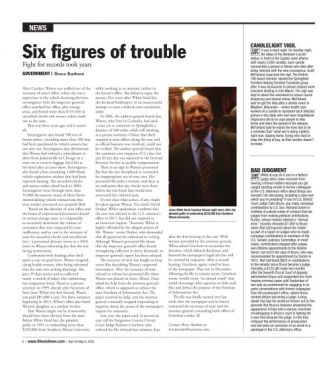
After Candace Wanzo was walked out of the secretary of state’s office, where she was a supervisor in the vehicle licensing division, investigators with the inspector general’s office searched her office, plus storage areas, and found more than $155,410 in uncashed checks and money orders made out to the state.
That was three years ago, and it wasn’t all.
Investigators also found 700 sets of license plates, including more than 100 that had been purchased by vehicle owners but not sent out. Investigators also determined that Wanzo had ordered a subordinate to drive from Jacksonville to Chicago in a state car to retrieve luggage she’d left at her hotel after an auto show. Investigators also found a box containing 1,000 blank vehicle registration stickers that had been reported missing. The uncashed checks and money orders dated back to 2004. Investigators went through more than 31,000 documents, many of them forms memorializing vehicle transactions that were neither processed nor properly filed.
“Based on the disorder of your office and the boxes of unprocessed documents found in various storage areas, it is impossible to accurately determine the volume of customers that were impacted by your inefficiency and/or cost to the secretary of state for uncashed checks and uncollected fees,” a personnel director wrote in a 2018 letter to Wanzo informing her that she was facing termination.
Confronted with findings after she’d spent a year on paid leave, Wanzo resigned, citing health reasons, after being informed that the state was seeking discharge. She gave 29 days notice and so collected nearly a month of salary after submitting her resignation letter. Hired as a private secretary in 1999, shortly after Secretary of State Jesse White was first elected, Wanzo was paid $87,600 a year. For three summers beginning in 2013, White’s office also hired Wanzo’s daughter as a student worker.
That Wanzo might not be trustworthy should have been obvious from the start. Before White hired her, she pleaded guilty in 1991 to embezzling more than $233,000 from Southern Illinois University while working as an assistant cashier in the bursar’s office. She failed to repay the money: Five years after White hired her, she declared bankruptcy in an unsuccessful attempt to erase a federal court restitution order.
In 2004, the auditor general found that Wanzo, who lives in Centralia, had used a state car to commute to Springfield, a distance of 100 miles, while still working as a private secretary. Claims that she’d stopped at state offices along the way, and so official business was involved, could not be verified. The auditor general found that the commute cost taxpayers $72 a day, but just $3 per day was reported to the Internal Revenue Service as taxable compensation.
There is no sign in Wanzo’s personnel file that she was disciplined or counseled for inappropriate use of state cars. Her personnel file lacks a resume, and there is no indication that any checks were done before she was hired that would have uncovered her criminal past.
It’s not clear what action, if any, might be taken against Wanzo. Via email, David Druker, White spokesman, confirms that the case was referred to the U.S. attorney’s office in 2017, but did not respond to an interview request. “Secretary White is highly offended by the alleged actions of Ms. Wanzo,” wrote Druker, who demanded that all questions be submitted in writing. Although Wanzo’s personnel file shows that the inspector general’s office found wrongdoing sufficient to merit dismissal, no inspector general’s report has been released.
The secretary of state has fought to keep secret files describing Wanzo’s suspected misconduct. After the secretary of state refused to release her personnel file when Wanzo was placed on leave, Illinois Times asked for help from the attorney general’s office, which is supposed to enforce the state Freedom of Information Act. The paper received no help, and the attorney general eventually stopped responding to inquiries about the status of the newspaper’s request for assistance.
Last year, the paper sued. It proved an easy call for Sangamon County Circuit Court Judge Raylene Grischow, who ordered the file released last summer, days after the first hearing in the case. With lawyers provided by the attorney general, White asked Grischow to reconsider her decision, which delayed disclosure and boosted the newspaper’s legal tab that will be covered by taxpayers. After a second hearing, Grischow, again, ruled in favor of the newspaper. That was in December. Allowing the file to remain secret, Grischow wrote, would create “an absurd result” that could encourage other agencies to hide such files and defeat the purpose of the Freedom of Information Act.
The file was finally turned over last week after the newspaper and its lawyer contacted the secretary of state and the attorney general, reminding both offices of Grischow’s order.
Contact Bruce Rushton at [email protected].