Group seeks nonprofit status and action toward demolition
Asbestos, arson and a dead dog. The things Pillsbury Mills are now known for are a far cry from its origins. “Pillsbury was a fantastic company,” said John Keller, president of the Pillsbury Mills Neighborhood Association. “They wanted to be a good neighbor. And most of the neighborhood worked over there at the time, that was really a nice area.”
The site is on the north end of Springfield, near the intersection of 11th Street and Phillips Avenue. It opened in 1930 and employed 1,500 people by 1955, according to the Sangamon County Historical Society. Keller, a contractor and president of the neighborhood group for some 20 years, said he knew dozens of people who worked there, before Cargill, Inc. bought it in 1991. Keller said Pillsbury was having trouble making a profit when it sold, and from there, it suffered a “slow death.” Various entities have sought the scrap metal it contains without taking responsibility for its deterioration. A community group formed last year, Moving Pillsbury Forward, hopes to become an official nonprofit so it can direct change and address public safety. And it wants buy-in from city leadership and a solid redevelopment plan.
The current owners are trying to get rid of the property. A “for sale” sign emerged earlier this year. Owners did not respond to a request for comment via calls to that number posted. In federal court in 2018, Joseph Chernis IV, part-owner, pleaded guilty to the illegal removal and disposal of asbestos and was sentenced to three years. “I have grave concerns about the damage to the community in this case,” Judge Sue Myerscough said at a hearing according to the State Journal-Register. The Illinois attorney general and Illinois Environmental Protection Agency have also pursued legal action.
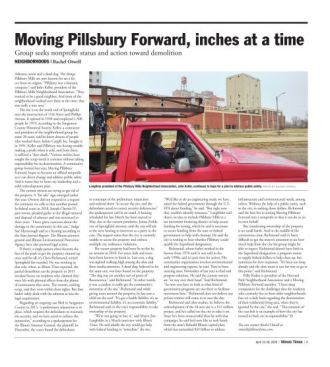
If there’s a single person who’s become the face of the push to get the property cleaned up once and for all, it’s Chris Richmond, retired Springfield fire marshal. He was working in that role, when, as Illinois Times reported, the partial demolition on the property in 2015 wreaked havoc on residents who claimed they were left with physical effects from the plume of noxiousness that arose. The owners, seeking scrap, said they were within their rights. But they hadn’t safely dealt with the asbestos as was the legal requirement.
Regarding an ongoing case filed in Sangamon County in 2015, “a preliminary injunction is in place, which requires the defendants to maintain site security, and we have acted to enforce the injunction,” according to a spokesperson for the Illinois Attorney General, the plaintiff. In December, the court found the defendants in contempt of the
preliminary injunction and ordered them “to secure the site, and the
defendants acted to correct security deficiencies,” the spokesperson
said in an email. A hearing scheduled for late March has been moved to
May, due to the current pandemic. James Zerkle, city of Springfield
attorney, said the city will ask at the next hearing to intervene as a
party in the case. The request states that the city is currently unable
to access the property and enforce multiple city ordinance violations.
The
vacant property had been lit on fire by an arsonist in 2018. For years,
kids and teens have been known to break in. Last year, a dog was
sighted walking high among the silos and drew media attention. A dead
dog, believed to be the same one, was later found on the property. “The
dog was yet another sort of point of fluorescence,” said Richmond. “In
other words, it was a catalyst to really get the community’s awareness
of the site.” Richmond said while giving tours around the property, he
has seen a child on the roof. “It’s got a health liability, it’s an
environmental liability, it’s an economic liability.” Richmond said it’s
the city’s responsibility to take ownership of the property.
“We’re not going to buy it,” said Mayor Jim Langfelder in a March interview with Illinois Times. He said ideally the city could get help with federal funding to “remediate” the site.
“We’d
like to do an engineering study, we have asked the federal government
through the U.S. EPA about funding,” he said. “But right now they
couldn’t identify resources.” Langfelder said there’s an idea to include
Pillsbury Mills in a tax increment financing district to help secure
funding for testing, which he said is necessary to secure funding from
the state or federal government to help with cleanup. He said the city
is waiting to hear whether Pillsbury could qualify for Superfund
designation.
Richmond,
whose father worked in the factory from 1970 until it was sold in the
early 1990s, said it’s past time for action. His community organization
involves environmental and engineering experts, he said. They’ve been
meeting since November of last year to find and propose solutions. He
said the current owners are “in way over their head.” Said Richmond, “So
now you have to look at what kind of government programs are out there
to facilitate movement here.” Richmond does not believe any private
entities will come in to save the day.
Richmond
said after studies, he believes the redevelopment of the 18-acre site
is a $12 million project, and he’s called on the city to take it on.
Since he’s been unsuccessful thus far with that campaign, he said he’d
now like to seek funds from the state’s Rebuild Illinois capital plan,
which has earmarked $45 billion to address infrastructure and
environmental needs, among others. Without the help of a public entity,
such as the city, in seeking those dollars, Richmond said the best bet
is turning Moving Pillsbury Forward into a nonprofit so that it can do
so on its own behalf.
But
transferring ownership of the property is no small battle. And in the
middle of the coronavirus crisis, Richmond said it’s been difficult to
get the mayor’s attention to see how much help from the city his group
might be able to expect. Richmond doesn’t have faith in the Superfund
designation, a program meant to supply federal dollars to help clean up,
but notorious for slow responses. “It’s been too long already and the
slow route is not the way to go at this point,” said Richmond.
Polly
Poskin is president of the Harvard Park Neighborhood Association and a
Moving Pillsbury Forward member. “I have deep compassion for the
challenges that the residents who currently live in these older
neighborhoods face on a daily basis regarding the deterioration of their
residential living area, when they’re ignored by the city,” she said.
“This remnant of the rust belt is an example of how the city has turned
its back on its responsibility.”
You can contact Rachel Otwell at [email protected].