
The battle for gender justice continues. One candidate aims for another chance.
It’s Nov. 6, 2018. Democratic nominee Betsy Dirksen Londrigan has been declared the winner of the U.S. House race for the 13th district. She’ll soon be headed to Washington, having been a successful contender as part of the blue wave.
Or so many thought, anyway, as CNN preemptively called the race that night in Dirksen Londrigan’s favor. Doris Turner, chair of the Sangamon County Democratic Party, was one of the supporters stationed with Dirksen Londrigan at Cafe Moxo in downtown Springfield. She cheered the news as it broke.
Later, as reality set in, the mood shifted.
“That night will forever be burned into my memory. Betsy ran a phenomenal campaign, she was engaged throughout the district and her campaign resonated with voters,” said Turner. “In that race, she was definitely the underdog.”
Dirksen Londrigan, from Springfield, came within a single percentage point of winning. Instead, she lost by a little more than 2,000 votes. She would have beat the incumbent, Republican Rep. Rodney Davis from Taylorville.
“It was a bit of a roller coaster,” said Dirksen Londrigan in a recent interview with Illinois Times. “I was and I am so proud of the amazing grassroots army that we built. When you consider that I was a first-time candidate and had to build everything from scratch, and we ended up with over 2,000 volunteers across 14 counties – that’s amazing.”
In the time since, she’s persisted, traveling the district and hearing from would-be constituents. Her sights are still on the seat. Dirksen Londrigan said this election year, the stakes are “still high.”
Women rising In 2017, more than 200 workers in state government signed a letter saying gender discrimination and sexual harassment were rampant throughout its ranks, after the MeToo movement went viral that same year.
The Illinois Anti-Harassment Equality and Access Panel formed in the wake of calls for change. A section of its report, compiled after state legislators and a constitutional officer toured the state for listening sessions, was devoted to the topic of electing more women to office.
“In order for the issue of sexual harassment to truly ever change, the entire culture has to change. And that means that women have to be in a position where they’re making the rules,” Illinois Comptroller Susana Mendoza said in a 2018 NPR Illinois interview.
While the report focused on state politics, groups like Women Rising, which was an outgrowth of Sangamon County Women for Hillary, shared the mission. “We had organized around (electing Rodham Clinton) and wanted to stay together to recruit, support and elect progressive women to local offices,” said Dirksen Londrigan.
Successful candidates the organization has supported include
Springfield city councilwoman Kristin DiCenso. The city council now has
the most women in its history – three, which is still only 30% of the
makeup.
“Women’s
voices, women’s perspectives are missing from so many discussions. And
the way that we get that seat at the table and carry women’s voices into
every corner of government is by electing more women,” said Dirksen
Londrigan. “And in Congress, women still only make up 23.6% of the
representation. We have a long way to go.”
Efforts
to reach a more equitable society have spread throughout the state in
recent years. The Illinois Council on Women and Girls issued its first
report earlier this month. The council is headed by Lt. Gov. Juliana
Stratton, who wrote in her introduction to the report, “For far too
long, women – especially women of color – were excluded from the
policymaking process.” Stratton is the first black woman to hold the
lieutenant governor post. 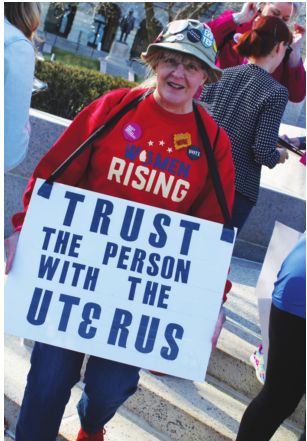
The council’s charge is to research and recommend legislative solutions to systemic problems, such as:
• More funding to process rape kits and address the backlogs
• New public awareness campaigns about gender-based violence
• Inroads for women and girls to engage with government officials
• Expansion of access to postpartum health care
State
Sen. Jacqueline Collins, a Democrat from Chicago, sponsored the
successful bill that led to the founding of the council last year. In a
statement she said, “The entrenched systems that keep women out of the
halls of power can only be cast aside by specific efforts to dismantle
them. I am committed to using the recommendations laid out in this
report as the basis for future legislation.”
Health
care, how? All of the three candidates running to represent the 13th
district, which covers all or parts of more than a dozen counties
including Sangamon, Champaign and Macon, talk about their personal
concerns and experiences regarding health care. Rep. Davis has held the
spot since 2013. He often talks about his wife surviving cancer – it’s
the first thing mentioned on the “healthcare” issues tab on his campaign
website.
“I
understand how important it is for all families and individuals to have
access to good, affordable healthcare,” the site reads, stating health
care is a top priority for Davis. (Repeated attempts to contact the
Davis campaign for this story were unsuccessful.)
“I
will continue to fight for full repeal of the Affordable Care Act (ACA)
and support solutions that reduce cost and increase access without
sacrificing our innovative and worldclass healthcare system,” the site
reads.
While she’s not
yet held office, Dirksen Londrigan has long been involved in politics.
“I’ve been on the sidelines helping other people for 25 years or more as
a volunteer,” she said. It was seeing Davis on the White House lawn
with President Trump in 2017 celebrating the House’s passage of the
so-called American Health Care Act which would repeal much of the
provisions in the ACA (also known as Obamacare) that set her will to run
for office on fire.
“Watching
congressman Davis celebrate that millions of people would lose their
health insurance and knowing that families would suffer and needed
somebody to champion and protect them, that was a message that I carried
from day one,” said Dirksen Londrigan. Her son had suffered a
life-threatening illness that made her especially sympathetic to the
issue; she said having insurance to help cover costs was a privilege she
thinks more people deserve to have.
Sue
Saltmarsh is a Springfield woman who spent decades living in Chicago
where she wrote for a publication focused on HIV and AIDS awareness.
While there, she became intimately aware of the plight of HIV-positive
people trying to navigate the medical system. She said the ACA that
Dirksen Londrigan wants to revamp is “unfixable.”
Saltmarsh has a rare chronic liver disease.
She’s
the founder and executive director of Demand Universal Healthcare (DUH)
which promotes a single-payer option and “vigorous participation in the
political process, including nonviolent protest and VOTING,” as its
website spells out. It also has a section devoted to Democratic
presidential nominee Bernie Sanders.
In the past, Saltmarsh volunteered for David Gill, a nominee for the
13th congressional district that Dirksen Londrigan beat in 2018’s
primary.
This year,
Saltmarsh said she will be voting for the one nominee running against
Dirksen Londrigan for the Democratic spot on the ticket in November,
Urbana’s Stefanie Smith.
“One
of the things that Stefanie has brought to the fore is that there’s a
lot of poverty in this district. And people who can afford to pay for
private insurance are sort of out of touch with the daily lives of those
who can’t,” said Saltmarsh, who herself relies on Medicaid.
Smith
has endorsements from the Democratic Socialists of America, the Rose
Conference and Our Revolution Illinois – all part of the movement toward
universal health care and supporters of Bernie Sanders.
Smith
had been in the public eye not for her policy proposals so much as her
ties to activists who have targeted Dirksen Londrigan. Last month, a
video of activists approaching Dirksen Londrigan and demanding that she
debate with Smith garnered criticism. The protesters are heard yelling
“block her in” as Dirksen Londrigan approaches her vehicle.
Dirksen
Londrigan said the incident was frightening. “It was a dangerous
situation that they created purposefully and that type of behavior is
absolutely unacceptable.”
In an interview with Illinois Times, Smith
said, “I don’t agree with the tactic. My tactic is to throw a joyful
party, but I am not going to condemn anybody.” Smith said the protesters
were asking for comments on health care and other issues.
Smith
is a fan of honesty and transparency in a way politicians are not known
for. In YouTube interviews and livestreams she talks about her own
chronic health issues, her troubled childhood, her experiences in sex
work, her bouts of housing insecurity and her “platonic husband.” She’s
bisexual and has two kids. All of these factors play into her politics.
“Politically,
I’m queer,” she said, noting her campaign is largely organized by queer
women focused on rights for the workers. She said anything less than a
single-payer health care system is “eugenics.” Smith also supports a
Green New Deal and sex work decriminalization.
Smith
has a general air of disgust when it comes to politics, and said it is
unlikely she would run for office again, “I don’t want to be a
politician. I just want to enact policies that are going to improve our
lives.” She said she plans to continue activism that will keep issues
like access to health care for those in poverty in the public eye.
“We’re all really tired”
Days
before the most recent Women’s March in Springfield, a group gathered
at a community room at Schnucks grocery store to make signs. It was two
days after Super Tuesday, and those who had supported Sen. Elizabeth
Warren for president were feeling stung over her recent dropout.
Keri
Tate from Springfield had voted early for Warren. She worked on a sign
that read, “If not Warren, when?” “Because if Warren is dropping out
today like she did, there is really not a viable female candidate. I
want to know when will there be,” said Tate. “This woman is extremely
competent, extremely authentic and has an incredible voice and an
incredible way of communicating with just regular people. And now we
don’t have a choice anymore. We have two white guys.”
Tate
helped create the activist group Resistor Sisterhood in the wake of
Trump’s election. The group pushed hard for the state’s ratification of
the Equal Rights Amendment among other efforts, like dressing up as
Handmaids and stationing themselves at the Statehouse to counter-protest
pro-lifers.
“Dang,
we’re all really tired,” said Tate, about the continuous activism. “We
feel like Trump has been a real problem and has created a lot of
nightmares for us and the people we care about. But at the same time,
there has been an incredible groundswell of female-led support. We love
the groups that have formed and we love the relationships that have
formed and the activities and the energy. And so, while I’m tired, I’m
also very excited. And I think good things are coming.”
Tate
lives in the 13th district and will again be voting for Dirksen
Londrigan. She’s phone banked for her and plans to canvas as the race
heats up after her expected win in the primary. When Tate’s car was
stolen last year, she said the thing she was most upset about was losing
the magnet on it that said, “Unseat Rodney.”
Creating
a sign that read, “Black Girl Magic,” was Sunshine Clemons, the
co-director of Springfield’s (unofficial) chapter of Black Lives Matter
(BLM), which centers its focus on police relationships with the black
community. BLM does not endorse political candidates, instead pushing
people to vote. But personally, Clemons is a supporter of Londrigan as
well.
“I am a
Democratic woman in the 13th district and I would like to be represented
by a Democratic woman in the 13th district. I’ve known (Dirksen
Londrigan) for several years now, I worked with her on various
progressive issues.
And
I think that her views are much more in line with mine than the person
who currently holds the seat,” said Clemons, who pinpointed access to
health care as a top concern of minority people living in the 13th.
“Jump in”
• Patriarchy has no gender
• Don’t diet, riot
• Vote like your life depends on it
• ERA means equal pay
• Protect women’s rights, vote blue
• Men of quality respect women’s equality
So
read some of the many signs that were on display at the Women’s March
this past weekend. The latter was being held by Tom Hughes, a former
Republican who worked as part of Gov. Bruce Rauner’s transition team. He
said witnessing the disconnect between what was promised by that
administration and what took place made him decide to switch parties and
go blue. He’s currently with the Illinois Public Health Association and
running for a county commissioner spot in Menard County.
“My
mom was the person that most inspired me that women should be treated
equally. And I think that she’d be very proud of what we’re doing
today,” he said. Hughes’ mother was a business owner and a Republican
Coles County chairwoman for many years.
Hughes said in 1974 his mom, Betty, took note of the many vacant
offices in the county, “And I will never forget she said, ‘Women are the
people that have done the folding of the envelopes and licking of the
stamps, it’s time to have the jobs.’” Hughes said that year “half
of the county board became women, the first county clerk was elected as
well as the first female state’s attorney.”
Hughes categorized representation by women in politics as a matter of fairness. “Men should not fear that,” he said.
The
women’s marches have taken place annually since Trump’s election. This
year’s had been scheduled for January but was postponed due to weather.
The date, March 8, coincided with International Women’s Day. The scene
suggested a crowd of 300 people or more. One elderly woman was dropped
off right near the Abraham Lincoln statue on the State Capitol lawn and
promptly put on her neon pink “pussy hat” as she blended into the crowd.
Kids ran around playing tag in front of the speakers. Some held signs,
like ones that read “feMINIst” and “girls 4 the future.”
Organizers,
including members of Action Illinois and Indivisible Springfield, were
intentional about setting an inclusive lineup. Clemons told the crowd
she was pleased that BLM had been invited to participate when other
cities had left the activists out of similar events. Clemons told the
crowd that too often, movements led by white people expect the support
of people of color but don’t offer it in return.
“This
culture of expecting support, but not offering it back has to end. This
culture of surface progressiveness has to end because how progressive
are you if you’re only working for the causes of people that look like
you,” Clemons said to applause.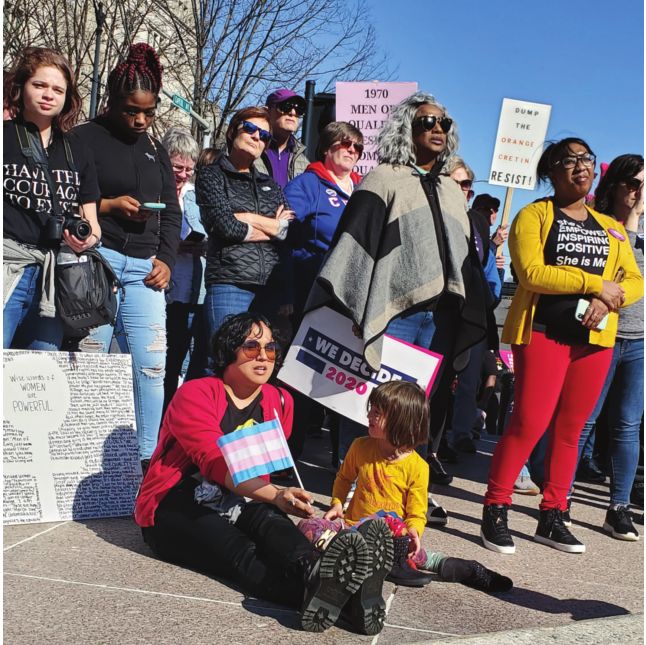
The
overarching theme of the day was to get out the vote. The importance of
participation in the census was also emphasized. Veronica Espina and
Valeria Cueto of the Springfield Immigrant Advocacy Network urged the
crowd to speak out against policies that put children and other innocent
migrant people in detention.
“Please
speak up for the hundreds of women behind bars, and the families that
will never journey to the polls with you to vote for a more just way to
govern. They need your resilience. They need you to dream big and fight
for our Dreamers,” said Espina, who has been working on a Welcoming City
ordinance for the city of Springfield.
Jonna
Cooley was also a speaker. She provides resources for the city’s LGBTQ
community as head of the Phoenix Center. “Mr. Trump pledged he would be
an ally to the LGBT community. It hasn’t worked out that way has it? He
appointed Supreme Court justices that want to repeal marriage equality,”
Cooley said. “Tell me how my right to marry has an impact on him.”
And
then toward the end of the rally, Doris Turner came up to the podium to
once again support one of her favored candidates. The local Democratic
party chair is also one of Springfield’s three councilwomen. She
introduced Dirksen Londrigan and said, “We have a unique opportunity in
Illinois’ 13th. We have an opportunity to send someone to Washington who
will speak for us.”
Dirksen
Londrigan took the mic to some of the loudest applause of the day. She
reiterated the messaging of Planned Parenthood of Illinois’ Jennifer
Welch who spoke about reproductive rights as a matter of health care.
Dirksen
Londrigan characterized her opponent, Rep. Davis, as a man who would
push women into the dark ages, “where we have to pay more for our birth
control. And when the act of becoming a mother means that we have a
pre-existing condition, so we would have to pay more for our health care
if we can even afford it at all. We’ve got news for him, we are not
going back.”
“When I’m
elected as the representative for the 13th congressional district, I
will fight for women’s rights to make our own decisions about our own
bodies,” she said.
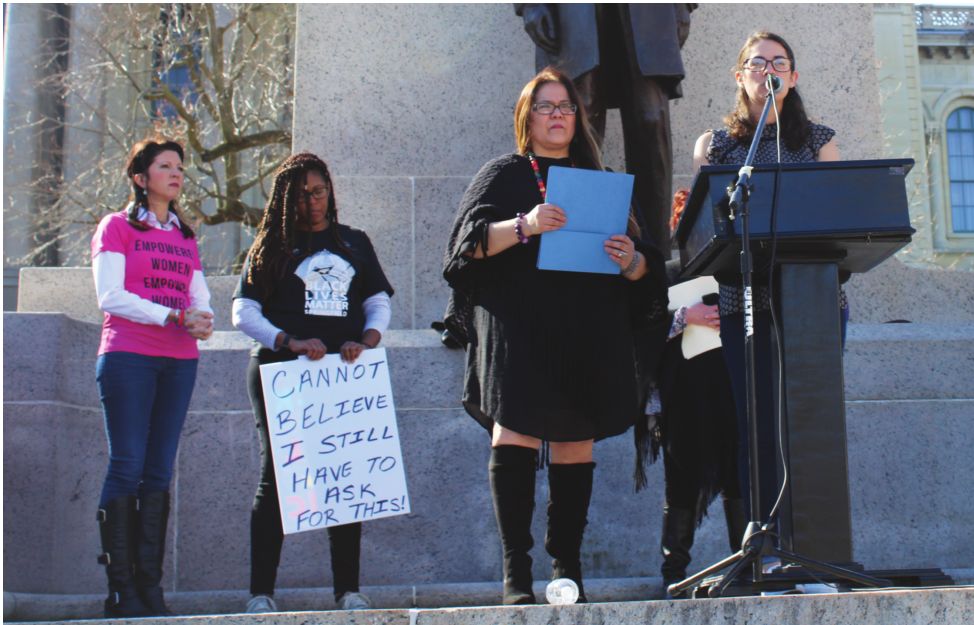
Wearing
a bright pink shirt with the words, “Empowered women empower women,”
Dirksen Londrigan spoke with her characteristic intensity, and left the
crowd with a parting plea to get involved in politics. She told the
rally-goers to vote and urge others to do the same. And then to take
their civic engagement beyond that. She said to sign up “to help a
candidate, to make phone calls, to knock on doors.”
“Jump
in. The water is nice and warm in this blue wave. 2020 is here. This is
our year. This is our time to elect Democrats and women up and down the
ballot,” said Dirksen Londrigan.
Afterward,
the crowd of women, men and non-binary people of various ages and
backgrounds poured out into the streets and, once again, they marched.
Contact Rachel Otwell at [email protected] and follow her on Twitter: @MsOtwell.


