
War is no fun, but there's a lot to write home about
BOOK REVIEW
In Their Letters – In Their Words – Illinois Civil War Soldiers Write Home, by Mark Flotow. SIU Press, 2019, 302 pages, $26.50. May be purchased at Books on the Square, Barnes and Noble, online at SIU Press or at markflotow.net.
What did the Civil War soldiers from Illinois write home about? Enlisting? Camp life? Love? Battles? Sickness? Prostitution? All of these and more.
Mark Flotow of Springfield, an independent researcher, is retired as the director of the Illinois Center for Health Statistics and currently serves as an adjunct anthropology research associate at the Illinois State Museum. He began reading soldiers’ letters, housed at the Abraham Lincoln Presidential Library, due to his interest in the Civil War. After a few years he realized the stories told by these soldiers needed to be compiled. Thus we now have an amazing collection of our Illinois soldiers’ thoughts and firsthand accounts in Flotow’s book, In Their Letters – In Their Words – Illinois Civil War Soldiers Write Home. The book includes 533 quotations from letters written by 165 soldiers between April 1861 and December 1865. Illinois had over 259,000 soldiers, the highest number per capita of any state. Many mustered out of Camp Butler near Springfield. Their median age was 24.
Millions of letters were written during the Civil War. Mail was important to the soldiers. “The mail is watched with anxiety and the soldier’s heart leaps for joy when he hears his name called at the distribution of the mail,” wrote one soldier. Another said, “Your letters are worth more to me than gold.”
At a recent presentation about his book, Flotow asked participants to comment on a letter that he had projected on a screen. “Neat,” said one. Another said, “No punctuation, poor grammar and spelling.” And another shouted, “In cursive, which kids today don’t know.” Flotow agreed with all. Soldiers filled the page because it was often considered an insult if the writer didn’t use all available space. Very little punctuation was used, and letters are riddled with misspelled words. Many are neatly written, which is surprising as the soldiers would often use a tree stump or their knapsack for a writing surface. Flotow emphasized that every letter he read was written in cursive.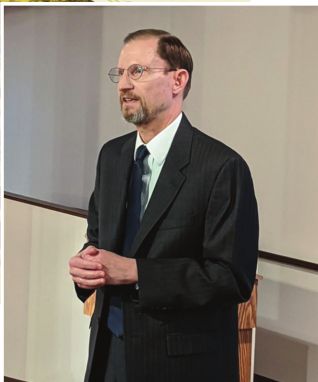
About 90% of Illinois soldiers were literate. They fought throughout the South and, as Flotow says, “never thought their letters would be read today; they were merely writing home.”
Flotow explained his process for compiling the selections. “The soldiers were like informants. I asked – how did their words reflect on the war?” He then researched topics to add historical context to the comments in letters. So, we come away from the book learning not only about the Civil War but also factual data from the period, specifics about a battle, mail delivery in the U.S., weather patterns in certain locations, diseases and names of ailments that today aren’t used, field hospitals, etc. The letters are arranged by topics.
“I know the principles that we are fiting for are write,” wrote Josiah Kellogg (Warren County) on May 9, 1863. He was killed the following May. We experience uneasiness in reading Elmer Ellsworth’s letter to his wife (Winnebago County) dated May 23, 1861: “We are to cross the river…one is somewhat likely to be hit…if anything should happen, darling…the highest happiness I looked for on Earth was a union with you.”
Many letters, like this one, make the reader wonder what happened to the writer.
Flotow
has added a short biography of each soldier that helps humanize each
person and sometimes makes one pause and view their letter in a new
light. In the
biographical sketch of Ellsworth we learn he came to Springfield in 1860
to study law and worked on Lincoln’s presidential campaign. He was
killed the day after he wrote to his wife.
Soldiers
faced diseases such as scurvy, diarrhea and what today we call
post-traumatic stress disorder. They had to deal with fleas and lice,
mud and rain, frostbite and sweltering heat, rationed food and bitter
coffee. They watched their fellow soldiers die on the field or have a
leg amputated. They watched some soldiers run from battle or be taken
prisoner. All of these topics are shared in detail in their letters.
Most
of the soldiers had never traveled far from home. An entire chapter is
devoted to their views of the Southerners and slaves. David Norton from
Cook County writes on Aug. 24, 1863, of talking with a Southern lady who
didn’t believe he was a Yankee. “When I asked why she didn’t believe me
she replied she had been told that a real yankee had but one Eye…in the
middle of his forehead and that some had horns on their heads like
cattle.” Another says the Southern farmers, known as planters “are
ignorant enough.”
There were opposing views of slaves.
Jonas
Roe (Clay County) writing on July 15, 1863, to his wife says, “Many of
the Slave owners do not treat their Slaves as well as we treat our
horses and Cattle.” Writing from Tennessee on April 24, 1862, James
Haines (Sangamon County) tells his brother, “I hope you will not get
offended at me for writing my sentiments…for hateing the plaguey
Negroes…I hope you will think alittle more of your own race.”
The
letters give an insight into every aspect of their daily life. Some are
uplifting and full of hope and love, others, disturbing and focused on
battles and harsh views. Flotow’s book is masterfully arranged and
provides a unique view of the Civil War.
Cinda
Ackerman Klickna found the letters quite interesting and plans to visit
the ALPLM to search for letters from Civil War soldiers buried in a
small cemetery in Tazewell County where her relatives are buried.


