STATEHOUSE YEAR IN REVIEW
Assessing the past year and looking ahead to 2020
A tumultuous year in Illinois politics draws to its close as the historic legislative accomplishments of May and June give way to a flurry of ongoing federal investigative activity, resignations and indictments.
Central to the story of 2019 is Gov. J.B. Pritzker, a Chicago Democrat and billionaire who spent more than $170 million of his estimated $3.2 billion fortune on a successful bid to unseat one-term incumbent Republican Bruce Rauner.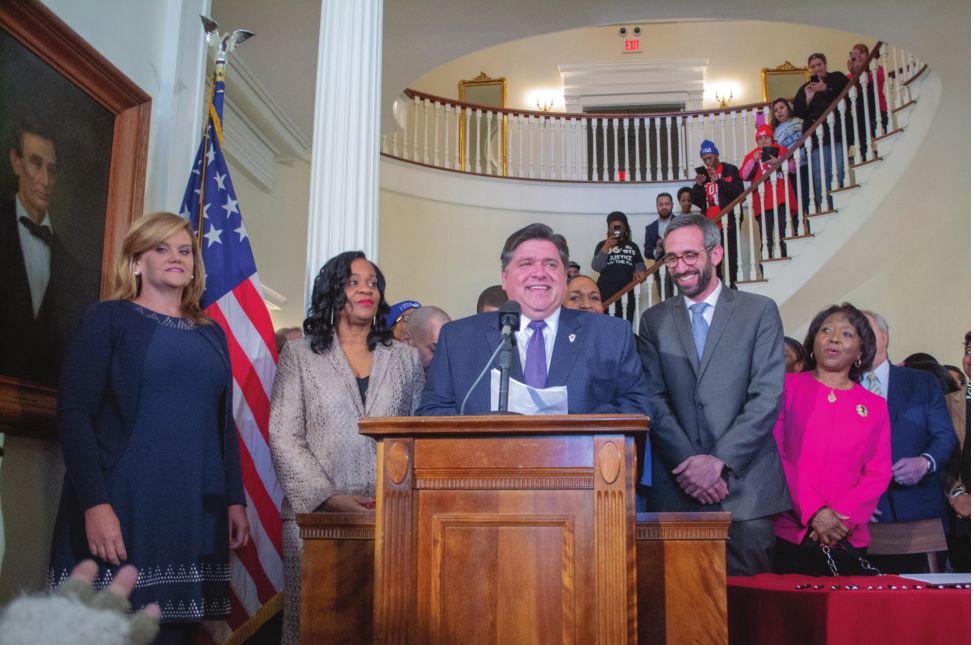
During the campaign, Pritzker positioned himself as a foil to Rauner and President Donald Trump and promised to usher in a wave of progressive policies. He also promised a new era of bipartisanship after four stagnant years that included a two-year budget impasse which led to a ballooning backlog of unpaid bills and cuts to many state services.
Rauner’s unpopularity, combined with a national “Blue Wave” which saw Democrats retake several statehouses and governors’ offices across the country, helped Pritzker to a near 16-point electoral victory and propelled Illinois Democrats to veto-proof supermajorities in both chambers of the state legislature.
Pritzker and fellow Democrats got to work quickly when the legislative session began, parlaying that electoral momentum into the February passage of a phased-in increase of the state’s minimum wage to $15 hourly by 2025.
As the months progressed, Pritzker worked with the General Assembly to turn several other campaign promises into legislative victories – legalization of adult-use recreational marijuana; a massive gambling expansion including the legalization of sports betting; a $45 billion capital infrastructure plan and the tax increases to pay for it; protection of rights to an abortion in the state and more. He also signed a state operating budget with vast bipartisan support.
But perhaps the most essential piece to Pritzker’s long-term agenda – one that the governor’s office estimates will generate more than $3 billion in added annual tax revenue – cannot become law without the approval of voters.
That measure – an amendment to the state’s Constitution allowing lawmakers to levy higher income taxes on greater levels of income – will be on the November 2020 general election ballot.
But as the fight for the
graduated tax gears up and some of the marquee policies of Pritzker’s
first year near their 2020 implementation dates, the FBI is in the midst
of a sweeping federal probe that has led to multiple resignations,
indictments and raids of lawmakers and Statehouse insiders.
Meanwhile,
Senate President John Cullerton, D-Chicago, announced plans to resign
from his leadership post and retire from the chamber on Jan. 19, setting
up the state’s first majority party legislative leadership change in a
decade.
Capitol News
Illinois interviewed several party leaders and political observers to
look back at 2019, discuss what could be on the agenda in 2020 and how
the ongoing federal probes affect the legislative process.
Pritzker’s first year
Leaders
of both parties agree the state took steps forward in Pritzker’s first
year, even if Republicans stand staunchly opposed to some of the marquee
proposals advanced by Democrats.
“I
thought we’d have a good session, but I did not expect it would be
quite as historic as it was,” Assistant Senate Majority Leader Don
Harmon, a Democrat from Oak Park, said.
The
$39.9 billion operating budget, a capital infrastructure plan that
relies on a doubling of the motor fuel tax, massive gambling expansion
and legalization of adult-use recreational marijuana all received
bipartisan support.
“I
think it was a good year for bipartisan solutions,” said Rep. Greg
Harris, a Chicago Democrat and majority leader in the House. “Obviously,
a lot of things we still disagree on, but those are philosophical
things. It just goes to show that when we have common interests, we can
work together to fix a lot of stuff.”
But House Minority Leader Jim Durkin, a Western Springs Republican, said that while the session may have ended on a bipartisan note, that wasn’t how it began.
“Let’s
just remember how we started the year,” he said. “First thing out of
the gate the governor was pushing through a very nearsighted approach
towards the minimum wage, and one that could have been resolved and
could have been negotiated with the support of the business community.”
Durkin
said Republicans and many business leaders wanted a minimum wage bill
that would reflect regional differences across the state.
The
rollout of the increase will begin in January 2020, when the wage goes
from $8.25 to $9.25 before hitting $10 on July 1. From 2021 to 2025, the
wage will see a $1 bump every January until it levels off at $15.
“But
the governor just took a, you know, one-size-fits-all approach towards
it,” he said. “And obviously to fulfill a campaign promise without, I
believe, truly recognizing and respecting what the short-term and
long-term effects that this will have on small businesses, nonprofits
and particularly along our border communities with other states.”
Toward
the end of the session, though, Durkin pushed for a series of
pro-business reforms that paved the way for extensive Republican roll
calls on the budget and capital bills.
Senate
Minority Leader Bill Brady, R-Bloomington, agreed with Durkin and
characterized the session as “the good, the bad and the ugly” from the
Republican perspective, noting he would push for changes to the minimum
wage rollout based on geography in 2020.
“The
governor was, in terms of communication, I think he was effective in a
bipartisan way. Do I believe that he reached across the aisle on
everything and worked with us? No,” he said.
Christopher
Mooney, a professor of state politics at the University of
Illinois-Chicago, said the cooperation on several issues was largely a
counterweight to four years of inaction and infighting under Rauner.
Cullerton,
the Senate president, agreed. “It was a good combination of timing,
where we had some pent-up demand because of the gridlock we had under
Governor Rauner, it had been 10 years since the last capital bill – and
there was a bipartisan effort on the capital bill, which is great,” he
said. “At the end of the session, even though we had supermajorities, we
worked with Republicans and got them to vote for a bipartisan budget in
terms of the revenues for the budget as well as the capital.”
As 2020 approaches, however, Mooney said he expects to see some of the bipartisan goodwill dissipate.
“Initially
(Republicans) have been happy to not have Rauner, but as time goes on,
and has gone on this year, I think things have been settled down into
more of the party debate over issues,” he said. “And I think they’re
done being happy that Rauner’s gone.”
Graduated tax
The parties are prepared for “war” on at least one issue in 2020 – the graduated income tax.
“We
know that there will be a war on protecting taxpayer interests when it
comes to this issue of altering our state’s constitution,” Brady said.
“...We want to convince the business community that this will be
defeated and they shouldn’t delay their investment in Illinois, their
growth in Illinois.”
Harris,
the House majority leader, said he believes the added resources are
needed to further investment in public education and human services.
“I
think when I go around my neighborhood ... I think people get the fact
that it’s appropriate for the people at the top end to pay more of their
fair share and people of lesser means at the lower end of the economic
scale to pay less in order to support our state,” he said.
Mooney
said he expects the measure to “be an effective test of Pritzker,” and
said it’s an “even money” bet as to whether it will pass.
“I
think the governor’s going to have a hard time selling it. The
opposition has a very good argument to say, ‘More taxes? You trust these
guys?’ That’s all you have to say, we’ve been in such trouble for so
long.” Mooney said.
Pritzker
has already shown he is willing to dedicate his personal fortune to
support the graduated tax, contributing $5 million in early December to
the Vote Yes for Fairness ballot initiative committee which is raising
support for the measure. That committee’s counterweight, Vote No on the
Blank Check Amendment, had yet to report any donation as of Dec. 13.
To
pass, the measure will require approval from 60 percent of those voting
on the question or the majority of those casting ballots in the
election.
“The early
response suggests that we will reach that supermajority, although I’m
sure it’ll be heavily contested by opponents,” Harmon, the Senate
sponsor of the measure, said.
If
the measure is successful, a rate structure passed by the General
Assembly this year will kick into effect. Per that structure, those
making less than $250,000 annually will see their income tax decrease or
remain at the current 4.95 percent rate, while those making above that
amount will see higher rates up to 7.99 percent for those making more
than $1 million annually.
Harris
said failure of the ballot initiative would mean “some pretty tough
decisions.” He pointed to public education, in which the state has
increased its investment by more than $700 million over the past two years.
“If
we have to start going backward and shift more of the cost of education
back to local school districts and just force more property tax
increases, that’s a very bad result,” he said.
Cullerton, who will be retiring in January, said one alternative is an increase to the current 4.95 percent flat tax.
“If it doesn’t pass, the same amount of money can be garnered by a 1 percent income tax raise across the board,” he said.
When
asked if he thought failure of the graduated tax initiative would mean
tax increases elsewhere, Brady responded, “I hope not.”
“I
hope what they (Democrats) focus on is economic growth, which will
drive natural revenues to the state and increase and enhance the
livelihood of our residents,” he said.

Federal probes and ethics reform
But
the graduated tax and the policies of Pritzker’s first year have been
overshadowed lately by the sweeping federal probe of alleged state
government corruption.
Just
two months after Pritzker signed the expansive capital infrastructure
plan – the first one passed by the General Assembly in more than a
decade – the Statehouse office of one of the bill’s lead architects was
raided by the FBI.
Sen.
Martin Sandoval, a Chicago Democrat who was chair of the Senate
Transportation Committee at the time, eventually submitted his
resignation from the chamber, effective Jan. 1.
News
quickly followed of raids on a former lobbyist for ComEd, an electric
utility company with close ties to Illinois House Speaker Michael
Madigan, D-Chicago. Later it was revealed that federal agents also
executed search warrants in several small towns in the southwest suburbs
of Chicago, apparently searching for information about red light camera
contracts.
Neither Sandoval nor any ComEd representatives have been charged with wrongdoing, despite the ongoing investigations.
In
October, however, Rep. Luis Arroyo, a Chicago Democrat, was arrested on
charges that he tried to bribe an unidentified state senator who was
later revealed by federal affidavits to have been wearing a wire for
investigators.
Before
any of that, state Sen. Tom Cullerton, a distant cousin of the Senate
president, was indicted in August on charges that he collected a salary
as well as health and pension benefits from a labor union “for which he
did little or no work.” He remains in the Senate.
The
constant flow of headlines pertaining to alleged corruption put ethics
reforms at the top of the agenda for the fall veto session, which
produced measures tightening disclosure laws for lobbyists and creating a
commission to study potential changes to ethics laws.
Harmon
said it will be “incumbent upon” lawmakers in 2020 to “demonstrate our
responsibility to voters.” He said the General Assembly should overhaul
statements of economic interest and institute “an even greater
separation” between legislative responsibility and fundraising
obligations.”
“I
hope (the federal investigations) reminds us all of the importance of
the public trust we hold and that we can only lead by example, even in
the face of these outliers,” he added.
Harris,
who was named to the ethics commission by Speaker Madigan, said it will
draw upon best practices in other states, bills filed by both parties
in the General Assembly, think tanks and others to craft effective
ethics policies. The commission is scheduled to report its findings in
March, and he said it would discuss pushing out reforms before that
deadline.
“I don’t
want this to be a kicking-the-candown-the-road exercise,” he said. “I
don’t want it to be a grandstanding exercise. I want people to come in
there and do real work. I think everyone in the state agrees that we
have some real problems with some of this lobbyist stuff and the ethics,
governmental ethics stuff, and transparency and accountability, and we
need to step up and fix them.”
Brady,
who criticized what he said is a partisan tilt to the commission, said
he will “continue to be hopeful” that it does its job.
“But
at the end of the day, what really needs to happen is all these
investigations, all these concerns about members of the General Assembly
wearing wires, needs to come to rest,” he said. “And the federal
government needs to give us some conclusion on the illegal activities
which are already illegal regardless of ethics reform.”
But
Mooney was less optimistic, saying the platitudes put before a task
force don’t always translate into effective legislation, because the
general public is more interested in headlines proclaiming “ethics
reform” than they are of details of the reforms.
“People
who are affected by the ethics reforms, they’re much more into details.
...The general public’s not that interested. Obviously, they just want
people to knock it off,” he said. “But the people that are involved, the
lobbyists and whatever and the legislators that these restrictions are
imposed upon, they would like to make them as loose as possible.”

Senate leadership change
The
surprise announcement earlier this year of the resignation of the
state’s top senator joins the federal investigations in creating
uncertainty for the 2020 political agenda.
President
Cullerton told reporters at the end of this year’s fall veto session
that his reason for leaving was to spend more time with family.
Democratic Senate caucus members are scheduled to choose his successor
on Sunday, Jan. 19, and several have been jockeying for position in
recent weeks.
Mooney, the UIC professor, said the dynamic in the Senate will be interesting to watch in 2020.
“When
you’re running for leader, you hand out goodies,” he said. “You say,
look, when I get in I’m gonna have, you want to be on this committee,
you want to have that chair? You know, you want to have this, you want
to do that? That’s how you get it. You give out favors. But once you’re
in, you owe people stuff.”
Cullerton said becoming a leader is a “humbling” experience, and he has no plans to take part in the effort to pick a successor.
“It’s
very humbling, because you’re asking your peers to elevate you and
you’re reminded of your shortcomings by your colleagues. They’re folks
who don’t say, ‘I’ll vote for you,’ right away. You have to win them
over. You’re constantly being reminded of your shortcomings. … That’s where the humility comes in,” he said.
While
the change to the Senate will be the first in majority leadership since
Cullerton assumed the office of president in 2009, House Speaker
Madigan will remain in the position he has held for all but two years
since 1983.
Through a
spokesperson, Madigan declined to be interviewed for this article but
distributed a statement to Capitol News Illinois.
“This
upcoming legislative session will largely focus on passing a
responsible, balanced budget. While we accomplished quite a bit last
session, there’s plenty of work that remains to be done. I look forward
to working with the legislative leaders and the governor on another
productive session that puts working families first,” the speaker said
in that statement.
The next session
The
governor reiterated his commitment to passing ethics reforms and laid
out some of his other 2020 agenda items at a news conference in Chicago
earlier this month.
He
said a top priority will be addressing the state’s $137 billion pension
debt, though he did not go into specifics. He also said he was focused
on expanding early childhood education in the state, further reforming
the criminal justice system and “expanding opportunities for working
families to get ahead.”
“I’ve
talked a lot about lowering the cost of health care, lowering the cost
of child care, lowering the cost of education so that we can raise the
standards of living for people who are working in our state in addition
to creating jobs for competition for labor so that we’re lifting up
their wages while we’re lowering their dayto-day costs,” he said.
Some
observers also said the federal probes into ComEd’s lobbying practices
and their connections to Madigan’s office have hampered another of
Pritzker’s campaign promises – addressing climate change by putting
Illinois on a path to 100 percent carbon-free energy.
“It’s
on life support right now,” House Republican Leader Durkin said of
energy reforms. “And until we get a full understanding of what is going
to happen with the investigations that are currently related to ComEd,
and also members of the legislature, I don’t see any desire for the
legislature to take up that particular piece of legislation.”
But
Harris said the Clean Energy Jobs Act will be on the top of the agenda
for House Democrats, despite the ComEd investigation having “some
effect” on its prospects.
“But
you know, there are a lot of different players involved in the whole
energy discussion,” he said. “You have the different solar providers,
you have wind providers, you have downstate fossil fuel providers who
are trying to get things. You have Exelon, which is a nuclear generator,
which has some specific asks. So, yeah, there’s a lot of moving pieces.
But from what I hear from people who are involved in those
negotiations, … they seem to be moving along.”
The
governor also said he would renew a legislative push to make a Chicago
casino more feasible. The $45 billion capital plan depends, in part, on
revenues from such a facility.
Harris
said much of the focus in 2020 will also be on making sure some of the
programs newly created in 2019 can be successfully implemented.
Durkin
said House Republicans plan to focus heavily next year on two issues:
ethics reform and overhauling the way the General Assembly redraws
legislative and congressional districts each year – a proposal they
refer to as “fair maps.”
“When
it comes to cleaning our own house and policing ourselves, we can never
do enough,” he said. “So that needs to be the priority for the session,
along with saying that we’re going to leave another question to the
voters. That is whether or not they should take the legislative
map-drawing for the legislature and Congress out of the hands of the
Democrat power brokers in Springfield and leave it to an independent
commission. … That is the one way in which you can clean and get rid of
the culture of Springfield.”
Brady,
the Senate Republican leader, echoed that sentiment, pointing to a
Pritzker campaign promise to veto partisan legislative maps.
“I
could only take Gov. Pritzker at his word that he will not sign a
gerrymandered, unfair map,” he said. “I think he knows the best way to
get there is to remove the opportunity that two people have, the
president of Senate and the speaker the House, to draw the map.”
He
also said he is looking forward to hearing recommendations from a
property tax reform task force that was established last year so the
General Assembly can get to work on the issue.
“We
need to make sure people know that we’re going to do whatever it is we
can, whether it be take natural revenue growth at the state and offset
property tax costs or we rewrite the property tax code in Illinois,
whatever it might be. And we need to give them confidence that we’re
going to take this issue seriously,” he said.
Contact Capitol News Illinois at news@capitolnewsillinois.com.