High atop the kitchen cabinets in my apartment sits a pottery bowl known as a cassole. It is quite large – about the size of a basketball. It is wide at the top and is tapered down to its base. My cassole is glazed in its interior and rim but is unglazed on the outside. It originally had two clay handles, but I broke one off before I ever got to cook in it.
My move from the old Spaulding Orchard farmhouse in Springfield to my tiny apartment in Oklahoma City required a drastic degree of downsizing. I would only have enough space for the bare essentials. I had to leave behind my books, most of my clothes and all of my furniture. My Kitchenaid stand mixer, my White Mountain ice cream freezer, my pasta maker, my pizza oven and my cast iron gumbo pots are hibernating in a storage unit. But I just couldn’t walk away from my beloved cassole, even though it’s barely been used over the 14 years I’ve owned it.
A cassole is a pot designed for only one function: making cassoulet. Cassoulet is a dish from the South of France that consists of beans slow-cooked with various meats and sausages.
Bon Appetit magazine writes:
“Layers of duck, two kinds of sausage, a hearty ragout and beans make this the comfort meal to end all comfort meals.”
Cassoulet, when made in the traditional way, is a large-format peasant’s dish that takes three days to prepare and will set you back well over $100 in hard-to-source ingredients (unless you are a peasant living in a little village in the south of France). It’s not the kind of dish you would consider preparing unless you had a dozen or more hungry people to feed. I’ve ordered cassoulet before in restaurants and have seen recipes scaled down and simplified for home kitchens but these inauthentic interpretations fail to deliver the warming comfort of the real deal.
About 15 years ago, I bought the newly revised edition of Paula Wolfort’s 1983 classic cookbook The Cooking of South-West France (which is now out-of-print and sells for $118.76 on Amazon). The 2005 revision had a picture on its cover of cassoulet in a traditional cassole pot. I was charmed by the image and went on a search to find my own cassole. I found out that there was only one remaining maker of cassoles in Provence, but their pots were nowhere as beautiful as the one
displayed on the book’s cover. After numerous inquiries I was able to
obtain author Paula Wolfort’s address and contacted her directly to find
out where she had obtained her cassole. She directed me to a pottery
studio in Minnesota called Clay Coyote Gallery and Pottery
(claycoyote.com) whose motto is, “We make art you can cook with.” They
are extremely cool artisans who have cooks and bakers on their team to
help them design and create functional culinary pottery.
One
night, after my better judgment had been suppressed by a bottle of
wine, I ordered my cassole and put a $165 charge on my credit card. A
week later a big box arrived and buried in a sea of packing peanuts was
my new cassole.
This
was 15 years ago, before you could get next-day delivery of pretty much
anything from Amazon. Traditional cassoulet recipes call for Tarbais
beans, pork shoulder, pig knuckles, pork shin, rendered duck fat,
pancetta, Muscovy duck legs, salt pork, bread crumbs, Toulouse sausages
and walnut oil. Needless to say, most of these items weren’t available
in Springfield so my pretty pot stayed on the top shelf of my kitchen.
In
my new role as a restaurant chef I am required to make “family meal”
once a week for my 15 co-workers, four of whom are vegetarians. My
cassole, which made the cut of the few items I chose to bring with me to
Oklahoma City, has now achieved functionality. It is the only pot I
possess that is big enough to feed 15 hungry people. I have taken the
concept of a traditional cassoulet and modified it to make it acceptable
to my vegetarians while still being appealing to omnivores.
This
Thanksgiving I will have two vegetarians at my dinner table and the
vegetable cassoulet recipe I make for family meal at the restaurant will
share center stage with my turkey. I have scaled down the recipe to be
appropriate for a smaller crowd. You don’t need to use an authentic
cassole. Any pot that can handle a 400-degree F oven will do. Remember
to soak the beans a day ahead.
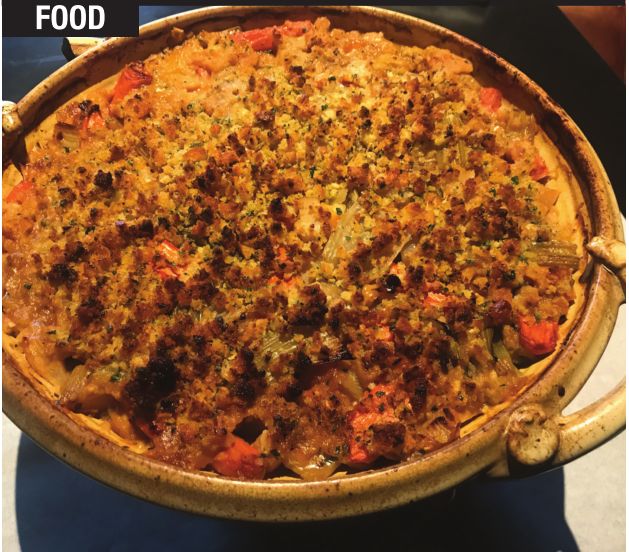
Vegetable Cassoulet 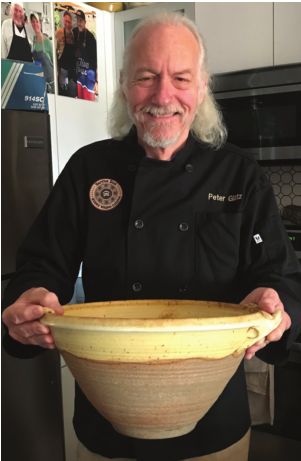
Serves 6
Ingredients
2 tablespoons extra virgin olive oil
1 onion, diced
3 garlic cloves, minced Salt and pepper
1 tablespoon tomato paste
1 plum tomato, seeded and diced
2 cups cannellini beans
6 cups low-sodium vegetable broth
6 stalks celery, cut into
1-inch pieces
3 medium carrots,scrubbed and cut into
1-inch pieces
2 large turnips, peeled and cut into bite-sized pieces
1 medium fennel bulb, cut into bitesized pieces
3 sprigs Italian parsley, 2 sprigs sage, and 2 sprigs thyme, tied together with kitchen twine
For the topping:
1 cup fresh bread crumbs
2 garlic cloves, minced
4 tablespoons chopped Italian parsley leaves
3 tablespoons unsalted butter, melted
Preparation Soak the beans overnight.
Then drain and rinse.
Heat
a small skillet over medium heat and add 2 tablespoons of olive oil.
Add the onion and garlic and cook until translucent. Stir in the tomato
paste and diced tomato. Set pan aside.
Put the beans in a large oven-proof pot.
Add
stock and bring to a boil, then reduce to a simmer. Stir in the
onion/garlic/tomato mixture. Season with salt and pepper. Gently place
the herb bundle, celery, carrots, turnips, and fennel on top of beans.
Simmer, covered, until beans and vegetables are tender, about 1 hour.
Remove the pot from the heat and discard the herb bundle.
Combine
the bread crumbs, garlic, parsley and melted butter. Spread evenly on
top of vegetables and bake, uncovered, in a 400-degree F oven until the
crumbs are golden brown and crusty, about 12 minutes.


