CENSORED 2020
THROUGH THE LOOKING GLASS
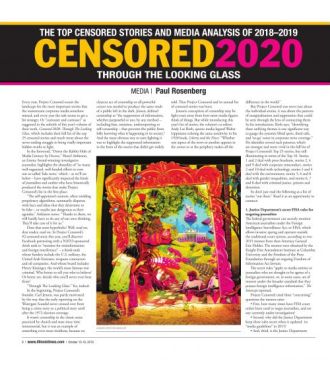
Every year, Project Censored scours the landscape for the most important stories that the mainstream corporate media somehow missed, and every year the task seems to get a bit stranger. Or “curiouser and curiouser” as suggested in the subtitle of this year’s volume of their work, Censored 2020: Through The Looking Glass, which includes their full list of the top 25 censored stories and much more about the never-ending struggle to bring vitally important hidden truths to light.
In the foreword, “Down the Rabbit Hole of Media Literacy by Decree,” Sharyl Attkisson, an Emmy Award-winning investigative journalist, highlights the absurdity of “so many well-organized, well-funded efforts to root out so-called ‘fake news,’ which – as we’ll see below – have significantly impacted the kinds of journalists and outlets who have historically produced the stories that make Project Censored’s list in the first place.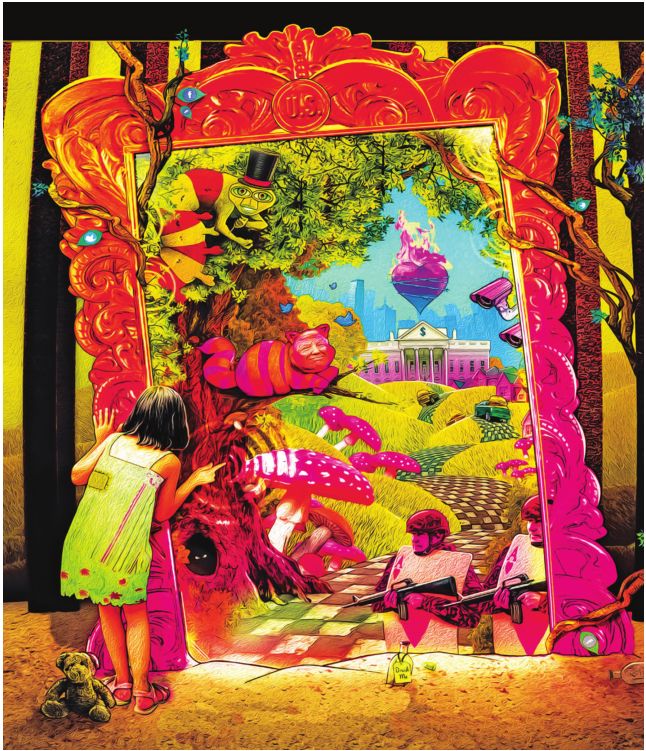
“The self-appointed curators, often wielding proprietary algorithms, summarily dispense with facts and ideas that they determine to be false – or maybe just dangerous to their agendas,” Attkisson notes. “Thanks to them, we will hardly have to do any of our own thinking. They’ll take care of it for us.”
Does that seem hyperbolic? Well, read on, dear reader, read on. In Project Censored’s #2 censored story this year, you’ll discover Facebook partnering with a NATO-sponsored think tank to “monitor for misinformation and foreign interference” – a think-tank whose funders include the U.S. military, the United Arab Emirates, weapons contractors and oil companies. And whose board includes Henry Kissinger, the world’s most famous war criminal. Who better to tell you who to believe? Or better yet, decide who you’ll never even hear from?
“Through The Looking Glass.” Yes, indeed. In the beginning, Project Censored’s founder, Carl Jensen, was partly motivated by the way that the early reporting on the Watergate Scandal never crossed over from being a crime story to a political story until after the 1972 election coverage.
It wasn’t censorship in the classic sense practiced by church and state since time immemorial, but it was an example of something even more insidious, because no clearcut act of censorship or all-powerful censor was needed to produce the same result of a public left in the dark. Jensen, defined censorship as “the suppression of information, whether purposeful or not, by any method – including bias, omission, underreporting or self-censorship – that prevents the public from fully knowing what is happening in its society.” And the most obvious way to start fighting it was to highlight the suppressed information in the form of the stories that didn’t get widely told. Thus Project Censored and its annual list of censored stories was born.
Jensen’s conception of censorship may be light-years away from how most media figures think of things. But while introducing this year’s list of stories, the volume’s co-editor, Andy Lee Roth, quotes media legend Walter Lippmann echoing the same sensitivity in his 1920 book, Liberty and the News: “Whether one aspect of the news or another appears in the center or at the periphery makes all the difference in the world.”
But Project Censored was never just about the individual stories, it was about the patterns of marginalization and suppression that could be seen through the lens of connecting them. In his introduction, Roth says, “identifying these unifying themes is one significant way to gauge the systemic blind spots, third rails, and ‘no go’ zones in corporate news coverage.” He identifies several such patterns, which are stronger and more vivid in the full list of Project Censored’s Top 25 stories, but still illuminating in terms of the Top 10. Stories 1 and 2 deal with press freedoms, stories 2, 4 and 9 deal with corporate misconduct, stories 2 and 10 deal with technology, stories 3 and 4 deal with the environment, stories 5, 6 and 8 deal with gender inequalities, and stories 6, 7 and 8 deal with criminal justice, prisons and detention.
So don’t just read the following as a list of stories “out there.”
Read it as an opportunity to connect:
1. Justice Department’s secret FISA rules for targeting journalists
The federal government can secretly monitor American journalists under the Foreign Intelligence Surveillance Act, or FISA, which allows invasive spying and operates outside the traditional court system, according to two 2015 memos from then-Attorney General Eric Holder. The memos were obtained by the Knight First Amendment Institute at Columbia University and the Freedom of the Press Foundation through an ongoing Freedom of Information Act lawsuit.
The secret rules “apply to media entities or journalists who are thought to be agents of a foreign government, or, in some cases, are of interest under the broader standard that they possess foreign intelligence information,” The Intercept reported.
Project Censored cited three “concerning” questions the memos raise:
• First, how many times have FISA court orders been used to target journalists, and are any currently under investigation?
• Second, why did the Justice Department keep these rules secret when it updated its “media guidelines” in 2015?
• And, third, is the Justice Department using FISA court orders --
along with the FBI’s similar rules for targeting journalists with
National Security Letters (NSLs) – to “get around the stricter media
guidelines”?
The
corporate media virtually ignored these revelations when they occurred.
The subsequent media interest in FISA warrants targeting Trump campaign
adviser Carter Page “has done nothing at all to raise awareness of the
threats posed by FISA warrants that target journalists and news
organizations,” Project Censored observed.
They ended with a quote from Krishnan, summarizing the stakes:
“National
security surveillance authorities confer extraordinary powers. The
government’s failure to share more information about them damages
journalists’ ability to protect their sources, and jeopardizes the news
gathering process.”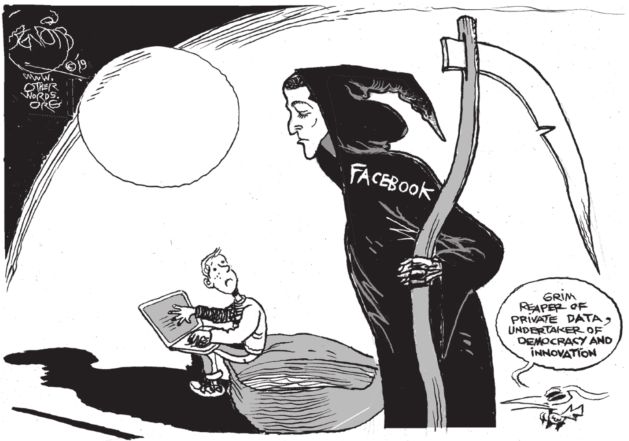
2. Think tank partnerships establish Facebook as a tool of U.S. foreign policy
In
the name of fighting “fake news” to protect American democracy from
“foreign influences,” Facebook formed a set of partnerships with three
expert foreign influencers in 2018, augmenting its bias toward
censorship of left/progressive voices.
In
May 2018, Facebook announced its partnership with the Atlantic Council,
a NATO-sponsored D.C. think tank to “monitor for misinformation and
foreign interference.”
“It’s
funded by the U.S. Department of State and the U.S. Navy, Army and Air
Force, along with NATO, various foreign powers and major Western
corporations, including weapons contractors and oil companies,
(including Chevron, ExxonMobil, Royal Dutch Shell),” noted Adam Johnson,
writing for the media watch group FAIR.
It went on to note that the major news outlets covering the story said nothing about any of the above conflicts of interest.
In
September, Facebook announced it would also partner with two Cold
Warera U.S. government-funded propaganda organizations – the National
Democratic Institute and the International Republican Institute.
In
October 2018, Jonathan Sigrist, writing for Global Research, described
one of the greatest Facebook account and page purges in its troubled
history: “559 pages and 251 personal accounts were instantly removed
from the platform… This is but one of similar yet smaller purges that
have been unfolding in front of our eyes over the last year, all in the
name of fighting ‘fake news’ and so-called Russian propaganda.”
3. Indigenous groups from the Amazon propose creation of largest protected area on earth
When
news of unprecedented wildfires in the Amazon grabbed headlines in late
August, most Americans were ill-prepared to understand the story, in
part because of systemic exclusion of indigenous voices and viewpoints,
highlighted in Project Censored’s number three story – the proposed
creation of an Amazonian protected zone the size of Mexico, presented to
the UN Conference on Biodiversity in November 2018.
The proposal, which Jonathan Watts, writing for The Guardian, described
as “a 200m-hectare sanctuary for people, wildlife and climate stability
that would stretch across borders from the Andes to the Atlantic,” was
advanced by an alliance of some 500 indigenous
groups from nine countries, known as COICA – the Coordinator of the
Indigenous Organizations of the Amazon Basin, who called it “a sacred
corridor of life and culture.”
“We have come from the forest and we worry about what is happening,” declared Tuntiak Katan, vice president of COICA, quoted in The Guardian. “This
space is the world’s last great sanctuary for biodiversity. It is there
because we are there. Other places have been destroyed.”
The Guardian went
on to note: The organisation does not recognise national boundaries,
which were put in place by colonial settlers and their descendants
without the consent of indigenous people who have lived in the Amazon
for millennia. Katan said the group was willing to talk to anyone who
was ready to protect, not just biodiversity, but the territorial rights
of forest communities.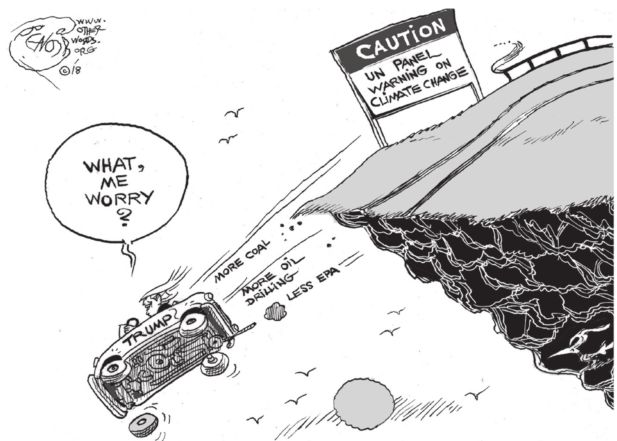
In contrast, The Guardian explained:
Colombia
previously outlined a similar triple-A (Andes, Amazon and Atlantic)
protection project that it planned to put forward with the support of
Ecuador at next month’s climate talks. But the election of new
right-wing leaders in Colombia and Brazil has thrown into doubt what
would have been a major contribution by South American nations to reduce
emissions.
4. U.S. oil and gas industry set to unleash 120 billion tons of new carbon emissions
Three
months after the United Nations’ Intergovernmental Panel on Climate
Change warned that we have just 12 years to limit catastrophic climate
change, Oil Change International released a report that went virtually
ignored, warning that the United States was headed in exactly the wrong
direction.
The report, Drilling Towards Disaster, warned
that rather than cutting down carbon emissions, as required to avert
catastrophe, the United States under Donald Trump was dramatically
increasing fossil fuel production, with the United States on target to
account for 60% of increased carbon emissions worldwide by 2030,
expanding extraction at least four times more than any other country.
References to the report “have been limited to independent media outlets,” Project Censored noted.
5. Modern slavery in the United States and around the world
An
estimated 403,000 people in the United were living in conditions of
“modern slavery” in 2016, according to the 2018 Global Slavery Index, or
GSI, about 1% of the global total. The GSI defines “modern slavery”
broadly to include forced labor and forced marriage.
Because
forced marriage accounts for 15 million people, more than a third of
the global total, it’s not surprising that females form a majority of
the victims (71 percent). The highest levels were found in North Korea,
where an estimated 2.6 million people – 10% of the population – are
victims of modern slavery.
The
GSI is produced by the Walk Free Foundation, whose founder, Andrew
Forrest, called the U.S. figure, “a truly staggering statistic, (which)
is only possible through a tolerance of exploitation.”
“Walk
Free’s methodology includes extrapolation using national surveys,
databases of information of those who were assisted in trafficking
cases, and reports from other agencies like the UN’s International
Labour Organization,” explained The Guardian, to compile its figures.
There are problems with this, according to others working in the field, The Guardian noted.
There’s no universal legal definition, and tabulation difficulties
abound. But the GSI addresses this as an issue for governments to work
on and offers specific proposals.
“The
GSI noted that forced labor occurred ‘in many contexts’ in the U.S.,
including in agriculture, among traveling sales crews, and – as recent
legal cases against GEO Group, Inc. have revealed – as the result of
compulsory prison labor in privately owned and operated detention
facilities contracted by the Department of Homeland Security,” Project
Censored noted.
6. Survivors of sexual abuse and sex trafficking criminalized for self-defense
On
Jan. 7, outgoing Tennessee Gov. Bill Haslam granted clemency to Cyntoia
Brown, who had been sentenced to life in prison in 2004, at age 16, for
killing a man who bought her for sex and raped her. Brown’s case gained
prominence via the support of A-list celebrities and Haslam cited “the
extraordinary steps Ms. Brown has taken to rebuild her life.” But
despite public impressions, Brown’s case was far from unique.
“There
are thousands of Cyntoia Browns in prison,” organizer Mariame Kaba,
co-founder of Survived and Punished, told Democracy Now! the next day.
“We
should really pay attention to the fact that we should be fighting for
all of those to be free,” Kaba said. “When you look at women’s prisons,
the overwhelming majority, up to 90 percent of the people in there, have
had histories of sexual and physical violence prior to ending up in
prison.”
“In contrast
to the spate of news coverage from establishment outlets, which focused
on Brown’s biography and the details of her case,” Project Censored
wrote, “independent news organizations, including The Guardian, Democracy Now!, Rolling Stone and Mother Jones, stood out for reporting that cases like Brown’s are all too common.”
7. Flawed investigations of sexual assaults in children’s immigrant shelters
“Over the past six months, ProPublica has gathered hundreds of police reports detailing allegations of sexual assaults in immigrant children’s shelters,” ProPublica reported
in November 2018. “[The shelters] have received $4.5 billion for
housing and other services since the surge of unaccompanied minors from
Central America in 2014 [and the reports reveal that] both staff and
other residents sometimes acted as predators.”
“Again
and again, the reports show, the police were quickly – and with little
investigation – closing the cases, often within days, or even hours,” ProPublica stated.
In
the case of Alex – a 13-year-old from Honduras – used to highlight
systemic problems, the police investigation lasted 72 minutes, and
resulted in a three-sentence report. There was
surveillance video showing two older teenagers grabbing him, throwing
him to the floor and dragging him into a bedroom. But ProPublica reported,
“An examination of Alex’s case shows that almost every agency charged
with helping Alex – with finding out the full extent of what happened in
that room – had instead failed him.”
“Because
immigrant children in detention are frequently moved, even when an
investigator wanted to pursue a case, the child could be moved out of
the investigating agency’s jurisdiction in a just few weeks, often
without warning,” Project Censored noted. “When children are released,
parents or relatives may be reluctant to seek justice, avoiding contact
with law enforcement because they are undocumented or living with
someone who is.”
8. U.S. women face prison sentences for miscarriages
“There
has to be some form of punishment” for women who have abortions,
candidate Donald Trump said in early 2016, which led to a wave of
denials from anti-abortion activists and politicians, who claimed it was
not their position. These women were victims, too, they argued: That
had always been their position. But that wasn’t true, as Rewire News
reported
at the time.
Women were already in prison, not for abortions, but for miscarriages
alleged to be covert abortions. And that could become much more
widespread due to actions taken by Trump Administration, according to a
2019 Ms. Magazine blog post by Naomi Randolph on the 46th anniversary of the Roe v. Wade decision, especially if the decision is overturned.
“Pregnant
women could face a higher risk of criminal charges for miscarriages or
stillbirths, due to lawmakers in numerous states enacting laws that
recognize fetuses as people, separate from the mother,” Project Censored
explained, adding:
One
example that Randolph provided is in Alabama, where voters recently
passed a measure that “endows fetuses with ‘personhood’ rights for the
first time, potentially making any action that impacts a fetus a
criminal behavior with potential for prosecution.” Collectively, these
laws have resulted in hundreds of American women facing prosecution for
the outcome of their pregnancies.
In fact, a 2015 joint ProPublica/AL.com investigation,
found that “at least 479 new and expecting mothers have been prosecuted
across Alabama since 2006,” under an earlier child endangerment law,
passed with methlab explosions in mind, which the “personhood movement”
got repurposed to target stillbirths, miscarriages and suspected
self-abortions.
9. Developing countries’ medical needs unfulfilled by Big Pharma
“The
world’s biggest pharmaceutical firms have failed to develop two-thirds
of the 139 urgently needed treatments in developing countries,” Julia
Kollewe reported for The Guardian in November 2018, according to a
report by Access to Medicine Foundation, which “found that most firms
focus on infectious diseases such as HIV/Aids, malaria and tuberculosis
but had failed to focus on other serious ailments….. In particular, the
foundation called for an infants’ vaccine for cholera and a singledose
oral cure for syphilis.”
It’s
not all bad news. “The foundation’s report also highlighted 45 best and
innovative practices that could ‘help raise the level of standard
practice’ and ‘achieve greater access to medicine,’” Project Censored
noted. “The report highlights examples such as the development of a
child-friendly chewable tablet for roundworm and whipworm, which infect
an estimated 795 million people,” The Guardian reported. “Johnson
& Johnson has pledged to donate 200m doses a year until 2020.” The
possibilities underscore why attention is vital. But attention has been
sorely lacking in the corporate media.
10. Pentagon aims to surveil social media to predict domestic protests
“The
United States government is accelerating efforts to monitor social
media to preempt major anti-government protests in the U.S.,” Nafeez
Ahmed reported for Motherboard in October 2018, drawing on
“scientific research, official government documents and patent filings.”
Specifically, “The social media posts of American citizens who don’t
like President Donald Trump are the focus of the latest U.S.
military-funded research,” which in turn “is part of a wider effort by
the Trump administration to consolidate the U.S. military’s role and
influence on domestic intelligence.”
The
Pentagon had previously funded Big Data research into predicting mass
population behavior, “specifically the outbreak of conflict, terrorism
and civil unrest,” especially in the wake of the Arab Spring, via a
program known as “Embers.” But such attention wasn’t solely focused
abroad, Ahmed noted, calling attention to a U.S. Army-backed study on
civil unrest within the U.S. homeland, titled Social Network Structure as a Predictor of Social Behavior: The Case of Protest in the 2016 U.S. Presidential Election.
Paul Rosenberg is senior editor at Random Lengths News in Los Angeles.