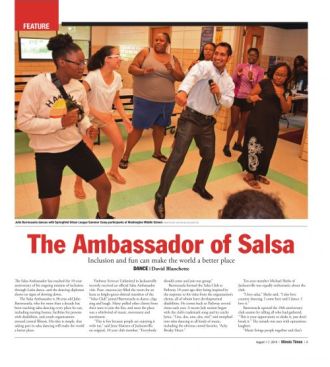
Inclusion and fun can make the world a better place
The Salsa Ambassador has reached the 10-year anniversary of his ongoing mission of inclusion through Latin dance, and the dancing diplomat shows no signs of slowing down.
The Salsa Ambassador is 38-year-old Julio Barrenzuela, who for more than a decade has been teaching salsa dancing every place he can, including nursing homes, facilities for persons with disabilities, and youth organizations around central Illinois. His idea is simple, that taking part in salsa dancing will make the world a better place.
Pathway Services Unlimited in Jacksonville recently received an official Salsa Ambassador visit. Pure, raucous joy filled the room for an hour as bright-green-shirted members of the “Salsa Club” joined Barrenzuela to dance, clap, sing and laugh. Many pulled other clients from their seats to join the fun, and soon the place was a whirlwind of music, movement and merriment.
“This is fun because people are enjoying it with me,” said Jesse Mattern of Jacksonville, an original, 10-year club member. “Everybody should come and join our group.”
Barrenzuela formed the Salsa Club at Pathway 10 years ago after being inspired by the response to his visits from the organization’s clients, all of whom have developmental disabilities. He comes back to Pathway several times each year. A recent July session began with the club’s trademark song and its catchy lyrics, “Uno, dos, uno, dos, tres!” and morphed into salsa dancing to all kinds of music, including the obvious crowd favorite, “Achy Breaky Heart.”
Ten-year member Michael Shelts of Jacksonville was equally enthusiastic about the club.
“I love salsa,” Shelts said. “I also love country dancing. I come here and I dance. I love it.”
Barrenzuela opened the 10th anniversary club session by telling all who had gathered, “This is your opportunity to shake it, just don’t break it.” The remark was met with uproarious laughter.
“Music brings people together and that’s what
I want to do through my efforts,” Barrenzuela said. “Words alone do not
do justice to the smiles and happiness this effort has created for the
population and for me.”
Barrenzuela
lives in California but spends a lot of time in Springfield, where his
family moved after emigrating from Peru 30 years ago and where his
mother still lives. This gives him the opportunity to pursue his mission
in an area of the country where most people think “salsa” is something
you dip with a tortilla chip.
Barrenzuela is changing that perception one salsa convert at a time, and is promoting universal inclusion in the process.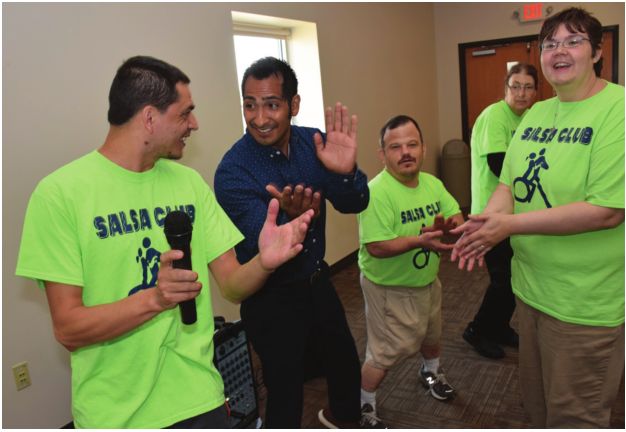
“I
want my ‘salsa visit’ to be more than just entertainment, but rather an
intentional representation of inclusion,” Barrenzuela said. “This is
where the impetus for the ‘Salsa Ambassador’ came from. The title
represents my intentional desire to visit people who are often
marginalized from participating in activities, such as salsa dancing,
because of financial, physical, mental or emotional reasons and invite
them into the Latin dancing community.
“The
hope is to make a difference by giving the community’s most unlikely
people, be it from their wheelchair or jail cell, the opportunity to see
themselves as salsa dancers and therefore members of a much larger
‘salsa community,’” Barrenzuela said. “An otherwise unspoken social
connection between them and a group they originally knew nothing about
nor felt any sense of relationship to.”
Barrenzuela
has been officially recognized as the Salsa Ambassador by the cities of
Springfield and Jacksonville. He was a finalist for the 2009
Springfield First Citizen Award.
“He did a very good job of opening our eyes to new things”
Most
of the 20 teens at the Springfield Urban League Summer Camp at
Washington Middle School didn’t even try to hide their lack of
enthusiasm upon entering the Salsa Ambassador’s session on July 22. But
Barrenzuela quickly connected with them by playing music to which the
kids regularly listen.
As
the kids jumped up to dance to the familiar music, Barrenzuela worked
some Latin dance steps into the mix, and while they were still up he
started in with some salsa music. Pretty soon half the room was moving
to a Latin beat.
Always
remember the salsa step count, Barrenzuela told them – 1, 2, 3, 5, 6,
7. He had the kids repeat the count until they knew it by heart. He also
demonstrated music’s transformative power by playing familiar tunes
such as “Happy Birthday.”
“This
was something new to learn, I really enjoyed it,” said 15-year-old
Brianna Jones. “He did a very good job of opening our eyes to new
things, that there is more to life than the internet and social media.”
Fifteen-year-old Mardell Daniels said the “salsa experience” made an impression on him.
“It takes me back to when I was having fun on hot, sunny days,” Daniels said.
Salsa
dancing originated in Cuba in the 1920s and its popularity has spread
to many parts of the globe. The distinctive dance may be performed solo
but is more often done with a partner or in a line with other dancers.
Salsa is easily recognizable because most of the movement occurs below
the waist, causing the dance’s signature hip movements.
Barrenzuela’s
vision for salsa as a tool for educating people on cultural issues
developed early in his career with the U.S. Navy. The 19-year-old sailor
traveled to ports where he didn’t speak the local language, but he
could always find a salsa club where everyone spoke the language of
dance.
“It was as if
there was an unspoken connection around the world that I was witnessing
firsthand,” Barrenzuela said. “While my friends saw it as simply ‘having
fun with the locals,’ I saw it as a cultural phenomenon that had to be
explored further.”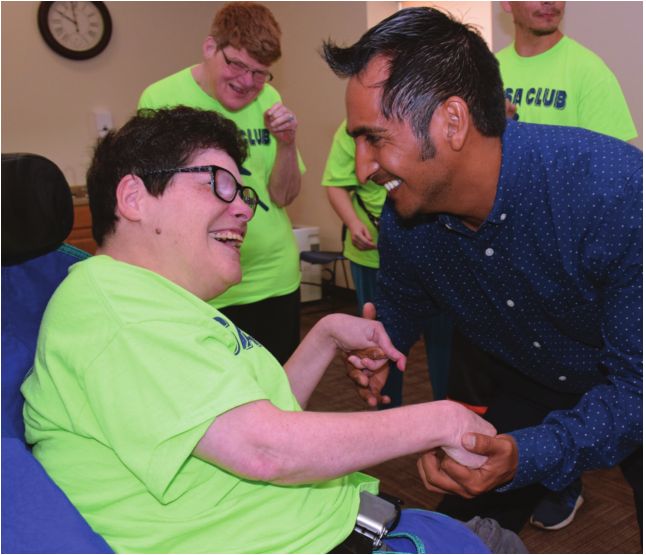
Barrenzuela
dedicated himself to replicating that experience at home after
returning from the Navy. He earned a bachelor’s degree in marketing from
Southern Illinois University-Carbondale, where he served as president
of the Latin American Student Association, the International Student
Council and the SIU Salsa Club. In those roles Barrenzuela traveled to
rural southern Illinois communities promoting cultural awareness among
at-risk children, older adults, and people with developmental and
physical disabilities.
Barrenzuela
graduated from SIU-C in May 2008 and returned to Springfield to promote
his idea that Latin music was a great way to bring people together and
to encourage social inclusion and cultural awareness. He read Malcolm
Gladwell’s book, Outliers, which argues that it takes 10,000
hours of practice to achieve mastery in a field. That book clicked with
his desire to reach people through dance, and inspired Barrenzuela to
embark on his 10- year journey as the “Salsa Ambassador.”
“I
understood early on that if I wanted to promote inclusion through music
and dance I would first have to explore my own personal ability to be
inclusive of others,” Barrenzuela said. “I would first have to make
sense of what it feels like to be excluded from the mainstream.
“That
is why I intentionally set out to meet people who would not have had
the opportunity to learn how to dance to Latin music if not for my
‘salsa visit,’” Barrenzuela said. “I wanted to meet the people who were being
excluded from the world of Latin music, either because they were told
they couldn’t or had convinced themselves they couldn’t dance.”
Barrenzuela
is an inclusion advocate in more than just the dance world. He has been
involved with the League of United Latin American Citizens, National
Image, Inc. and the Immigration Project, defending immigrants against
discrimination and promoting educational attainment for underprivileged
children. He also earned a master’s degree in Media for Social Justice
from Woodbury University in Burbank, California, and received cultural
competence training from Harvard’s School of Education Think Tank on
Global Education.
Barrenzuela
will begin a Ph.D. program in Cultural Studies at Claremont Graduate
University in Claremont, California, in the fall of 2019. His
dissertation will focus on how Latin dancing brings communities
together.
“All of the music and dances bring back a lot of memories”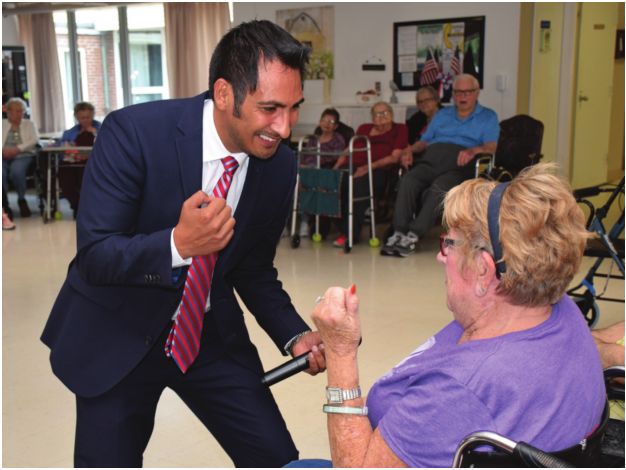
“Memories”
was the program theme at Sunny Acres Therapy & Senior Services in
Petersburg on July 24. The 40 residents attending smiled, nodded and
clapped as Barrenzuela played Wagner’s “Bridal Chorus,” patriotic songs,
the theme from “Rocky,” and “Happy Birthday.” They also sang along with
Barrenzuela, some with gusto, on the one-word song he first learned as
an eight-year-old United States immigrant – “Tequila.”
Barrenzuela
then segued into dance, asking the audience members to “move as you are
able.” He individually asked residents, “May I have this dance?” Most
agreed and moved to the music from their wheelchairs. One 95-year-old
man spontaneously got up from his wheelchair and danced, first with
Barrenzuela, then with a female activity staff member.
Barrenzuela has been coming to Sunny Acres for 10 years, and the residents look forward to each program.
“I
loved it today, and when he was here last year I really enjoyed it,”
said 99-yearold Florence Galassi, who boogied from her wheelchair. “He
even danced the polka! ‘Roll out the Barrel!’” Joann Morris was nearly
finished with her rehabilitation stay in Sunny Acres, but was glad she
got to experience the Salsa Ambassador.
“I
know the ‘Electric Slide’ and how to Cha-Cha, about the only dance he
didn’t do was the waltz,” Morris said. “All of the music and dances
bring back a lot of memories.”
Barrenzuela’s passion for salsa and his military service inspired him to team up with a nonprofit called “Soldiers Who Salsa,” a San Diego-based
program that uses Latin music as recreational therapy for wounded, ill
and injured veterans. He said the organization has asked him to serve as
its executive director to try and get the program into more than 150
Veterans Administration hospitals nationwide.
 World-famous
salsa performer and composer Rubén Blades is one of Barrezuela’s role
models. Blades shares his passion to give salsa a more meaningful role
in the world, not just as a musical genre, but as a force to educate and
promote unity.
World-famous
salsa performer and composer Rubén Blades is one of Barrezuela’s role
models. Blades shares his passion to give salsa a more meaningful role
in the world, not just as a musical genre, but as a force to educate and
promote unity.
“In
the early days of salsa, when the beats and lyrics were simple, Blades
gave his songs purpose and integrity and used them to educate his
public, similar to what Bob Dylan did with folk music,” Barrenzuela
said. “Blades’ 1984 anthem, Buscando America, for example, best
captures a version of the American dream from an immigrant perspective, a
dream not of individual success but of transforming the promise of
democracy and social justice into a reality.
“Blades’
powerful lyrics resonate with me because not many Latin singers dare to
risk their careers today the way he did in the 1970s,” Barrenzuela
said.
But it’s not all seriousness and deep social philosophy. The Salsa Ambassador wants participants to have fun.
“I
often share with my audience that all of us have the innate need to
enjoy ourselves ‘As we’re able, on our feet, in our chairs, or on the
tables.” Barrenzuela said.
And
if the Salsa Ambassador is not available to get you dancing, his
protege is. He is the president of Pathway Services’ Salsa Club, who
shared the microphone with Barrenzuela on July 24 to get nearly 50 of
his fellow persons with disabilities moving to the beat.
“We’ll teach them how to do it,” Jesse Mattern said. “Uno, dos, uno, dos, tres!”