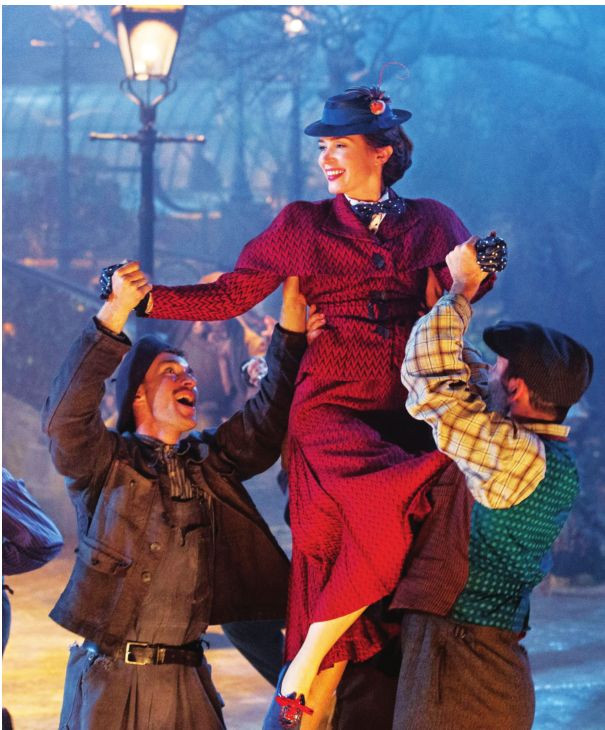
Mary Poppins Returns is magical
“Everything old is new again” seems to be the mantra at Disney Studios where their movies are concerned. Never mind the Marvel Films and Star Wars franchises, when it comes to Disney properties, the powers that be at the Mouse House are plumbing the vaults, plucking out previously successful projects and repackaging them for a new generation. The success of liveaction versions of Cinderella, The Jungle Book and Beauty and the Beast, have opened up a new revenue stream for the studio and new versions of Dumbo and The Lion King will be gracing screens soon enough.
Disney’s latest foray into dusting something off and putting a new shine on it is Mary Poppins Returns, a follow-up to their 1964 Oscar-winner that manages to recreate a bit of the old magic from the Julie Andrews vehicle. Using the newest in animation technology and a series of jaunty songs that are good enough to stand alongside tunes from the original by Richard and Robert Sherman, the belated sequel is an unexpected delight. However, whether kids today will be interested in seeing people dance with animated penguins remains to be seen.
Picking up 25 years after the original, the Banks family is in trouble once more. Now grown, Michael (Ben Whisaw) is a recent widower grappling with raising his three young children, Anabel, Georgie and John (Pixie Davies, Joel Dawson and Nathaniel Saleh) with the help of his sister Jane (Emily Mortimer). To add to his woes, the grieving father has forgotten to pay the mortgage on the family home for months and now faces foreclosure. As if on cue, the clouds part and who shows up on the scene but the nanny with all the answers, Mary Poppins (a delightful Emily Blount).
The plot is of the barebones variety and is forgotten nearly as soon as it’s set up. The screenplay by David Magee is nothing but a series of setups for the elaborate musical numbers choreographed by director Rob Marshall (Chicago, Into the Woods). Working with songs by Marc Shaiman and Scott Wittman (Hairspray), the filmmaker lets his imagination run wild with Can You Imagine That?, an elaborate romp in which the Banks children go from the bathtub into a frothy ocean of suds populated with helpful dolphins and giant rubber ducks; The Cover is Not the Book finds the nanny, her charges and lamplighter Jack (Lin-Manuel Miranda) frolicking about a vibrant animated world, rubbing elbows with a myriad of colorful animals; and Turning Turtle centers on a visit to an antique shop owned by Poppins’ cousin Topsy (Meryl Streep) that just happens to turn upside down on Wednesdays.
These three numbers are the highlights in a sea of riches, each of them executed with a sense of enthusiasm that’s infectious. Even if you’re not a fan of musicals, you’ll likely find yourself tapping your foot or smiling from ear to ear. To be sure, Mary Poppins Returns is nothing but fluff, but it’s pretty magical fluff all the same. –Chuck Koplinski

Beautiful Roma, a personal odyssey
The opening shot of Alfonso Cuaron’s gorgeous autobiographical film Roma is
a curious one at first. The sound of scrubbing is paired with the image
of water washing away soap and dirt down a drain. This is repeated
again and again. It serves as a simple metaphor, not only for the family
at its center but also for life itself. Mistakes are made, disasters
occur and clean slates are needed.
The
agent of renewal for the household in question is Cleo (Yalitza
Aparicio), the unassuming maid who wipes away tears, cleans up messes,
tucks children in and lends a concerned ear whenever necessary. She is
the glue, as well as the heart and soul, that holds this family
together. Cuaron has been upfront about the fact that Roma is a
tribute to her as well as to his mother (Sofia in the film, played
wonderfully by Marina de Tavira), the two women who saw him through a
tumultuous childhood and made him the man he is today.
To
provide a plot summation would be akin to listing events that may seem
mundane. Relationships begin and end, childhood crises crop up and are
solved, an unexpected pregnancy occurs, a household is irreparably
altered and a tragedy is narrowly averted. Life, with all of its joys
and woes, is on display, gorgeously shot as if through a warm, gossamer
lens. Serving as his own cinematographer, Cuaron renders these memories
of Mexico City in the early 1970s with an eye for detail that culminates
in a nostalgic look backwards to a world that hasn’t changed all that
much.
There’s an
organic feel to the movie, grounded in naturalistic turns from most of
the cast. As you might expect, there’s not a calculated moment from
Diego Cortina Autrey, Carlos Peralta, Marco Graf and Daniela Demesa who
inhabit the children’s roles in the sort of genuine manner only the
uninitiated can exhibit.
This
quality is never more evident than in Aparicio’s performance. Having
accompanied her sister to the open call for the film near their home in
Tlaxiaco, Mexico, she had no intention of auditioning for a part. Yet,
Cuaron plucked her from the crowd and gave her the lead role. It was a
wise choice. There’s an unassuming quality about her that makes Cleo all
too human and relatable. There are no affectations to her performance.
She’s able to create an authenticity about her character that has us
sympathizing with her from the moment she appears on screen. While some
may discount her efforts as those of a well-directed amateur, pay heed
to an unbroken, traumatic sequence that occurs in a hospital. No trained
actress could break your heart more powerfully than she does in this
moment.
A loving ode of praise, Roma is
a work with international appeal and reach. Cuaron powerfully reminds
us that there’s nothing inconsequential in the eyes of a child. Being
continually present and aware of their concerns is a kind of magic all
its own. –Chuck Koplinski
Roma is available on Netflix.
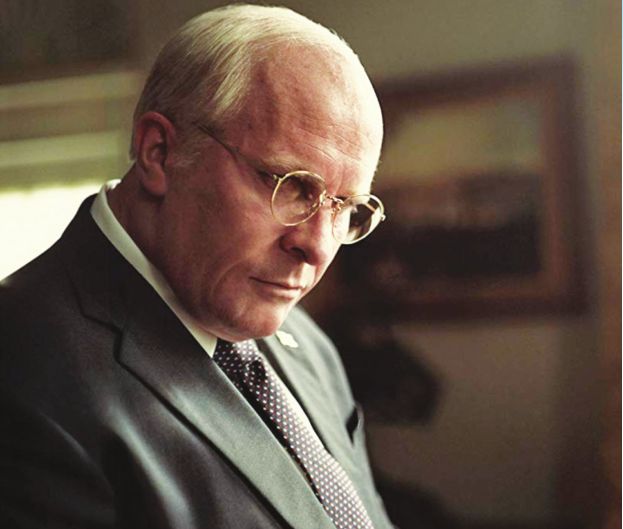
Bale dominates ambitious Vice
A magical thing happens in Adam McKay’s Vice. There
comes a time – and it doesn’t take long – before you cease seeing
Christian Bale in the title role and are convinced you’re watching Dick
Cheney himself, speaking out of the side of his mouth, his measured,
deliberate cadence manipulating everyone around him. It’s what every
performer wants – to completely disappear so that nothing of themselves
is present and all that’s seen is the character they’ve been hired to
portray.
This
transformation is one of the many delights in McKay’s
black-as-midnightin-a-coal-mine comedy that recounts the destruction
wrought between 2001 and 2008 when Cheney served as vice president to
President George W. Bush. Usurping power from a variety of government
agencies that were not normally under his office’s purview, he was able
to manipulate and create policy for his own personal gain. McKay posits
that these actions were due to his being bullied and neglected by his
father.
It’s a damning
indictment and an intriguing one as well, a social disaster you can’t
tear yourself away from. McKay briskly moves from one Machiavellian
moment to the next. We see Cheney thrown out of Yale, being given a
stern, life-altering talking to by his domineering wife Lynne (Amy
Adams), becoming a member of the congressional intern program where he’s
taken under the wing of Donald Rumsfeld (a slimy Steve Carrell),
becoming the youngest chief of staff, for President Ford, his failed bid
for a seat in Congress and his ingratiating himself into the Bushes’
inner circle.
It’s a
dizzying journey and at times all of the information thrown at the
viewer threatens to be overwhelming. McKay deftly balances humor and
drama, keeping the audience on its toes with an occasional curveball or
two. Of particular note is the presence of Naomi Watts as an imaginary
Fox News reporter who chimes in occasionally from the news desk to
comment on Cheney’s actions. Alfred Molino pulls off the cameo of the
year as a waiter at a posh D.C. eatery serving Cheney, Rumsfeld and his
cronies. He lists legal maneuvering such as the Patriot Act,
imprisonment in Guantanamo Bay and other underhanded acts as if they
were a menu of entrees. It comes as no surprise that the VP orders them
all.
The veteran cast
rises to the occasion to play these historical figures, all of them
inhabiting their characters with a slightly comic tone that deceptively
dulls the edge of their manipulative nature. Sam Rockwell captures
Bush’s one-step-behind-everyone demeanor to a tee, while Tyler Perry
steals each scene he’s in as the conflicted Colin Powell, reluctantly
showing allegiance to the commander-in-chief at the cost of his soul.
In
the end, McKay bites off more than he can chew, trying to touch on and
wrap up far too many Cheney anecdotes. Yet that plays to Vice’s advantage.
This lack of closure effectively underscores the fact that the results
of his deeds are still being felt, a ripple effect that continues to
wreak havoc. –Chuck Koplinski

Avoid the disaster that is Second Act
There are hurricanes, tornadoes, forest fires, earthquakes and many other disasters. Then there’s Second Act.
A cinematic cataclysm of astounding proportions, this “rom-com” from veteran comedy director Peter Segal (Tommy Boy, 50 First Dates) is
bad in the way only an earnestly acted, poorly written film can be.
With Jennifer Lopez in the lead role, you know right out of the gate
there will be no shortage of overly sincere moments and obvious
reactions. Her character, underappreciated everywoman Maya, tries to
make her mark in a world that doesn’t appreciate her. By the end of this
disaster, you won’t want much to do with her either.
Having
missed her opportunity to go to college when she became pregnant as a
teen, Maya gave up her daughter for adoption and began working a series
of menial jobs, eventually scrambling her way to the top of the retail
world as assistant manager at a local foods store, where her innovations
have proved successful. However, when she’s passed over for a promotion
because she lacks a college degree, she hits rock bottom, lamenting to
her best friend Joan (Leah Remini) and her teenage son Dylan (Dalton
Harrod) about the injustice of it all. Taking matters into his own
hands, the young man creates a fake resume and website touting Maya’s
false virtues and, presto chango, she has a job at Franklin and Clarke,
one of the largest beauty products corporations in the world. Before you
know it, she’s living in a
corporate
apartment off Central Park and is competing with his boss’s adopted
daughter Zoe (Vanessa Hudgens) to come up with a profitable organic
beauty product line.
Eschewing
intelligence and originality as if they were twin plagues, the script
by Justin Zackham and Elaine Goldsmith-Thomas is a pastiche of clichéd
plot points and “You gotta be kidding me!” twists. The result is a movie
that’s dead on arrival, a collection of tired bits and ridiculous
moments that will have you shaking your head in disbelief. (When a dance
scene broke out in a kitchen between Maya and her friends, I was
assured by a nearby female film critic that this has never, ever
happened in the history of womankind.)
Remini’s
foul-mouthed character is nothing new for the actress who specializes
in snark, so she’s able to phone it in, while Milo Ventimiglia as
Lopez’s doofus love interest gives what is surely the worst screen
performance of the year, sporting an unconvincing Bronx accent and an
approach that’s an embarrassment of clichés. You’ll find yourself
cringing whenever he appears. As for Lopez, there’s no denying she has a
strong screen presence, but without a firm hand to guide her, she
resorts to obvious choices and delivers a lazy performance.
The movie’s message of blue-collar empowerment is valid. But the silly way in which Act approaches the message doesn’t do it justice. The result is a cinematic lump of coal. –Chuck Koplinski


