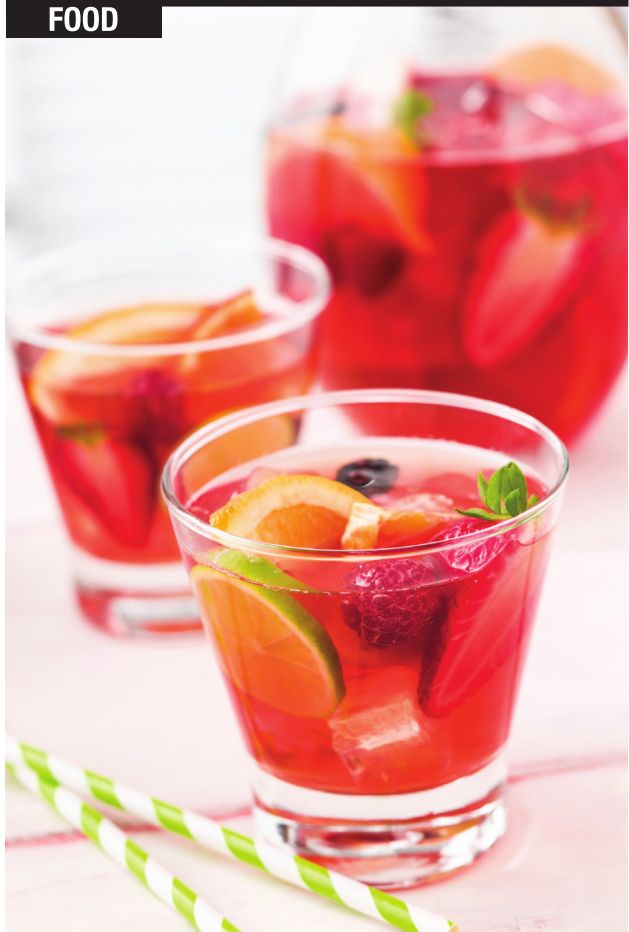
Few beverages look more enticing at a summer soiree than a big pitcher of sangria. Ripe fruits suspended in a concoction of dry wine, seltzer, a bit of sugar and liqueur make up this traditional Spanish punch that is as beautiful to look at as it is delicious. In addition to being attractive and quaffable, sangria is perfect to serve a crowd in hot weather. It’s an economical way to stretch a bottle of wine and the alcohol level can be adjusted to accommodate your own tastes.
Sangria, or something like it, dates back to the early Greeks and Romans. Spices and fruits were added to wine and water, known as hippocras. This made the wine more palatable and the addition of alcohol made the water safer to drink. The custom evolved with the rise and fall of empires, and eventually wine punches enhanced by brandy and fruit were ubiquitous throughout Europe by the mid 1700s. Americans were first introduced to the Spanish-style sangria at the New York World’s Fair, and it’s been popular ever since. The name sangria is derived from the Spanish word sangre, or blood, and traditional Spanish sangria was made with dry red wine, often Tempranillo. Sangria blanca, made with white wine, is a newer but equally-delicious innovation.
Traditional sangria is served throughout Spain in bars and restaurants. It often accompanies tapas, small bites of food brought to your table, sometimes for no charge, to entice you to order more drinks. Originally tapas, derived from the Spanish verb tapar, meaning to cover, were thin slices of bread or meat that patrons would use to cover their glass of sherry to protect it from fruit flies. Eventually bar owners got creative and began topping the breads with different vegetables, meats or cheeses.
These days a wide variety of tapas are served in Spain and in
Spanish-style restaurants and bars around the world. Tapas can either be
hot or cold and are not just limited to canapé-type offerings. Some of
my favorite tapas include olives marinated with herbs and orange peel or
slices of baguette panfried in an irresponsible amount of butter and
olive oil, then topped with fresh, bright tomatoes and basil. Two more
simple and traditional tapas are tortilla espanola, a type of baked
omelet filled with peppers and onions, and patatas alioli, an
exceedingly delicious room temperature salad of new potatoes swathed in
garlic mayonnaise and parsley, perfect to serve alongside a pitcher of
colorful sangria on the patio.
CLASSIC SPANISH SANGRIA
• 1 bottle dry red wine, such as Tempranillo or Grenache
• 1 oz. orange juice
• 1 oz. orange liqueur, such as Grand Marnier or Cointreau
• 1 T. sugar
• 1 sliced orange, lemon and apple
• 12 oz. seltzer or club soda
• Ice Mix the wine, juice, liqueur, sugar and fruit in a large glass
pitcher and allow it to marinate, refrigerated, for several hours or
overnight.
Add seltzer or soda and ice just before serving.
BASIL PEACH SANGRIA
• 1 bottle dry white wine, such as verdelo
• ½ bottle Lynfreds Peach Wine
• 2-3 T. honey, or to taste
• 4 c. sliced and peeled peaches
• 2 sliced limes
• 6-8 large basil leaves
• 12 oz. seltzer or club soda, chilled Mix the honey and peaches
together in a large glass pitcher and let it sit for 15-30 minutes.
Add the white wine, peach wine and sliced limes and refrigerate for
several hours. Before serving, add the basil leaves and chilled seltzer.
Serve over ice, and be sure to include some of the macerated peaches.
ROSE SANGRIA WITH BLUEBERRIES AND THYME
• 1 bottle dry rose wine
• 2 T. sugar
• 4 c. blueberries
• 4-5 sprigs fresh thyme
• 1 sliced lemon
• 2 oz. limoncello or lemon vodka, optional
• 12 oz. can tart lemon soda, such as San
Pellegrino
Limonata Lightly mash 2 cups of the blueberries with the sugar in a
large glass pitcher and allow it to sit for 15-30 minutes. Add the
remaining blueberries, thyme sprigs, and sliced lemon and Limoncello or
lemon vodka if using, and refrigerate for several hours or overnight.
Before serving, add the chilled lemon soda and serve over ice.
PATATAS ALIOLI (POTATOES IN GARLIC MAYONNAISE)
• 1 lb. small, new potatoes
• Juice of ½ a lemon
• 2/3 c. real mayonnaise, either homemade or a brand like Hellman’s or Dukes
• 3 gloves garlic, finely minced
• ¼ c. minced parsley
• Salt and pepper to taste If the potatoes are quite small, leave them whole; otherwise cut them into ½-inch chunks.
Add them to a pot of cold, heavilysalted water and bring to a boil.
Simmer for 15 minutes or until tender. Drain, then immediately toss with
the lemon juice and set aside to come to room temperature.
Once
potatoes are room temperature, gently fold in mayonnaise, minced garlic
and parsley. Season to taste with salt and pepper. Best served at room
temperature.
TOMATO AND NECTARINE TOASTS
• 1 baguette, sliced into 8 rounds
• 3 T. butter
• 4 T. olive oil, divided
• 3 ripe tomatoes
• 3 ripe nectarines
• 1 T. balsamic vinegar
• 6 oz. fresh mozzarella pearls, drained if in water
• 5-6 basil leaves Wash the tomatoes and nectarines and cut them into slices.
Add 1 tablespoon of the olive oil, 1 tablespoon balsamic vinegar, the
mozzarella pearls, and salt and pepper to taste. Set aside.
Roll up the basil leaves tightly like a cigar and thinly slice into fine ribbons, then set aside.
In
a large skillet, melt the butter and remaining 3 tablespoons olive oil
over medium high heat. Pan-fry the baguette slices, turning them
halfway, until golden brown and crispy. Drain on paper towels, then top
each slice with a spoonful of the tomato-nectarine salad, then garnish
with the thinly sliced basil. Serve immediately.
Contact Ashley Meyer at [email protected]


