 This
is the fourth in a series of in-depth profiles of statewide political
candidates. Erika Harold, the Republican candidate for attorney general,
was profiled last fall. See “The GOP’s fresh face: Conservative with a
clean image, Erika Harold launches unlikely campaign for attorney
general,” at illinoistimes.com.
This
is the fourth in a series of in-depth profiles of statewide political
candidates. Erika Harold, the Republican candidate for attorney general,
was profiled last fall. See “The GOP’s fresh face: Conservative with a
clean image, Erika Harold launches unlikely campaign for attorney
general,” at illinoistimes.com.
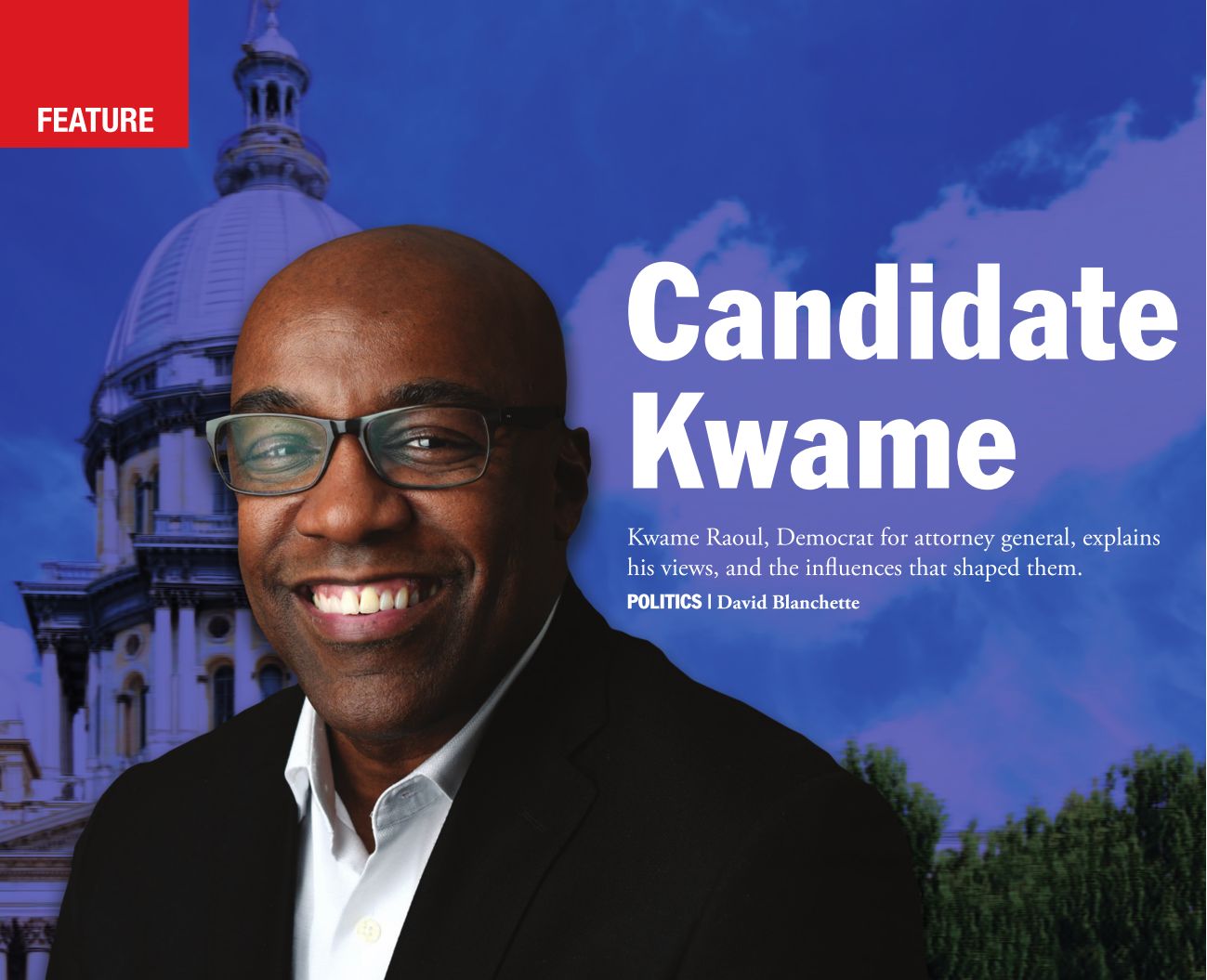
The man who wants to be Illinois’ next attorney general has a mean jump shot, would rather listen than talk, has survived cancer and draws inspiration from his own life experiences when taking a stand on key issues. One of those experiences profoundly affected his life and political outlook.
“I recall about seven years ago a 13-year-old boy was shot right across the street from my home and my son was also 13 at the time,” said 53-year-old Kwame Raoul, a Democrat who is currently a state senator from Chicago.
“My daughter has witnessed somebody put a gun to someone’s head. I have personal friends who have lost kids to gun violence within a mile of my home.”
Arne Duncan has been friends with Raoul for more than 40 years.
“Kwame called me right when that happened and I’ve probably never heard him more upset and scared,” said Duncan, who was U.S. Secretary of Education for President Barack Obama for seven years. “It shook him to his core and I literally remember where I was standing when he called me.
“When this happens directly in front of your house and there is yellow tape everywhere and you’re trying to figure out where your teenage son is, it doesn’t get more real than that,” Duncan said. “So this issue is extraordinarily personal for Kwame.”
Stopping gun violence has been a priority for Raoul in the state Senate and it’s one he says he’ll bring to the attorney general’s office if elected in November. He would prefer to focus his efforts on dealing with the issues that cause shootings, rather than getting mired in the polarizing debate over guns themselves.
“It makes me feel as a father who is involved in public policy that we haven’t done an adequate job of creating a safe environment for our children,” Raoul said. “I can recall my daughter when she was about 12 years old asking, ‘Why can’t I live somewhere where I can play outside like some of my friends?’” Several Raoul-sponsored or cosponsored gun control bills have passed the Illinois General Assembly in recent years. Bills that deal
with background checks for private firearms sales and establishing a
mandatory minimum sentence for the crime of firearms trafficking have
both become law. Legislation that requires state licensing, staff
training and new recordkeeping requirements for Illinois firearms
dealers, and a bill that establishes a Firearms Restraining Order, both
await gubernatorial action. Gov. Bruce Rauner vetoed a Raoulcosponsored
bill requiring a 72-hour waiting period on the purchase of assault-type
weapons.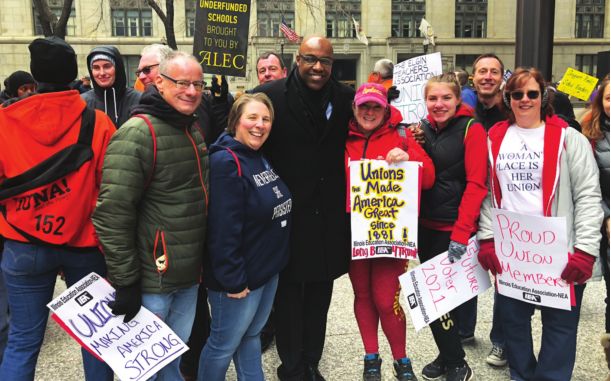
Raoul
was the chief sponsor or cosponsor of introduced legislation to ban
bump stocks and trigger cranks; limit concealed carry permit holders to
carry just one gun at a time; ban the sale of assault-type weapons and
high capacity ammunition magazines; let municipalities pass their own
assault-type weapons regulations; and require the private sales and
transfers of concealable firearms to take place at a federally licensed
firearms dealer.
The
Illinois State Rifle Association has broadly opposed the gun control
measures that Raoul has sponsored or supported in the Illinois General
Assembly. They agree with the would-be attorney general that something
needs to be done about the root cause of the violence, but feel more gun
restrictions aren’t the answer.
“Gun
control measures just make it very hard on the legal person and it
doesn’t do anything to the criminals. In fact, criminals have an
advantage with gun control laws because it makes it harder for people to
defend themselves,” said Illinois State Rifle Association (ISRA)
executive director Richard Pearson. “Guns are inanimate objects, they
aren’t legal or illegal, but the people who operate them are legal or
illegal.”
That is a rare point on which the ISRA and Raoul agree.
“I
think there’s merit to what some people say regarding that individuals
are responsible, that triggers are not pulled by themselves,” Raoul
said. He has not owned a gun, but Raoul has fired one at a southern
Illinois shooting complex.
Raoul the person
Kwame
Raoul is the divorced father of a 20-year-old son and an 18-year-old
daughter. He represents the 13 th Senate District, which stretches from
downtown Chicago to the city’s south side where it meets the Indiana
border. Raoul was appointed in 2004 to the seat left vacant when Barack
Obama was elected U.S. senator and has served ever since. He won a
bruising, eight-way March 20 Democratic primary race for attorney
general and will face Republican Erika Harold on the Nov. 6 general
election ballot.
Raoul
is a lifelong resident of the Hyde Park/Kenwood area of Chicago. He
completed his undergraduate education at DePaul University and earned a
law degree from Chicago-Kent College of Law. Raoul served as a
prosecutor in the Cook County State’s Attorney’s Office, was a labor and
employment attorney for the City Colleges of Chicago, and is currently a
partner in the health law group of Quarles & Brady. By his own
admission, Raoul is at his best in the afternoons and evenings.
Kwame
is a common West African first name. The surname Raoul is French, the
primary language spoken in his parents’ home country of Haiti.
“Kwame
was one of my closest friends throughout high school and we were
cocaptains of the high school basketball team,” said Duncan, who
attended the University of Chicago Lab School with Raoul. “He was a
really good athlete, we still play together and in fact played several
weeks ago, and he still has a really good jump shot.”
“We definitely laugh, joke
and talk a little trash on the basketball court,” Duncan said. “But he
can also be a policy wonk and be very, very serious on issues. He’s
quiet, he’d rather listen than talk. He’s also an emotional guy and I’ve
seen him moved to tears or choke up when he talks about people
struggling.”
Congresswoman
Robin Kelly of Matteson is a Democrat who represents the 2 nd District,
and has known Raoul since 2004 when he was tapped to replace Obama.
“He’s
very easygoing, we have this joke that I’m his big sister because I’m
older, and he has almost like a sheepish grin,” Kelly said. “He’s very
smart, easy to work with, supportive, he always has good ideas on how to
clean up legislation or make it better. He doesn’t know a stranger,
he’s willing to work across the aisle with people who have a different
ideology than he does.
“When
he came to the Senate in 2004 he heard a lot of, ‘Oh, you have big
shoes to fill’ by taking over Obama’s seat,” Kelly said. “But he had his
own shoes that he filled quite nicely. He didn’t have to fill Obama’s.”
Health care and health scare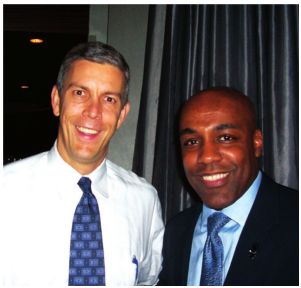
Raoul
learned about health care from his father, a community physician who
often came home with a fruitcake or a block of cheese because he
wouldn’t reject a patient due to an inability to pay.
“That
plays heavily into my determination that everybody has access to health
care,” Raoul said. “We should embrace this notion of health care as a
human right instead of something that is just for the privileged.”
That feeling was reinforced two years ago when Raoul was diagnosed with prostate cancer.
“I
got the call, I cried, and I said ‘OK, I’ve got to deal with it,’”
Raoul said. “Having access to health care allowed me to get early
detection and get the treatment I needed to be healthy.”
Raoul’s
father and grandfather died from prostate cancer. Election day, Nov. 6,
is the anniversary of the death of his father, a Haitian immigrant whom
Raoul considers a role model.
“My
parents came from a country that our president referred to as a
‘shithole,’” Raoul said. “I’m proud of my Haitian heritage. I know that
Haitian-American immigrants have made tremendous contributions to this
country going all the way back to the Revolutionary War where Haitian
soldiers fought at the siege of Savannah.
“So
for the United States to have a discriminatory animus expressed by our
Commander-in-Chief toward Haitian immigrants makes me more sensitive to
the issue,” Raoul said. “I voted for legislation that said we wouldn’t
use Illinois law enforcement resources to enforce immigration laws,
that’s not our job.”
Raoul
was referring to the TRUST Act, which became law last year and
prohibits any Illinois law enforcement officer from stopping, arresting,
searching or detaining someone solely on the basis of citizenship or
immigration status. It also limits cooperation between Illinois law
enforcement and federal immigration authorities regarding immigration
detention orders or non-judicial immigration warrants.
Cause and experience
Raoul knows many people who have been victims of sexual assault and harassment.
“We
need to evolve as a society and recognize that in all workplaces we’ve
tolerated a culture that we need to move on from,” Raoul said.
One
outcome of this experience and strong feeling is Raoul-sponsored Senate
Bill 3404 which has been approved by the General Assembly and is headed
to the governor’s desk. The bill provides additional protections and
rights for survivors of sexual assault or abuse. It also creates the
Survivors’ Bill of Rights, filling gaps in Illinois’ current laws and
bringing the state in line with federal guidelines.
Raoul
also knows people who have experienced voter access issues and pledged
to continue to protect voting rights as attorney general.
“Sometimes
we take one step forward and a couple of steps back,” Raoul said.
“You’d think that we would want to be inclusive, would want to maximize
voter participation. But there are concerted efforts to negatively
impact voter participation.”
Raoul
feels he has been racially profiled in his lifetime and has definitely
experienced racism. He does not consider Illinois a racist state,
although he feels many state residents have conscious or unconscious
biases.
As a former prosecutor, you’d think that Raoul would support a return of the death penalty, but that’s not the case.
“We have a history of charging the wrong person for some really heinous crimes,” Raoul
said. “So it’s a dangerous thing to look at how heinous a particular
murder may be and say because of the heinous nature of that, they ought
to impose the death penalty.”
State Representative Barbara Flynn Currie, the House Majority Leader, shares her district and many of her views with Raoul.
“When
it comes to social service programs we are very much on the same page,”
Currie said. “The more than two years in which Illinois had no budget
both of us were very concerned about the many social service programs
that were falling through the cracks, and we were always trying to find
ways that those programs could be funded.”
Representing
a district with liberal views is one thing, but there are concerns that
as a potential statewide officeholder Raoul might be reluctant to back
conservative issues that are dear to many Illinoisans.
“If
Mr. Raoul gets to be our attorney general, I would hope he would uphold
the parental notification law, for example,” said Tim Moore, president
of Springfield Right to Life. “And I would expect that, regardless of
where Mr. Raoul stands on the issue of life, he would want to look for a
higher quality of inspection for these abortion clinics across the
state which seem to fly under the radar of the inspection criteria for
standard clinics.”
“I
understand Mr. Raoul’s position for abortion so I think that would be
quite a surprise if he would come out and do that,” Moore said. “We very
much would like to have conversations with Mr. Raoul if he gets into
office, and I would be duly impressed if Mr. Raoul wanted to open that
conversation.”
Take the money and run
The
Attorney Registration and Disciplinary Commission of the Supreme Court
of Illinois has no record of discipline or pending proceedings against
Raoul. His legislative career has been free of the scandal that
sometimes engulfs those in Illinois public service and he will put his
legal career on hold if elected attorney general. None of the lawmakers
on either side of the aisle contacted for this story had anything
negative to say about Raoul as a person.
But
there’s one issue that could be a potential problem as the general
election campaign gets into full swing. It was brought to light by his
fellow Democrats during the primary, the fact that Raoul accepted
campaign contributions from industries he may have to regulate if
elected attorney general, such as tobacco and utility interests.
Raoul
will be under greater scrutiny because of this. It would be much more
reassuring to voters if he opted out of these contributions,” said Mary
Miro, executive director of the Illinois Campaign for Political Reform.
“In a perfect world there would be a process where Raoul would not need
to take money from these industries.”
Miro’s
organization advocates a state matching program for small contributions
that could help eliminate the need to accept this type of campaign
funding. The donations in question are perfectly legal, but may raise
questions about Raoul’s objectivity if he’s elected, she said.
“Other
states have done this and it equals the playing field for candidates,”
Miro said. “It creates an opportunity for candidates to decline
contributions like this from private companies that they’ll be
overseeing and still have the capacity to raise funds for their
campaign.”
Whether
these contributions become a major issue in November may hinge,
ironically, on money as well, according to Kent Redfield, professor
emeritus of political science at the University of Illinois Springfield
“It depends on how much money Erika Harold has to effectively raise
those issues,” Redfield said. “That’s one of the ways she could work to
get an advantage is trying to define him as business as usual, not
somebody who could carry on in the public interest, and question how
independent he could be.”
Raoul
said the contributions will not affect his ability to properly do the
job if elected, and his 14-year voting history proves it.
“Much
was made of me taking contributions from a gentleman who has tobacco
interests,” Raoul said. “My voting record has been 100 percent
consistent with the advocacy of the American Lung Association on tobacco
issues and inconsistent with what tobacco companies would want.”
“The
Attorney General’s Office could potentially regulate any business in
the state,” Raoul said. “I don’t think there has been an individual who
hasn’t accepted a financial contribution from a business that could
potentially be regulated by the Attorney General’s Office.”
The campaign
“I
met Erika Harold on several occasions on the campaign trail,” Raoul
said. “She’s always been very pleasant when we’ve met. I am looking
forward to debating her. From what I sense she’s of a personality that
would want to engage in a positive, issue-oriented debate.”
A debate between the attorney general candidates may be a good way for Raoul and Harold to get the voters familiar with them, since it might be tough for them to find enough air time or advertising space in the months leading up to November.
“J.B.
Pritzker and Bruce Rauner will spend $200 million on the governor’s
race,” said Redfield of UIS. “It’s going to be difficult for the two
attorney general candidates to break through all of the spending and
noise that’s going to be involved in the legislative and governor’s
races.
“You’ve got to
have a message and you’ve got to have the money to deliver it, so you
are somewhat dependent on outside money,” Redfield said. “Pritzker and
Rauner are going to pour money into their own parties’ races, and the
attorney general’s contest is the only other statewide contest where
there’s going to be any action. Who is putting money in and from what
direction will be an interesting thing to watch.”
Raoul’s
constituent base is currently in the Chicago area and Harold is from
Urbana. Raoul knows he needs to campaign heavily downstate to counter
his opponent’s base.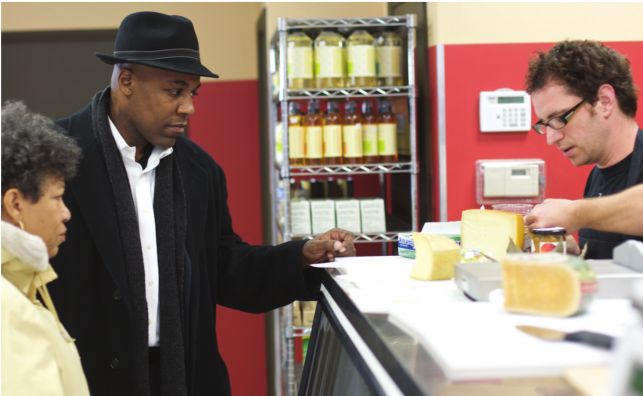
“Downstate
is an important battleground and I plan on traveling throughout the
state during the campaign,” Raoul said. “Lisa Madigan’s late
announcement that she wasn’t running kind of shrunk our window of
opportunity to do that in the primary.”
Raoul
was able to make several forays into central Illinois during the
primary, often in the company of incumbent legislators like 48 th
District State Senator Andy Manar, a fellow Democrat.
“He’s
a good listener, especially when it comes to issues in downstate
Illinois,” Manar said. “He has always gone the extra mile to try to
better understand parts of the state that he doesn’t represent, for
every issue from school funding to concealed carry.”
Manar recalled a day he spent with Raoul in several 48 th district communities.
“We
stopped by a coffee shop on the square in Carlinville and by the time
he was done he had talked to every single person in that coffee shop,”
Manar said. “He sat at their tables on his own, I didn’t prompt him. He
met a girl who was running for Miss Macoupin County and had his picture
taken with her, bought a couple of raffle tickets from her and wished
her good luck.
“Anybody
who would spend time like that with average, everyday people in a
coffee shop in Carlinville brings something to the table that we
desperately need,” Manar said.
Then
there’s the issue of the Democratic Party itself, specifically the head
of the party, House Speaker Michael Madigan, the father of current
Attorney General Lisa Madigan. Gov. Rauner has spent millions to
demonize the speaker and hang him like an albatross from the neck of of
every Democratic candidate, as well as several Republicans who have
defied Rauner.
What does Raoul think of the Democratic Party leadership?
“I
firmly believe that something we haven’t done well enough in the
Democratic Party or politics at large is to pass the baton,” Raoul said.
“I think it would be a healthy thing for the speaker to look at
allowing somebody else to ascend to that leadership role at some point.
We need to embrace passing the baton.”
David Blanchette is a freelance writer from Jacksonville and is also the co-owner of Studio 131 Photography in Springfield.


