
Reflections on life with the soil
You need to be really good at what you do. You’ve got to be an innovator while respecting tradition. An inspirational leader and a public servant. A mechanic, conservationist, lobbyist, financial planner, gambler, philanthropist and working-class hero.
Four people have what it takes this year to be selected as Master Farmers by Prairie Farmer magazine: Fred Reichert of Auburn, Tom Martin of Mt. Pulaski, Darell Sarff of Chandlerville and Jim Rapp of Princeton.
“It’s become a Hall of Achievement for Illinois farmers like no other, because it’s honored farmers who seem to do it all, combining top agricultural production skills with community service, grassroots achievement and dedication to their families,” said Prairie Farmer editor Holly Spangler. “Master Farmers leverage every bit of talent, skill and opportunity they possess and use it for the greater good, for their family, their farm, their community and their industry.”
Prairie Farmer presents the annual awards because of the important contributions farmers make to Illinois agriculture and their local communities. Candidates are nominated by farmers, agribusiness leaders and farm organizations from throughout the state. Judges for the 2018 awards were Spangler; Karen Corrigan, McGillicuddy Corrigan Agronomics; Linnea Kooistra, 2011 Master Farmer; Ed McMillan, University of Illinois Board of Trustees; and Steve Myers of Busey Ag Services.
Prairie Farmer, which was established in 1841 and is the oldest continuously published farm periodical in the United States, first offered the award in 1925 and since that time more than 400 men and women have been chosen to receive the honor. The 2018 Master Farmers were announced in the March edition of the magazine and publicly recognized at a March 14 luncheon in Springfield.
Prairie Farmer also named a new Honorary Master Farmer this year: Max Armstrong, who has made broadcasts from 30 countries and every state in the U.S. for
WGN Radio, “This Week in Agribusiness” and Farm Progress. He is the
first Honorary Master Farmer to be named since 2010, and only the 15 th
to have been named by the magazine.
Master Farmer Fred Reichert Auburn, Sangamon County
Fred Reichert of Auburn has been farming longer than most people have been alive, and he still looks forward to going to work.
“I
thank the Good Lord every day that I can still get up every morning and
go do something,” said the 86-year-old Reichert, who has been farming
for 65 years. “Either get on a tractor and plant corn, or run a combine,
or mow weeds, or whatever needs to be done.
“It’s
a way of life. I grew up on a farm, I’ve lived on a farm all of my
life, and it’s very rewarding,” Reichert said. “Drop a seed in the
ground in the spring, let it grow, then harvest it. There’s a lot of
satisfaction there.”
Reichert
and his wife, Eileen, live in the same house on the same farm they
moved to following their 1956 wedding. They operate a 3,000-acre western
Sangamon County grain farm with their son, Mark, and son-in-law Jim
Ringer, with help from their grandson, Neil Ringer.
“Everybody has a hero. Mine is my dad.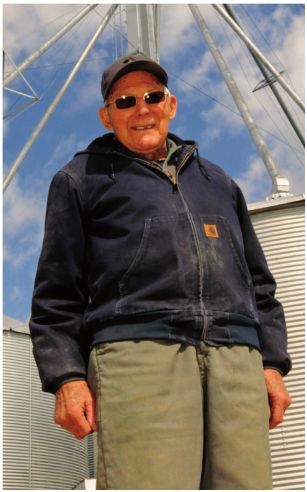
He
has taught me just as much or more than my higher education. He has
taught me life and how to live it,” said Mark Reichert. “I can think of
no greater reward than to be able to work side-by-side with Dad every
day.”
It’s hard to imagine, but there was a time in Fred Reichert’s life when he didn’t want to be a farmer.
“The
first two or three years in high school I didn’t want anything to do
with the family farm,” Reichert said. “I considered being a coach
because I played football, basketball, track. When I got out of high
school I went to the university for two years and I thought I’d had
enough college, so I quit, and then went into the Army.
“Then
all of a sudden it kind of dawned on me that maybe it might be better
to be a farmer, so that’s how I got here,” Reichert said.
Even
though he’s quite a bit “more experienced” than most farmers, Reichert
is not afraid to adapt new agricultural technologies. He has four
vintage John Deere tractors he’s restoring in his shop, which is also
full of vintage tools, but Reichert’s day-to-day working machinery has
the most efficient and up-to-date features.
“You’d
better try new technology when it comes down or you’re going to be
behind,” Reichert said. “With an old fellow like me it takes a little
longer to get used to it. But you can’t fight it, it’s here. The only
problem I find with technology is if you blow a fuse, you’re done.”
Reichert
feels public involvement is both a privilege and a civic duty. He has
worked tirelessly in the community, helping to build schools, celebrate
sesquicentennials, care for cemeteries, raise funds, and memorialize
fallen soldiers. Reichert has served with the Sangamon County Farm
Bureau, Illinois Corn Growers Association and the National Corn Growers
Association, where he actively lobbied for agricultural issues.
“We
have certain things that we want to see happen and if we don’t speak
up, nobody else will speak up for us,” Reichert said. “We used to go to
Washington, D.C., about once a year and meet whatever group we needed to
meet with to try and get our point across.”
Politics,
the weather, grain prices and other variables may make farming seem
like a gamble. Reichert certainly views it that way, but has a positive
attitude about the situation.
“My
dad used to say that he never learned to play poker because he worked
too hard for his money,” Reichert said. “But my answer to that is, we
are the biggest dad-gummed poker players going. You get handed a pair of
dice every spring and you roll ’em. Sometimes they come up snake eyes,
but there are more sevens than there are snake eyes!” Reichert still
gets up early every day, enjoys a cup of coffee, and does whatever needs
to be done on the farm until quitting time, which is usually by 6 p.m.
He’s well-known throughout the area as an early bird.
“As
a fellow early riser, I usually open the doors at our dealership at 6
a.m.,” said Roger Spires of Sloan Implement Company in nearby Virden.
“More often than not, Fred will be right behind me needing parts or
needing to schedule a service call. Or if not farming, he’ll just stop
in to visit and see how things are going. That is how relationships and
partnerships in farming and communities are made.”
Reichert has fans among other area businesses as well.
“Through
the years and with many deals and business transactions behind us,
Fred’s sound character and high integrity have always been present,”
said Greg Toppmeyer of Prairie State Bank and Trust in Virden. “His word
is stable and true.”
Lately there have been several things that have replaced farming as the greatest joy in Fred Reichert’s life.
“We
have several grandchildren, and three very precious great-grandchildren
and another one coming. Any time you get to be around them is very
rewarding,” Reichert said. “You spoil them a heck of a lot more than you
do your own kids.”
Reichert is passing along to these next generations his philosophy on farming and life.
“Do
the best you can, and if it turns out good, well that’s good, and if it
doesn’t, then next year you try harder,” Reichert said.
Master Farmer Tom Martin Mt. Pulaski, Logan County
Tom
Martin of Mt. Pulaski is an innovator, community supporter and has held
state agricultural leadership roles. But there’s one thing he does
which Martin considers even more important.
“My
favorite thing about being a farmer is being a husband and a dad, it
has nothing to do with ag production,” said the 61-yearold Martin. “A
farmer has the ability, first and foremost in my mind, to raise a
loving, compassionate, giving family and I feel I have been blessed to
be able to do that and I have a wonderful family to show for that.”
Martin is the sixth generation of his family to farm in Logan County.
“A
lot of the groundwork was laid before I ever came. My mom and dad gave
me the opportunity to be here,” Martin said. “When you talk blessings
and you get to the hand of the Lord, reaching out and blessing us all to
a certain extent, I do feel like there was something special that
allowed me to be here and to raise my family here.”
Martin
manages Martin Agricultural Enterprises, LLC, a 2,700-acre corn,
soybean, wheat, hay and straw operation, with his 25-year-old son,
Chris. Tom’s wife of 35 years, Cheryl, is a Certified Public Accountant
and partner with Kerber, Eck & Braeckel in Springfield. Their
daughter, Kari, and her husband live Edwardsville with their two
children.
Martin grew
up on the family farm and attended college to get a biology degree and
work in the medical field. He had no intention of returning to farming,
but had a change of heart in 1982 and has never looked back. He was an
early user of new technology and processes, particularly no-till and
strip-till farming, and his biology degree helped him to realize these
activities could help preserve the environment while saving time and money.
Rodney Weinzierl served with Martin on the Illinois Corn Marketing Board.
“Tom
is a conservationist. He believes in maintaining and improving the
health of the farm for future generations,” Weinzierl said. “I remember
specifically his, at the time, cuttingedge efforts toward minimum till,
no-till, well-timed nitrogen applications and prairie grass
installation.”
Now, Martin is trying his green hand at vegetable production.
“We
are trying to raise a variety of things right now for local
consumption, and we are also working with a small restaurant that wants
to do some canning and jarring of products,” Martin said. “It’s all kind
of brand new to us, we are still in the process of developing what we
are going to plant.”
Martin
led Mount Pulaski’s year-long 175th anniversary celebration and founded
Abe’s Million, a $1 million effort to restore Mount Pulaski’s
courthouse where Abraham Lincoln practiced law. Today, he’s leading
Mount Pulaski’s economic advisory committee. Martin’s community service
ethic was first instilled by his grandfather, Harry Wible, and although
past generations of the family were staunch Democrats, he still wants to
preserve the area’s Lincoln heritage.
“When
they built our courthouse where Abraham Lincoln practiced law, my great
great-grandfather was the person who hauled all of the bricks up to the
courthouse square,” Martin said. “He also lived just right up the road
where most everybody would have traveled, and when Lincoln was in town
for three or four days at a time I assume they crossed paths and
discussed a few things.”
Corey Leonard of Shelter Insurance Companies has worked side by side with Martin to improve the Mt. Pulaski area.
“I
have seen firsthand the genuine love that Tom has for his community,”
Leonard said. “He has dedicated his time and resources to making our
community a better place.”
At
age 28 Martin became involved with the Illinois Ag Leadership Program, a
twoyear stint that took him to places around the world where he
wouldn’t have had the opportunity to go on his own. He has also been
involved with the Illinois Corn Marketing Board, U.S. Grains Council and
several other proactive organizations which taught him the importance
of lobbying.
“Like
everybody I wish we didn’t have to put so much of our efforts into the
political end,” Martin said. “But it’s just reality, that’s how it
works, and the lobbying end is just such a huge part of everything we
do.”
The biggest
change Martin has noticed during his career as a farmer, besides
constantly expanding technology, is the fact that farming has become
much more of a business in recent years.
“We
spend a lot of time on our computer and on our books and in marketing.
It changes so quickly now,” Martin said. “It’s not every day, but every
year you have got to be adjusting and changing and taking a good hard
look at what you are doing and if you are going down the right path.
Because if you aren’t doing the right thing, you’re not going to be here
two or three years from now.”
Tom Martin’s focus on the “family” part of family farming has not been lost on the next generation.
“When
I think about the person I want to grow up to be, it’s my father,”
daughter Kari Gardner said. “He not only has enough love to spread to my
family, but he shows the love he has for the land he farms and his
community.”

Master Farmer Darell Sarff Chandlerville, Mason County
When
Darell Sarff farms his acreage near Chandlerville in Mason County, he’s
part of more than a century and a half of family heritage.
“My
family homestead has been here since 1862 and I’m proud to be the fifth
generation farmer here,” the 69-year-old Sarff said. “I try to improve
what was given to me.”
Sarff
and his wife of 48 years, Rosanne, once farmed 3,500 acres but they
have since partially retired and downsized to 900 acres. Like most of
the farmland in Mason County, their land sits atop a major aquifer,
providing an irrigation source to grow some unusual crops in the sandy
soil.
“Over the years
we’ve raised a lot of processing vegetables, and it gives us an
opportunity to do something a little bit different from some of the corn
and soybean people,” Sarff said. “We raised peas, pumpkins and cucumbers, all
for processing. The only thing we raised for fresh market was
asparagus. Everything else has been for processing.
“I
would get an early crop of peas in, they’d be planted in March, then
I’d follow them up with two crops of cucumbers so in those particular
years I’d get a triple crop,” Sarff said. “Sometimes it felt like I was
chasing my tail. For a six-month period from the spring to the fall, we
would plant every month for six months, all different types of crops.
Sometimes you’d harvest a crop and within 12 hours you’d have a new crop
seeded.”
The Sarffs
now concentrate on raising popcorn, soybeans and corn while running
their farm real estate business, Kennedy Sarff Real Estate, with offices
in Havana and Mason City. Darell is also a longtime hunting enthusiast
and has managed three different hunting clubs since the 1970s. He has
brought duck hunting enthusiasts to the Havana area and managed water,
habitat and food plots.
Sarff
is no stranger to hard work, and he has brought that drive and
dedication to the various organizations he has served that promote
Illinois agriculture, including the Illinois Agricultural Association
board and the Illinois Farm Bureau board. Sarff has also represented
Illinois and Indiana farmers on the board of a company that sells
processed fruit, vegetables and popcorn.
“During
my tenure on the Illinois Farm Bureau board, we were very active in
politics on the state and national level. You can get crushed as an
individual. You need the unity of all the farmers that you can put
together on every issue,” Sarff said. “My colleagues would always ask me
to step up to the plate. It gives you a lot of self-satisfaction to
know that they think enough of you that they want you to help in those
areas. I worked hard on the farm and I tried to work as hard for the
different organizations that I was involved with.”
Sarff’s advocacy for his fellow farmers is well-respected by state leaders.
“Darell
has always been a go-to guy for addressing local problems, and his
opinions are well thought through,” said Illinois Department of
Agriculture Director Raymond Poe. “He’s been a great asset for every
board he has been a member of, and he is continuously up to speed on all
pertinent issues.”
Sarff may have firm historic roots in farming, but he realizes that modern agriculture has a lot of special challenges.
“Farmers
will tell you it’s a way of life and that’s true, except in this day
and age it’s also got to be a business,” Sarff said. “You don’t run it
just for the sake of enjoying the farm, that’s just the bottom line.”
That also applies to using new technology, which Sarff approaches cautiously.
“I
sit back and watch somebody else do something for a year or two, then I
will try it on a small scale. I’m more of a follower than a leader on
that,” Sarff said. “With the GPS and other technology that came into
agriculture and the irrigation systems, I just didn’t want to spend the
money until I made sure what I wanted, what worked best for me.”
Sarff is adept at balancing the business and human relations facets of farming.
“Darell
would be the first to say that his business success can be attributed
to luck. But I differ on this opinion,” said Colleen Callahan, former
Illinois director of Rural Development. “Darell has been successful
because he’s worked hard and treated people fairly. People trust him.”
Joe Springer of Compeer Financial has known Sarff for many years.
“Darell
is not afraid to ask questions, and he is always eager to learn more,”
Springer said. “I have had the opportunity to observe many successful
producers in my business, and Darell ranks in the top tier of that
group.”
Like several
of his fellow Master Farmer honorees, Sarff initially did not plan to
return to the family farm after school. He started working at
Caterpillar after high school and obtained a machinist’s degree.
“But
I soon came to realize it just wasn’t for me and I wanted to get back
to where I started as a farmer,” Sarff said. “So I tried something else
and I came back to farming.”
Today
neither of the Sarffs’ children are involved with the farm, so Darell
and Rosanne have brought their nephews into the operation and have begun
transferring management to the next generation.
“Some
days I would say farming is a blessing and other days I’d say it was a
curse,” Sarff said. “I’ve had a very good life. I’ve been able to raise
my kids on the farm, I’ve been able to be my own boss, to set my own
trail where I want to go.”
“My
greatest joy comes when you see that corn and it’s about head high and
it’s just a green so deep it’s almost black, and it’s blowing in the
wind, it’s a real joy to me,” Sarff said.
Master Farmer Jim Rapp Princeton, Bureau County
“I’ve
never worked a day in my life,” said 69-year-old Jim Rapp, who farms
near the Bureau County community of Princeton with his wife, Nancy, and
sons, Nick and Ben. “When you do what you love, it’s not work.”
“I
like every bit of it. I like that I can be outside most every day, I
just like putting things together and seeing that it grows,” Rapp said.
“It’s a good way to live, to raise a family, and to make a living.”
Rapp’s
corn and soybean farm has grown from 100 acres in 1967 to 2,800 acres
in 2017. Farm responsibilities are delegated between Jim and his sons
and they try new farming practices together.
“I’m
not always on the cutting edge of everything, but it’s easy to see
sometimes that things look pretty good and there’s a possibility,” Rapp
said. “About six years ago we made a switch from conventional tillage to
strip tilling and now we are starting to use cover crops. There are no
clear-cut answers on all of that stuff. But we have learned that striptill does work, we are much more competitive than with conventional tilling.”
Todd Winter of In Field Ag, Inc. has watched the Rapp farm lead the way over the years as an example of what farming can be.
“They
strive to not only be good stewards of their ground, but to raise the
most they can in a profitable production model,” Winter said. “People
like Jim and Nancy, who are helping their boys to be the future of their
family’s heritage, are a huge part of agriculture’s future success.”
Part
of that success is due to Rapp’s taking an active role in the issues
that impact farmers. He has served on the Illinois Corn Marketing Board,
the National Corn Growers Association’s ethanol action team and the
U.S. Grains Council. Rapp said farmers need to keep the pressure on
policy makers to ensure that sufficient quantities of Illinois grain
make it to the several ethanol plants that have been built recently in
Illinois.
“Right now
we need to make sure that we have a clean Renewable Fuel Standard and
not have it flawed with a cap” on the federal credits that are the
“currency” of the program, Rapp said. “The Secretary of Agriculture says
he supports ethanol and the Renewable Fuel Standard, but if they put on
a cap it will put a cap on the growth of ethanol too.”
Tom Marquis, the president of Marquis Energy, has worked with Rapp to keep ethanol production at the political forefront.
“Jim
was instrumental in implementing higher ethanol blends in gas pumps. He
really does epitomize the term ‘leader’ and continues to lead the way
in agricultural advancements,” Marquis said. “I have known Jim for over
30 years, and see firsthand his dedication to farming and his
effectiveness in advancing agriculture.”
Another
issue about which Rapp feels strongly is international trade,
particularly the North American Free Trade Agreement (NAFTA), which is
being renegotiated. He feels trade agreements like NAFTA help the
state’s farmers.
“We are in a good location in the country.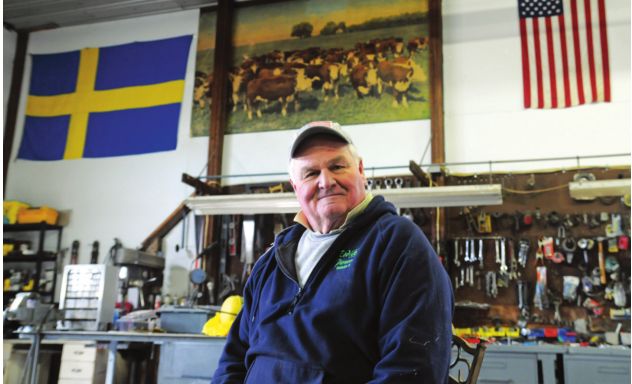
We
can grow corn, we are in a pretty reliable area because of our climate.
We are in a good location because of our transportation system,” Rapp
said. “Illinois has trains that can go both east and west. We have the
Illinois and Mississippi Rivers, and that has been very beneficial for
exports.”
Rapp
appreciates how far he has come and feels he owes a lot to his Swedish
immigrant grandfather who started the family farm, and to his own
father, who continued it.
“I
was able to follow in his footsteps and I have my sons following in
mine. We have some grandchildren and maybe they will too,” Rapp said.
“I’m in a good producing area, I’ve been blessed to have good friends,
good people to work with, a wonderful wife, and it just all adds up.”
Rapp
pays his good fortune forward in several ways. Among other things, he
plants nearly two acres of sweet corn and donates it to Illinois food
pantries. He’s never considered being anything but a farmer, and his
chosen profession continues to be his biggest joy.
“I
think the neatest thing is when you first plant the crop, and you wake
up in the morning and you go out and look down and see those kernels
coming up, and start to see those rows, that’s the first sigh of relief
that it’s going to come out of the ground,” Rapp said. “And the biggest
thrill is when you get in there with a combine and you’re getting a
really good crop, the yield monitor looks good, and you have a big
stream of corn coming out of the unloading auger, well, that’s the
frosting on the cake right there.”
David Blanchette is a freelance writer from Jacksonville and is also the co-owner of Studio 131 Photography in Springfield.


