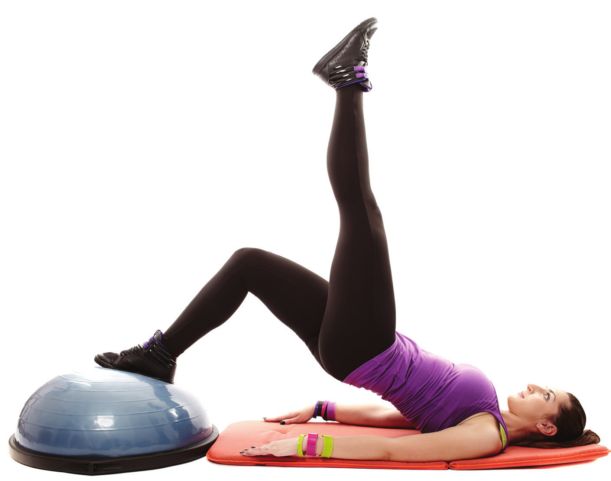
Knee pain is common and may be caused by many things, including sports injury, trauma, repetitive strain or arthritis. Patellofemoral pain occurs when the kneecap does not track properly and causes anterior knee pain. If you have knee pain or other lower extremity problems, you must pay close attention to your hips and the strength of your hip muscles. Your hip muscles, like the gluteus medius, control the position of your thigh and knees. Proper hip strength is critical in preventing and treating knee and lower extremity problems.
In order to understand the connection between knee pain and the hips, one must first understand some basic anatomy. The hip is a ball and socket joint and there are many muscular attachments around the hips that help control the motion of the joint and your leg. The gluteus maximus is the buttock muscle and is a powerful extender of the hip, while the gluteus medius muscle helps to abduct the hip and thigh, or to pull your leg out to the side. When you are standing and walking, the gluteus medius is also active keeping your pelvis level.
When your gluteus medius muscle becomes weak, it allows your thigh to rotate inward abnormally and may then cause increased valgus, or knockknee position. This can affect the entire lower extremity, or what may be called a collapsing kinetic chain. The abnormal position of your thigh causes altered alignment, excessive strain around your knee joint, causing abnormal forces and abnormal position of the patella. It can also predispose to knee ligament problems such as anterior cruciate ligament (ACL) injury.
Injury to the ACL in the knee is a common sports injury which occurs in jumping and cutting sports, and often requires surgical reconstruction and several months of rehabilitation. The ACL is one of two ligaments that cross in the center of the knee joint, connecting the femur (thigh bone) to the tibia (leg bone), and lending stability to the knee. While we do a great job of surgically treating these and other injuries and rehabilitating the athlete to full return, our goal is to prevent these injuries from happening in the first place.
Females tear their ACL at a rate four to eight times higher than males given the same amount of participation exposure.
One theory is related to
hip position and hip function. The anatomy of a female may predispose to
injury, with a wider pelvic bone causing a more exaggerated angle from
the hip to the knee and a more “knock-knee” (valgus) position. Landing
with the knee in valgus increases risk of ACL injury. To correct the
neuromuscular imbalances of athletes and
train them in proper jumping and landing techniques, preventive programs
are available, using a combination of hip strengthening, jump training,
plyometrics, balance, core stabilization and flexiblility.
A
strengthening program to target specific hip muscles can prevent other
knee problems or treat knee pain. If your gluteus medius is weak, your
doctor and physical therapist should prescribe specific exercises to
help
strengthen the gluteus medius. Balance and proprioception exercises are
also beneficial in restoring normal control and position of your thigh.
Resistance bands can be very beneficial and allow focused training, and
use of a Bosu ball or balance board may help to work on muscular control
of your leg and thigh.
A simple screening test
which everyone should try is a single-leg stance, observing the position
of the pelvis and the entire leg during standing and also while doing a
slight knee bend or partial squat while on one leg. Do this in front of
a mirror to observe. Ideally the pelvis should remain level when
standing on one leg, and the hip should remain in line with the knee,
which in turn should remain in line with the ankle. If there is abnormal
tilt or collapse, then hip weakness is present and specific training is
in order.
Activation
retraining exercises for your glute muscles may be necessary, since we
as a population spend too much time sitting. As a result we suffer from
what noted spinal researcher Stuart McGill terms “gluteal amnesia” –
your buttock muscles essentially “go to sleep” and do not function
properly. When your glutes aren’t functioning properly, other muscles
(such as the hamstrings and lumbar extensors) are called in to do the
job of the glutes, mainly hip extension. Inability of activating the
glutes can result in low back pain, hamstring strains, hip pain and knee
pain.
A few specific
hip exercises can help “wake up” the gluteal musculature and correct hip
weakness. To activate your gluteus maximus, a single-leg hip lift
(bridge) is done by lying on the floor with your legs bent, lifting one
foot off the floor, and then pushing through the other foot and lifting
the hips and buttocks up in the air, concentrating on contracting the
glute muscles.
An
exercise designed to activate your gluteus medius and strengthen the
abduction and external rotation is the “clam-shell” exercise using a
rubber exercise band around the thighs just above the knees. Walk
sideways in each direction by striding against the band and then slowly
allowing the other leg to follow.
Another
good exercise for gluteus medius strengthening is a pelvic dip (or hip
hiking). You stand on one leg on a small step, and then dip the opposite
leg down, allowing your pelvis to drop down only a few inches and then
contract the hip on the stance side to bring the pelvis back to level.
Athletes
who performed a hipstrengthening program and also patients with
osteoarthritis have reported improvement in knee pain and achieved
greater gains in hip and core strength, which should decrease
predisposition to future episodes of pain. “Get hip!”

About the author
Diane
Hillard-Sembell, M.D., is a board-certified orthopaedic surgeon at the
Springfield Clinic, specializing in knee surgery and sports medicine.
She earned her undergraduate degree in physical therapy from Northern
Illinois University, where she is a member of the NIU Athletic Hall of
Fame, and she continues to be active with road racing, triathlons and
CrossFit. “Dr. Di,” as she is known by many, has experience with care of
athletes at all levels, from youth to pro athletes, but her real love
is taking care of local high school and collegiate athletes, serving as
team physician. Dr. Hillard-Sembell is passionate about the need for
injury prevention awareness, and continues to do research on ACL injury
prevention. She has been instrumental in the implementation of local ACL
and sports injury prevention programs.


