How Scotch eggs rescued me from a fight
Most of the foods that show
up every year on my family’s holiday table have origins in the culinary
practices of our past generations. Our holiday table has never been a
forum for innovation; it has always been a showcase for our family
traditions. We always have Nana’s creamed spinach. We always have mashed potatoes with gravy and bread stuffing with sage. We always have
suet pudding for dessert. The same smells and tastes from the family
kitchen year after year reconnect us with our roots and trigger pleasant
memories from our past. A notable deviation from our unchangeable
family tradition is the Scotch eggs that started showing up on our
holiday table about 25 years ago.
A
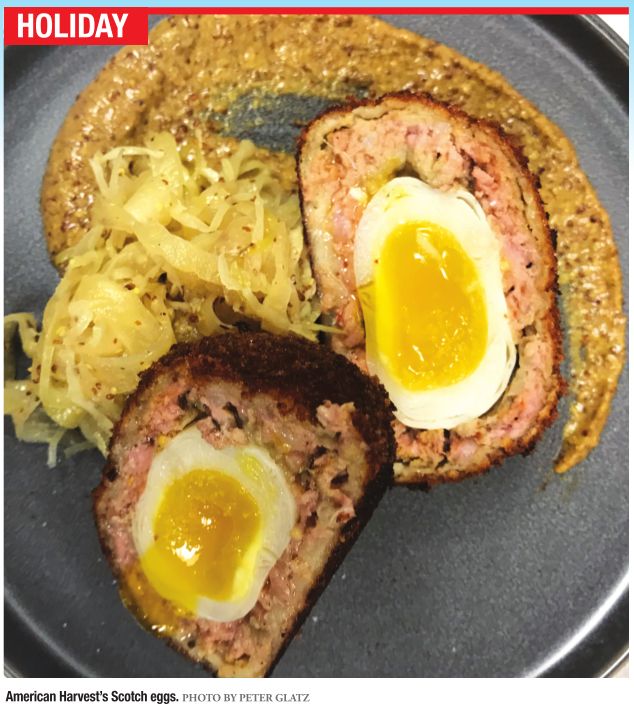
Scotch egg is a hard- or soft-boiled egg wrapped in sausage meat,
coated in bread crumbs and deep-fried or baked. The Scotch egg
originated in the kitchens of the London department store Fortnum and
Mason in 1738 as a portable snack to quell the hunger of wealthy
travelers during their long and arduous carriage rides.
According
to the store’s archivist: “It is a compact snack that required no
cutlery and could be transported easily – even in a pocket, wrapped in a
handkerchief.” The Scotch egg was the historical precursor to our
modern day “fast food.”
In
modern times the Scotch egg is a popular pub snack or a brunch item.
The original Scotch egg was made with small pullet eggs from immature
hens and was covered with forcemeat, a mixture of lean ground meat bound
up with fat. Today’s Scotch eggs are larger and usually made with
breakfast sausage.
I
clearly remember the first time I experienced a Scotch egg. It was the
early 80s and I was with my family vacationing in Disney World. We
stopped for a midafternoon snack at the Rose and Crown Pub in the World
Showcase pavilion at EPCOT. Scotch eggs were featured on the bar menu
and I decided to give them a try. While waiting for my Scotch eggs I
struck up a conversation with a group of young men with interesting
accents sitting next to me at the bar. I discovered they were a visiting
soccer team from South Africa. I had just heard an interview with their
fellow countryman, Archbishop Desmond Tutu, on NPR and I innocently and
naively (but stupidly) remarked to the inebriated white South African
athletes about how impressed I was with what I heard from their black archbishop. I
im-mediately realized I had hit a very raw nerve. They began screaming
at me. “I cannot believe what I am hearing! Desmond Tutu is an evil man!
How could anybody be so wrong?” I knew I was in trouble. I prayed:
“Beam me up Scotty!!!” Security arrived before any fists started flying
and my new friends were escorted away. My heart rate slowed back down
and my hands stopped trembling. I gulped down my beer and ordered
another round. Soon my Scotch eggs arrived: two hard-boiled eggs wrapped
in sausage and deep-fried, served cut in half, with a mustardy
mayonnaise sauce. It was love at first bite!
I was able to locate the Rose and Crown Pub’s Scotch egg recipe in Disney’s 1986 cookbook, Cooking with Mickey Around Our World –Walt Disney World’s Most Requested Recipes. Over the years I’ve made a few changes.
Scotch
eggs can be a bit tricky to make at first and I will share some tips to
avoid problems. One key to success is to make sure the frying oil is
hot. Use a thermometer and heat oil to 350 degrees. If the egg goes into
cold oil, it will become soggy and dripping in fat and won’t develop
the crunchy bread coating. When wrapping the sausage around the egg,
don’t use too much sausage. A thin sausage layer will allow thorough
cooking of the meat without burning the breadcrumb coating. If you cut
into the egg and find that the sausage is undercooked, wrap the egg in
foil and put it in a 350-degree oven. The sausage will finish cooking
without drying out the egg.

Scotch eggs
Recipe adapted from Rose and Crown Pub and Dining Room, England Pavilion, EP- COT
Ingredients:
• 1 pound breakfast sausage
• 5 peeled hard-boiled eggs, chilled
• Olive oil for lubricating hands
• 2 eggs, lightly beaten
• 1/3 cup whole milk
• ½ cup panko bread crumbs
• ½ cup rolled oats
• 1 cup all-purpose flour
• Neutral oil for deep-frying
• Kosher salt
Mustard sauce:
• 1/2 cup mayonnaise
• 3 tablespoons Coleman’s mustard
• 1 teaspoon Worcestershire sauce
• 1-2 tablespoon fresh lemon juice
Preparation:
• Preheat oven to 350 degrees.
• Divide the sausage into 5 equal-sized balls and chill.
• Combine mustard sauce ingredients.
•
Coat your hands and work surface with a thin film of olive oil. Flatten
the sausage balls onto the palm of your hand to a thickness of 1/3
inch.
• Place egg in
middle and wrap the egg with the meat. Pinch edges together and smooth
ball so that there are no seams or openings.
•
Put flour in a shallow bowl. Beat together the remaining eggs and milk
in a second shallow bowl. Combine the panko and rolled oats in a third
shallow bowl.
• Dredge the sausage balls in flour. Then roll into milk-egg mixture. Then roll in panko-oat mixture.
• Add enough oil to deep fryer or saucepan to cover egg. Using a thermometer, heat the oil to 350 degrees.
• Deep-fry the eggs 1 or 2 at a time, keeping the temperature close to 350 degrees.
Fry until eggs begin to brown (about 1 minute), then finish baking in oven about 10 minutes or until sausage is cooked through.
Serve warm or cold with mustard sauce.
The
next public informational seminar presenting the experiences of the
CrossFit Instinct intermittent fasting study will be held on Wednesday,
Dec. 20, at 6 p.m. at Springfield Clinic at 900 N. First St. Free
parking is available in the adjoining parking garage to the north. Enter
into the first fl oor and turn left into the first hallway to the media
room.


