SIU School of Medicine remains a leader among medical schools worldwide
Founded in Springfield in
1970, Southern Illinois University School of Medicine has seen 2,818
students graduate (with 42 percent of those currently practicing
medicine doing so in Illinois). That same year, the medical school –
part of the overall Southern Illinois University system, with campuses
in Carbondale and Edwardsville – began partnering with the former
Springfield Memorial Hospital (now Memorial Medical Center) and St.
John’s Hospital (now HSHS St. John’s Hospital) as part of its mission as
a clinical “safety net” institution, providing health care for
underserved patients throughout central and southern Illinois. Along
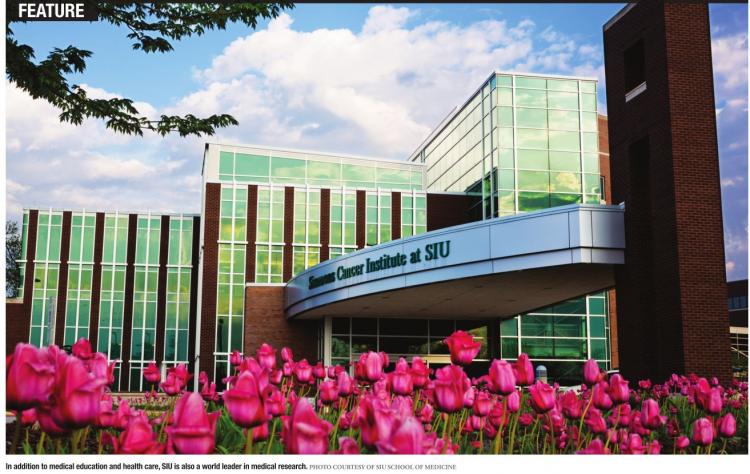
with medical education and health care, SIU is also a world leader in
medical research, with groundbreaking work in the treatment of
Alzheimer’s disease only one jewel in its crown.
“We
are the only medical school in the history of American medicine to get
full, consecutive eight-year accreditations with no citations,” said Dr.
Jerry Kruse, M.D., who serves as dean and provost of SIU School of
Medicine as well as CEO of SIU Medicine, the institution’s clinical
division. Recently, the Southern Illinois University system has
undergone a major administrative facelift, with Kruse having taken over
as dean of the medical school at the beginning of 2016, right around the
same time as Randy Pembroke took over as chancellor at SIU
Edwardsville. Most recently, Carlo Montemagno became chancellor at SIU
Carbondale. “From an academic standpoint, that’s the SIU leadership team
for President Randy Dunn,” Kruse said.
There are other changes in
the SIU air, some administrative, others more cosmetic. “You’ve probably
noticed the change in our brand, from green to purple, along with, the
new logo and the ‘Forward. For You. tagline,” said Dr. Harald Lausen,
chief medical officer at the school of medicine. “We have also initiated
a reporting system internally so that anybody with an SIU email account
can send us a report on anything that they see that is a quality or
safety issue for a patient or an employee.” Lausen says that the number
of reports making their way through the new system is ever-increasing,
but they consider this to be a good thing. “The only way you can work on
improving is if you know what’s going on. It could be something as
simple as, ‘We saw a rip in the carpet over here and we’re afraid
somebody’s going to trip’ or something far more serious. We’re trying to
bring everybody up to a higher level.”
For
the school’s employees, a recognition program called “Forward Together,
” echoing the outward “Forward. For You.” catchphrase, has been
started. Lausen says the program focuses on internal safety and involves
periodic raffles and other rewards.
As
with all Illinois state institutions, the school of medicine suffered
under the recent budget impasse but things are starting to get somewhat
back to normal, according to Kruse. “We’re now operating with state
funding at 12.25 percent less than we did in fiscal year 2014,” he said.
There are a couple pieces that still remain very difficult, he says,
including the fact that the school still hasn’t been paid for care
provided to state of Illinois employees.
“We are now about 500 days behind for that one.” Being a communitybased medical school,
he explained, means that SIU doesn’t own its own hospital, instead
relying on its formal affiliation agreements with Memorial and St.
John’s, which are even further behind on receiving their state payments
than the school is. “Since we work in a collaborative arrangement, when
they have that kind of issue it certainly affects us as well,” Kruse
said. Also included in the new state budget was a significant pension
shift regarding medical doctors, which Kruse said disproportionately
affects schools of medicine beyond other state institutions “Our
teachers are by and large physicians and so that’s been a difficult one
to budget for as well. Our budgetary issues and challenges continue but
they aren’t as bad as they would have been without a state budget for
sure.”

Some things that had been neglected during the state budget
impasse, including leaving positions unfilled, have since been
addressed. “I think we, as an institution, were about to hit the wall
with that – everybody had done about all they could do at that point and
it was good that the budget arrived to release the pressure valve on
those kinds of things for sure,” he said. “A much greater portion of our
entire budget consisted of state funding 10 years ago than it does
right now.”
Lausen
described a recent safety and service program being implemented at the
institution’s clinical sites which has been a particular success. “We go
through, on an ongoing basis, and look for anything that would be a
potential quality or safety risk,” he said. “We’ve had a phenomenal
improvement in our implementation of HIPAA (Health Insurance Portability
and Accountability Act of 1996) privacy issues – we’re much better than
we were and patients are happy about that. We’ve had some really
phenomenal results which at the end of the day results in safer patient
care.”
“When the school of medicine was founded,” Kruse said, “one
of our core foundational principles was social accountability to the
people of southern and central Illinois – that’s 66 counties, 2.2
million people.”
In
the state of Illinois there are two “safety net” state medical schools,
Unversity of Illinois and SIU, with most of U of I’s activity centered
in the Chicago area. “Both schools, as safety nets, are dependent on
additional funding,” explained Lausen. “That means we can see the
disproportionate share of Medicaid and Medicare as well as underserved
patients. That’s who we are there for, ultimately.”
Kruse
has had a front-row seat for the ongoing controversy surrounding the
Affordable Care Act (popularly nicknamed “Obamacare”), including the
national circumstances which led to its creation. “In the late 1990s in
this country, we weren’t positioned very well,” he explained. “Health
care in the U.S. cost a little bit more than in most countries, our
outcomes were a little less than you’d expect for that cost and we had a
lot more people uninsured.” This was followed by a period
which Kruse characterizes as “the decade of shame” for American
medicine, which lasted through 2008. “The gap between the United States,
for the amount spent on health care, became wider and our overall
outcomes – particularly for people aged less than 65 – became
dramatically worse compared to the rest of the world. Our number of
uninsured grew even higher. It got up to almost 50 million uninsured at
one point,” he said.
Given
this, it is unsurprising that Kruse saw the passage and implementation
of the Affordable Care Act in 2010 as a positive development. “The idea
was that it would authorize and appropriate things as a start and that
then there would be a need for continuing, ongoing legislation to fix
some things that weren’t exactly right.” Of course, further legislation
was not forthcoming, and despite the current administration’s ongoing
attempts to repeal the ACA, there continue to be positive outcomes for
SIU’s clinical wing.
“We actively sought out people in the community who would qualify for the health insurance marketplace
or expanded Medicaid and worked very hard to get them signed up,” said
Kruse. “We saw dramatic declines in emergency department use, our number
of uninsured went down by more than 80 percent and bad debt went down
by more than 80 percent.” Kruse said that for the country as a whole the
insured rate is up from 82 percent to about 91 percent, leaving about
28 million still uninsured.

However,
the recent tax proposal currently under review in Congress could lose
any ground gained over the past seven years, according to Kruse, who
points out that every version of the legislation has contained so-called
Medicaid block grants. “This saves the federal government about $340
million over 10 years but shifts almost a trillion dollars, $900
billion, to the states over that period of time by doing these grants,”
Kruse said. “Obviously, that money is going to become a state
obligation.” The Congressional Budget Office (CBO) has reported that
different versions of these plans could cause up to 35 million people
curriculum, often
considered the major piece of a medical school curriculum. “We’ve
changed that to focus on shorter, hard-hitting educational experiences,”
Kruse said “The student will see twice as many patients, they won’t
have any tests at all, there won’t be any lectures and they’ll have a
15-week period of time where they can develop rotations that can help
them with their career choice. All of the outcome indicators are better
than we would have anticipated.”

Recently
the Association of Medical Educators of Europe, which includes 92
member nations, invited two of SIU’s medical students to make a
presentation about that curriculum. “We have amazing students,” said
Kruse. “It was really fabulous. I was there for the seminar and there
were people there representing 24 different nations. The people from
Denmark were really, really excited about it. That program is just
another way in which the SIU School of Medicine moves those things
forward.”
“We
want to continue to increase our path of improvement,” said Lausen.
“The slope that we’ve had so far is good but we want to kick it up a
notch and so we are dedicated to improving our services. There will be
more to come. Keep an eye out for us.”
Kruse
agreed. “With research, clinical service and the systems of care that
we’re delivering to improve the health of communities and the teaching
methodologies that we do, what we have is a well-rounded medical school
that is making a big impact.”

Scott
Faingold’s father, Carl L. Faingold, is a professor and chair in the
SIU Medical School Department of Pharmacology as well as the
longest-serving faculty member in the Southern Illinois University
system. Scott can be reached at [email protected].