The news last week of
Prince Harry’s engagement to Meghan Markle was a welcome break in a
typically tenuous news cycle. During the interview in which they
officially announced their engagement, the couple, clearly smitten with
one another, described the culmination of their courtship as a cozy
evening at home in their cottage, “just roasting chicken.”
“Trying to roast a chicken,” the prince interjects.
It
was a very sweet moment, and in true royal fever fashion, roast chicken
has now gone viral. Maybe I’m being overly optimistic, but this gives
me a warm, fuzzy feeling about the future. Roast chicken is a
fundamental dish to prepare. It is sustaining, nourishing, delicious and
exudes loving care. More people roasting chicken is a good thing.
Roasting
a chicken is beautifully simple and adaptable. One four-pound bird will
serve two hungry people or four alongside other dishes. I often roast
two chickens so there are leftovers to make another meal.
How to roast a perfect chicken If
you can, buy a local, pastureraised chicken. These birds get to stretch
their wings, eat bugs and doze in the sunshine, resulting in a finished
product with authentic flavor and texture. Find them at Food Fantasies
Naturally (1512 Wabash Ave, Springfield) and Willow City Farmstand (731 S
Durkin Dr., Springfield) and directly from farmers through buyers clubs
like Triple S Farms (https://www. triplesfarms.com) and Sugar Grove
Farms (http://www.sugargrovefamilyfarms.com).
When
you are ready to roast, pat the chicken dry and sprinkle a mixture of
coarse salt and pepper inside the cavity (about one teaspoon). I like to
rub a mixture of butter, Dijon mustard, and fresh thyme or rosemary
under the skin of the breast meat, but this is a completely optional
step. Cut a lemon in quarters and place two of them in the cavity, along
with some thyme or garlic if desired. No lemon? No worries! This too is
an optional step that helps to flavor the chicken and keep it moist as
it cooks.
Wedges of lime, orange, apple and onion work well too.
Sprinkle
the outside of the chicken with more coarse salt and pepper from a
height of about six to eight inches. Letting the seasoning rain down
like this helps it to distribute evenly, resulting in a uniform coating
that helps create a delicious, crackly crisp skin.
Next truss the chicken, if you wish.
Trussing
helps the chicken to cook more evenly and results in a polished-looking
dish. If you’re not feeling ambitious, just tie the legs together with
kitchen twine and tuck the wing tips under the body of the chicken. Or,
the chicken can just go in the oven with no tying at all and it will be
fine.
If you’re going for perfect roast
chicken though, it must be trussed. To truss, place the chicken breast
side up, legs away from you on the cutting board. Use your hands to
press and shape it into a nice form, then take a section of string about
30 inches long and slip it underneath the tail of the chicken. Bring
the two ends of the twine up and cross them over the drumsticks, then
pull each side of twine down and under each drumstick to create a figure
eight that can then be pulled tight so that the legs come together.
Pull the ends of the twine toward the neck of the chicken, then wrap
them
around the front of the chicken and over the wings, turning the chicken
upside down and tying the twine off securely under the wing. Place the
chicken breast side up and it’s ready to roast. Many wonderful videos
are available on YouTube showing just how simple it is to truss a
chicken.
Finally,
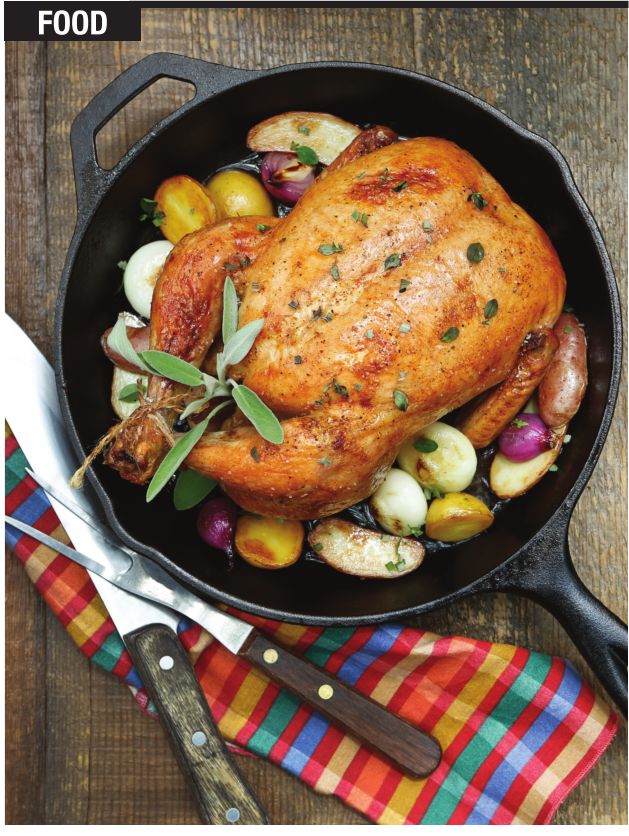
place your chicken, trussed or not, in a large oven-proof skillet and
into a preheated 400-degree oven. Roast for 60- 90 minutes, until the
juices run clear when pierced with a knife in the deepest part of the
thigh, or when the temperature registers 160 degrees on an oven
thermometer. The bird will continue to cook after it is taken out of the
oven, and the temperature will rise to 165 degrees (the safe internal
temperature for poultry) as it rests.
Vegetables
like cut carrots, potatoes and Brussels sprouts can be roasted in the
skillet alongside the chicken. Add them after the chicken has roasted
about 30 minutes so they finish cooking about the same time as the
chicken.
It is
critical that the roasted chicken be allowed to rest for 20-30 minutes
after coming out of the oven. During cooking, the muscle fibers in the
meat firm up and push water out toward the surface, some of which
evaporates during cooking.
Letting the meat rest allows this moisture to redistribute into the
muscle, resulting in a juicy, succulent roast. If meat is cut into
immediately upon removal from the oven, the moisture that has been
working its way to the surface of the meat will run straight out and the
meat will dry out.
Transfer
the meat to a cutting board to rest, and reserve the pan drippings left
in the skillet. Do not place foil over the roast as it rests, as this
will steam the beautifully crisp skin that developed during roasting and
turn it soggy.
While
the meat rests, you can make a pan sauce. Set the skillet with the pan
drippings over medium heat and cook, stirring until the chicken bits
left in the pan turn a deep golden brown, then spoon off all but about 4
tablespoons of fat. You can reserve this excess fat and mix with a dash
of lemon juice or vinegar and minced shallot, then toss with salad
greens to serve alongside the roast. Return the pan with browned
drippings and four tablespoons of fat to a burner over medium heat and
pour in about one cup of white wine, chicken stock, cider or even water.
Boil until reduced by half, scraping up the brown bits in the bottom of
the pan, about 5 minutes. Add any juices that have accumulated from the
resting chickens, then take the pan off the heat. Add one tablespoon
cold butter to the pan and swirl just until butter has melted and caused
the sauce to thicken. If necessary, reheat gently but do not boil or
the sauce will “break” and the butter will separate out.
When
the time comes to carve the chicken, I prefer to use kitchen scissors.
First I cut the wings off, then I cut along the backbone to remove the
leg-quarter. Cut through the leg joint to separate the leg from the
thigh, and place these on a warmed platter along with the wings. Then
use the scissors to cut through the ribs and remove the breast from the
backbone. I like to cut the breast through the breastbone into halves,
then cut each half into quarters. Drizzle the pan sauce over the cut
chicken and serve additional sauce in a dish on the side.
Be
sure to save the bones and carcass from the chicken to make stock (aka
bone broth). Just throw them in a slow cooker along with some onion,
celery, carrot and a bay leaf or two, cover with water and cook on high
for one hour. Turn down the heat to low and let cook for 24 hours, then
strain and use immediately in soup or freeze for later use.
Contact Ashley Meyer at [email protected].