 We welcome letters. Please include your full name, address and telephone number. We edit all letters. Send them to [email protected].
WEAK KNEES CAN’T KNEEL
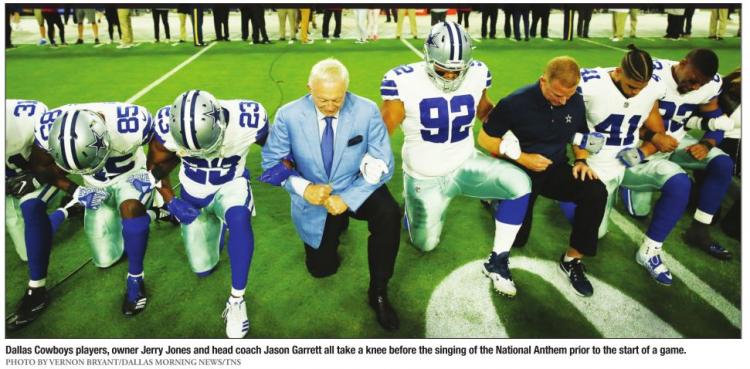
Strong knees bow and kneel boldly for justice. Weak knees will never kneel for justice; they stumble and fall down to every wind and force of power.
To be clear, every football player that took a knee for justice during the National Anthem had strong knees. Their knee bowing is a symbol of every knee that will boldly bow to our Lord Jesus. When men kneel boldly, every earthly force of power is null and void.
There may be confusion in the land, but there is no confusion concerning the brutal killing of young and old black men being killed by white police officers. This injustice has brought strong black men to bow the knee. They may lose their jobs for the sake of justice, but will never lose their integrity.
The haters of justice have twisted the exclusive reason for the knee bowing of strong football players as being unpatriotic. When haters refuse to face the truth, they will try hard to confuse matters. Wisdom speaks loud to the strong by telling them that they will never be able to reason with haters and people with weak-knees. I am glad I have strong knees. Alyce Lyle Springfield
CONCERNING ‘CHECK PLEASE’
We’re not questioning the integrity of the aldermen (“Check please,” Illinois Times, by Bruce Rushton, Oct. 5); we’re questioning how stupid do they think we are about pay to play. Shame on them! MT Lott Springfield
WELCOMING CITY RESOLUTION
Thank you to the three city council members who voted in favor of the
welcoming city resolution (“A welcoming city in the making,” Illinois Times, by
Scott Faingold, Oct. 12). I am disappointed by the vote of the other
city council members to agree to table the resolution. One alderman has
resorted to fearmongering over the nonexistent loss of federal funding
to justify tabling it.
Like
most of you reading this, my family is a story of immigrants. My
greatgrandfathers came to America from Ireland and Germany. They came
seeking a better life for their families. They were greeted not with
open minds but with signs that read “Irish need not apply” and slurs of
“Go home, heine.” Both of them were accused of coming to America to take
American jobs. Both families were Catholic. That raised the issue of
religious intolerance, of my family being papists who, given safe
harbor, would turn America into papal rule. There were no open arms, no
welcome mat and no welcoming attitude.
The
welcoming city resolution proposes a different greeting for our city
and for new immigrants and refugees. It proposes that newcomers to
America will be met with friendship rather than hostility and fear in
our city, the hometown of Abraham Lincoln.
The welcoming city
resolution is about attitude ... not force of law. It proposes putting
out a welcome mat at our front door rather than a locked chain across
it.
I hope that
members of the city council will rethink their positions, bring the
welcoming city resolution back, and vote “yes” for it. Ed Wollet Springfield
THE HOMELESS PROBLEM
I found the letter to the editor about port-a-potties downtown (Illinois Times, Oct.
5) to be interesting in the aspect that I think I am familiar with the
wheelchair man. This guy was at the Route 66 car show, making a scene,
which the Springfield police handled respectfully. This guy, you say,
cannot walk? Well, then I witnessed a miracle as I saw him get out of
the chair and walk. Springfield is trying to make downtown attractive
for residents and tourists alike, and port-a-potties will not improve
the area.
The increase
of homeless came as a result of the closing of the Jacksonville state
and zone centers in Springfield, Bartonville, Decatur, etc. early in the
60s. I can say that as a student nurse doing my rotation in
Jacksonville I saw that it was a village unto itself where people
functioned and had a roof over their heads and food in their tummies.
People worked in various capacities according to their abilities, even
at the farm on the edge of town. Society has created the homeless
problem, and we have to deal with it. Barbara Hopgood Sherman