Going where many filmmakers
would fear to tread, director Denis Villeneuve has ventured into
dangerous territory by making a sequel to Ridley Scott’s Blade Runner with Blade Runner 2049, a
lavish continuation of the cult sci-fi classic that manages to be an
improvement on the original. I know this opinion will be seen as heresy
by that film’s legion of fans, but even after a recent viewing, I found
the movie to be far too slow and emotionally distant. While Villeneuve’s
movie does overstay its welcome, it proves to be a more poignant
exercise as it delves more effectively into the question of what it
means to be human, while containing more than a few surprises that
spring organically from this continuing narrative.
Set
some 30 years after the events of the first film, blade runners still
exist, though most of the rogue replicants have been rounded up while
new models have been made with failsafe mechanisms that prevent them
from rebelling. Under the command of Lieutenant Joshi (Robin Wright),
blade runner K (Ryan Gosling), a synthetic himself, is assigned to track
down older models that have gone their own way and live in seclusion.
While taking down one such synthetic (Dave Bautista), K stumbles across a
grave that contains the skeleton of a woman who is determined to have
died during childbirth.
This
the jumping-off point to a story that, like all film noirs, is consumed
with narrative and physical shadows that reluctantly give up their
secrets, each proving to have sprung organically from the story, none of
them being the least bit trite or manipulative. K’s journey for answers
– as it is soon discovered that there’s much more to do with those
human remains than initially thought – takes him out of the perpetually
gloomy Los Angeles to the boundaries of civilization and beyond, until
he ends up in a deserted Las Vegas that is inhabited solely by Rick
Deckard (Harrison Ford), who may have the answers he seeks.
Visually, Villenueve, production designer Dennis Gassner and cinematographer Roger Deakins have created a
worthy successor to Scott’s groundbreaking original. The vision here is
equally dank and wet; the buildings soar to the heavens, crushing the
spirit of those who walk among them, while the advertising holograms
have become more risqué. But it’s when the action shifts away from the
city that this trio gets to put their distinctive stamp on this world,
creating a landscape of ruins littered with massive structures reduced
to rubble, indicative of the wasted potential and broken dreams of this
world. It’s an immersive experience that never feels less than genuine.
The
question of what makes us human was touched upon in the original, but
screenwriters Hampton Fancher and Michael Green wisely bring it to the
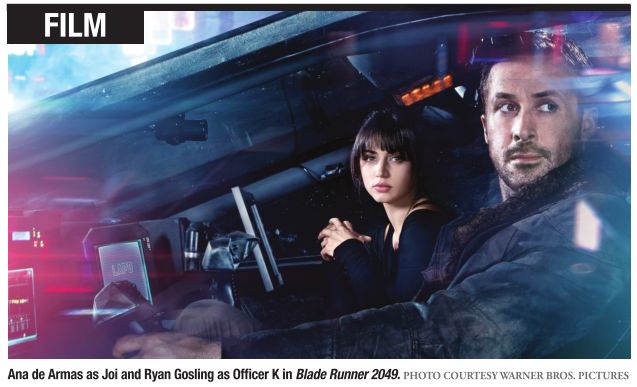
forefront here. While K is aware that he’s a replicant, he still longs
to experience life as a human being, yearning most of all to feel
genuine love. On the rare occasion he comes home to his shabby
apartment, he’s met by Joi (Ana de Armas), a beautiful young woman who
prepares dinner for him while engaging in “How was your day?” banter.
Unfortunately, Joi is a holographic replicant, and despite the couple’s
efforts to create a romantic, domestic relationship, they will always
fall short. Their yearning for this and the lengths they go to in order
to realize them prove surprisingly poignant and effectively remind us of
our own humanity.
While many of the recent reboots have felt like opportunistic exercises made to prey on viewers’ sense of nostalgia, Blade Runner 2049 is
a rich, thought-provoking continuation that benefits from the passage
of time. Much more than just a visual exercise, this hypnotic film
transcends its genre roots to become a commentary on the importance of
personal connections – real or imagined – in an impersonal world.
Contact Chuck Koplinski at [email protected].
For a review of American Made, go to the Cinemascoping blog at http://illinoistimes.com.


