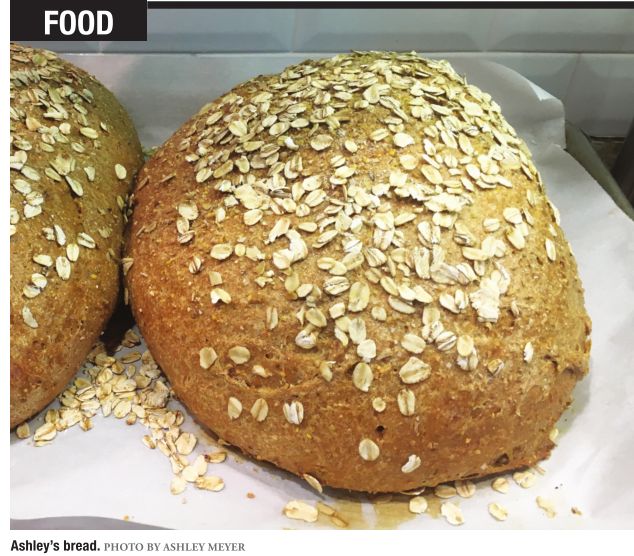
Bread and I have always had
a tenuous relationship. I had dreams of crusty artisan loaves and soft,
pillowy rolls, but at a certain point, every attempt produced leaden
bricks. It wasn’t until late one night, when I couldn’t sleep and I
decided to watch old Baking with Julia Episodes on PBS that I
seemed to discover the keys to producing satisfying yeasted goods. While
sharing her kitchen with bakers such as Marion Cunningham, Gale Gand,
Nancy Silverton and Joe Ortiz, Julia Child helped to demystify the
secrets behind a wide range of great baked goods. (Full episodes of
baking with Julia are available to watch at http://www.pbs.org/food/julia-child/juliachild-video-collection.)
Baking
with yeasted products is different than baking cookies and cakes.
Precision is still important, and care should be taken when measuring,
but at a certain point you just have to let the dough talk to you.
Watching those master bakers manipulate perfectly elastic rounds of
dough out of flour and liquid, I was able to see the distinctions in
various stages of readiness in the dough as it came together. It became
clear that I had been making a few key mistakes when baking bread, and
since then I am able to reliably produce deliciously soft, whole-grain
rolls and sandwich breads.
I
haven’t spent much time playing around with baking crusty, free form
artisan breads, mostly because Springfield has such a wonderful local
bakery where I can purchase them. Patrick Groth has been delighting
central Illinois with European-style breads since 1995 at his bakery,
Incredibly Delicious. The breads and croissants he and his bakers
produce are truly some of the best I’ve ever had, rivaling much of what
I’ve tasted in Europe.
I
stopped by Incredibly Delicious to speak with Nathan Powers, one of the
artisan bakers who helps to produces those perfectly crusty loaves.
“Many people don’t realize that it’s not actually that difficult
to make these types of artisan breads. A lot goes into the preparation,
making sure you have every single thing you need, and that you’ve read
the recipe through to the end two or even three times. What I love about
baking here is that we use a hearthtype oven that has a stone bottom.
This allows you to control the heat from both the top and the bottom, so
I would definitely recommend using a pizza stone when baking artisan
breads at home.”
Another
tip that Powers shared is to place a water bath on the bottom rack of
the oven underneath the bread as it bakes, to get a little bit of steam
going. “The steam helps to create a nice solid crust on the bread, the
kind that crackles when you break it open.”
No
matter what type of bread you’re interested in baking, there are some
universal tricks that can help us all to become better bakers. King
Arthur Flour has excellent resources on their website, and if you read
through to the comments with each recipe, King Arthur bakers often reply
to the comments with helpful tips and ideas. I’ve outlined some
concepts to keep in mind should you get the urge to roll up your sleeves
and try your hand at home bread-baking. • Weigh your ingredients.
Professional bakers and many home bakers rely on a kitchen scale to
measure ingredients, rather than measuring by volume with a cup measure.
Depending on how you scoop
flour out of the bin, the weight of a cup of flour can vary greatly. It
also speeds up the process, as you don’t have to pull every measuring
cup out of the drawer just to produce a batch of rolls. Set your mixing
bowl on a scale, then zero out the scale. Add the required weight of an
ingredient, then zero the scale again, then measure in your next
ingredient, zero the scale and so on. Liquids can be measured by weight
also. This is a much more accurate way to measure, and conveniently, all
the recipes available on www.kingarthurflour.com can be viewed in volume, ounces or grams. Kitchen scales are widely available for about $15-$20.
•
Temperature is a critical factor. Yeast is a living thing, and drastic
fluctuations in temperature can inhibit or even kill yeast, preventing
your bread from developing flavor and rising. An inexpensive kitchen
thermometer is useful for checking the temperature of liquids. Most
bread yeast thrives at around 110 degrees, which should feel barely warm
to the touch. Ambient air temperature plays a critical role in the
rising time of breads. The warmer the air temperature, the faster the
bread will rise. Last week when the temperatures were in the ’90’s, the
bread dough I had made was ready to punch down in just 45 minutes, about
half its normal rising time. A slower rise at a cooler temperature
always results in a more flavorful loaf, and many breads will benefit
from rising slowly overnight in the fridge, allowing you to prep them
ahead (which is very helpful when preparing an elaborate meal like
Thanksgiving dinner).

•
I often add about 3 tablespoons of Vital Wheat Gluten with Vitamin C
(available from Hodgson Mill) in with my flour. Gluten is the protein
that gives breads their structure and helps to add loft to the loaves.
Vitamin C (ascorbic acid) acts as a natural preservative and will help
keep the finished loaf fresher, longer.
•
When making a batch of bread dough, especially whole wheat breads, I
like to mix the ingredients together initially with a sturdy wooden
spoon until they just come together. I then let the shaggy dough rest
for 5 minutes before kneading it for 5-7 minutes with a dough hook in my
stand mixer. That five-minute resting period allows the flour to fully
absorb the liquid before the kneading process begins. Whole wheat flour
takes longer to absorb liquid than white flour, and dough that may have
looked as though it needed additional flour simply needed extra time to
absorb.
• I like to
let my dough rise in a large glass measuring bowl so that I can track
its progress and accurately see when it has doubled. When your dough has
completed its first rise (usually about 2 hours at 70 degrees for basic
bread recipes), it should have doubled in bulk. Punch it down with your
fist in one sure movement to deflate the gas bubbles that have formed
in the dough. At this point it is important to treat the dough with
respect, so as to not destroy the beautiful network of gluten.
•
I always use a kitchen thermometer to check loaves for done-ness,
looking for a temperature around 195-200 degrees. There’s nothing worse
that ruining a perfectly good loaf of bread by pulling it out of the
oven too soon.
Bread
baking is an immensely satisfying endeavor, and a wonderful activity to
make with children. Home-baked bread not only has wonderful flavor and
aroma, but it’s also free of noxious preservatives, dough conditioners
and stabilizers. At a cost of about $1 per loaf, making your own bread
is economical as well.
Contact Ashley Meyer at [email protected].


