In 1831, Abraham Lincoln
arrived in New Salem as a penniless young laborer who took on a variety
of odd jobs, including manual labor, to support himself. His experience
in the village gave him the confidence, social connections, and work
experience necessary to climb out of poverty and become a successful,
professional gentleman. Just over a century later, during the depths of
the Great Depression, the Civilian Conservation Corps gave another group
of poor, single young men the opportunity for a better life through
manual labor at New Salem.
The
town had already started to wane by the time Lincoln left for
Springfield in 1837. In 1839, nearby Petersburg was named the seat of
Menard County, and within a year New Salem was all but abandoned. By
1866, a single log cabin was all that remained of the once-thriving
town; a few years later, that too was gone.
The
legend of Lincoln’s time in the town persisted, however, and the site,
though abandoned, was never forgotten. With a few decades after
Lincoln’s death, people were making “pilgrimages” to the town’s site to
connect with Lincoln’s
spirit. Newspaper magnate William Randolph Hearst was so taken by
Lincoln’s connection to the site that he purchased it in 1906 and
donated it to the Old Salem Chatauqua Association.
Interest
in New Salem grew with the Illinois Centennial celebration of 1918, and
that year the village site was donated to the state of Illinois with
the goal of one day reconstructing the village. In 1932, work began on
rebuilding the village’s original buildings, using research into plats,
biographies, letters and reminiscences, as well as archaeological
excavations of the foundations to inform their work. Taking place as it
did during the Great Depression, the reconstruction of New Salem was a
source of local pride. Residents of Menard County looked to their
pioneer heritage as an example of how their ancestors had worked hard
and succeeded at overcoming economic hardships.
Certainly
Americans of the 1930s were familiar with economic hardships. By 1933,
25 percent of the American workforce was unemployed. Those who did have
work saw their wages cut. Foreclosures, bread lines, garbage picking and begging became common facts of life.
In
1933, President Franklin Roosevelt created the Civilian Conservation
Corps (CCC) to give work to unemployed men while at the same time
improving the country’s infrastructure and natural resources. During its
nine-year run, more than 2.6 million young American men lived in CCC
work camps, where they were paid a dollar a day for their unskilled
labor. Of those, more than 92,000 served in Illinois at one of the
50-plus camps that operated within the state. Illinois CCC workers
planted trees, worked with farmers on soil erosion control, restored
river banks, cleaned out ditches, constructed roads and bridges and
brought electricity to rural areas. The CCC also built state parks,
including Giant City, Fox Ridge, Kickapoo, White Pine, Mississippi
Palisades, Illini and Matthiessen.

By
the summer of 1934, the director of the Illinois Department of Public
Works and Buildings, Robert Kingery, announced his intention to locate a
CCC camp at New Salem to finish the reconstruction of historic
buildings and do other work to improve the park. The camp opened at the
end of August with 216 enrollees, mostly men from northern Illinois.
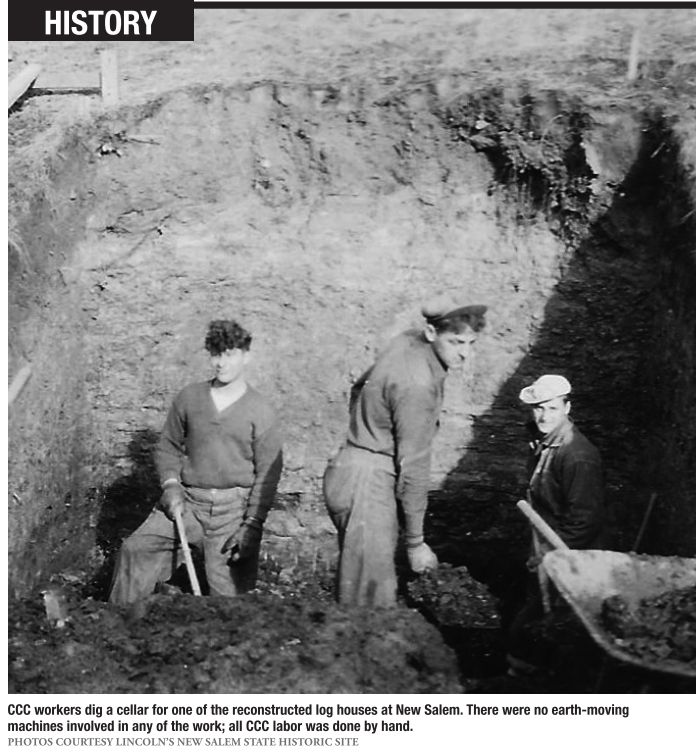
Over the next seven years, the “dollar-a-day boys” reconstructed seven
log houses, a carding mill and a sawmill/ gristmill. They also built
fences, hiking trails, shelters, a sewage treatment plant, an open air
theater and a
restaurant. Indeed, the New Salem that visitors experience today is
largely the result of CCC labor, right down to the hundreds of trees
planted in and around the historic village. Ironically, in Lincoln’s day
the village site was likely barren of trees, as they would have been
felled to provide fuel and building material.
In
celebration of its lasting CCC legacy, New Salem State Historic Site
will welcome Michigan-based author/songwriter Bill Jamerson to its
visitors’ center on Thursday, Oct. 12, at 7 p.m. to present “The CCC
Boys of Lincoln’s New Salem: A Musical Tribute to the Civilian
Conservation Corps.” This hour-long program will include excerpts from
his historical novel Big Shoulders, about a teenager who joins the CCC; clips from his documentary Camp Forgotten - The Civilian Conservation Corps in Michigan, and live performances of original songs from his CD Dollar-a- Day Boys: Songs of the CCC. Some of the songs performed in the program include Chowtime, a fun look at the camp food, City Slicker, which tells of the mischief the young men get into in the woods, and Wood Tick, about the nicknames the locals gave the enrollees.
Erika
Holst is a local writer and historian. Her grandfather, Alois Rozinek,
leased his team of horses to the CCC to create Lake MacBride in Johnson
County, Iowa, during the Great Depression.