The tranquil lower Illinois
River valley, roughly the 71-mile stretch from Meredosia to where the
river meets the Mississippi near the southern end of Calhoun County,
belies its more turbid past. In the last 50,000 years, two fluvial
episodes particularly affected the formation of the river valley seen
today. Prior to about 20,000 years ago, the then-mightier Ancient
Mississippi River flowed through the lower half of the current Illinois
River valley, which broadened its width. The second valleyshaping event,
about 19,000 years ago, was the Kankakee Torrent. When an ice dam and a
blockade of moraines gradually eroded and finally catastrophically gave
way, unimaginably massive amounts of glacial meltwater roiled down the
length of the Illinois River. While the height of the torrent likely
lasted but a few days, the frigid, turbulent waters scoured the valley
walls and swept the largest boulders and smallest sands downstream. The
outflow soon slowed, depositing first its boulders and eventually the
sands in the Illinois valley, as its force became spent.
Today,
the lower reaches of the Illinois River descend barely an inch each
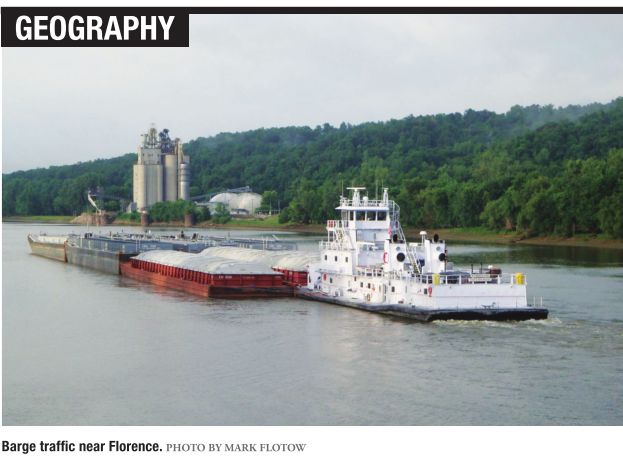
mile. The river waters, which carry both commercial barges and pleasure
boats, reside in a lock-and-dam controlled channel that now looks
curiously small compared to the generally three- to fourmile span from
eastern to western blufftop.
(The
only lock-and-dam on the lower Illinois River, built in 1939, is just
north of Meredosia, with the rest of the lower river controlled by those
built for the Mississippi River, such as at Alton.) The barges carry
coal, petroleum and agriculture products, potentially from Lake Michigan
to the Gulf of Mexico. In early historic times (and likely also in
prehistoric periods), this stretch of the river carried people and goods
in small
watercraft from the Peoria area to the Mississippi River and the St.
Louis region. There also is a tremendous amount of prehistoric
archaeological evidence that the lower Illinois valley had been occupied
for thousands of years by various native peoples who exploited its rich
riverine resources. Pre-European occupations and activities are
displayed at the Center for American Archeology’s museum in Kampsville.
The Center also conducts archaeology field schools in the summer.
The
Illinois Department of Transportation currently operates two free, 24/7
ferries (in lieu of bridges) on the lower Illinois valley – one at
Kampsville and the other near Grafton and Brussels at the river’s mouth,
both of which connect Calhoun County to parts east. Calhoun County’s
western boundary is the Mississippi River and, along with the Illinois
River, sometimes this peninsular piece of land is referred to as “The
Island.” Versions of the Kampsville ferry have been functioning since at
least the Civil War era, prior to its state operation. It is no
surprise, then, that this county has no railways, and it is rural enough
to have no traffic lights.
Like
many large rivers, the Illinois overflows its banks from time to time.
Many readers may well remember the last large-scale flood in 1993. In
some places at its highwater mark, floodwaters stretched across the
entire width of the valley. Just beyond the eastern end of the Florence
bridge there is a modest highway marker thanking some of the people who
worked on flood control.
Portions
of the lower Illinois valley contain quarries yielding gravel and sand.
The sand is from the Kankakee Torrent’s direct deposition as the
flood(s) waned, from pre-flood glacial outwash (especially south
of Peoria), and some subsequent wind-blown redeposition into dunes onto
terraces. A modern consequence of that is some Illinois valley farmlands
require irrigation because of their well-drained sandy soils.

There are a number of other local features and histories in and around the valley. Here is a small smattering.
•
Pearl, in southeast Pike County, was a shirt button manufacturing
center about 100 years ago, when Illinois River mussels were harvested
for the iridescent qualities of their shells.
•
The Eldred-Bushnell cemetery, in Greene County, is perhaps the only
small-acreage set of graves that has a 55 mph thoroughfare (Hillview
Road) through its middle. The accessible, flood-resistant terraces,
which often are adjacent to the base of towering limestone bluffs, by
necessity have become shared prime real estate for homes, roads and even
cemeteries.
• If
during travels in the area you lose track of Time, it would be hardly
surprising. With less than 30 residents, Time, four miles west of Pike
County’s Milton, is one of the state’s smallest incorporated places.
However, Valley City, also in Pike County, has half as many residents
and is quite possibly Illinois’ least populated incorporated place.
•
The Illinois River bridge at Florence, built in 1929, was once part of
U.S. Route 36 until I-72 usurped that designation via its Valley City
Eagle Bridges, around 1991. The Florence bridge has a “vertical-lift
through truss” design that raises for the passage of river barges.
If
you plan to travel through the lower Illinois valley area, you might
consider also visiting the nearby county seats of Pittsfield (Pike
County) and Winchester (Scott County). Pittsfield is the self-proclaimed
pork capital of the Midwest. It hosts an annual “Pig Days” festival,
held in July. Abraham Lincoln occasionally stayed in Pittsfield while
practicing law. Winchester was home to Stephen Douglas in the 1830s,
when he was a schoolteacher, before becoming a lawyer.
Like the river through the valley, take your time to enjoy the journey.
Mark Flotow of Rochester is a frequent contributor to Illinois Heritage magazine,
a publication of the Illinois State Historical Society, where this
article first appeared. It is reprinted with permission.


