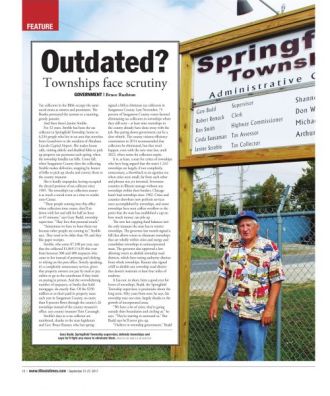
Tax collectors in the Bible
occupy the same social strata as sinners and prostitutes. The Beatles
portrayed the taxman as a taunting, greedy parasite.
Tax collectors in the Bible
occupy the same social strata as sinners and prostitutes. The Beatles
portrayed the taxman as a taunting, greedy parasite.
And
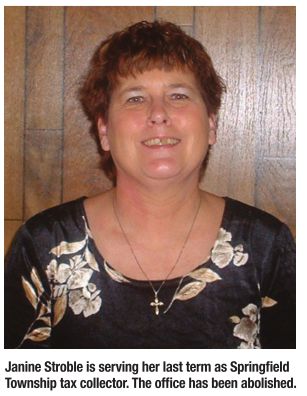
then there’s Janine Stroble. For 32 years, Stroble has been the tax
collector in Springfield Township, home to 6,234 people who live in an
area that stretches from Grandview to the outskirts of Abraham Lincoln
Capital Airport. She makes house calls, visiting elderly and disabled
folks to pick up property tax payments each spring, when the township
handles tax bills. Come fall, when Sangamon County does the collecting,
Stroble makes deliveries, stopping by homes of folks to pick up checks
and convey them to the county treasurer.
She
is hardly unpopular, having occupied the elected position of tax
collector since 1985. The township’s tax collection season is as much a
social event as a time to render unto Caesar.
“These
people coming into this office when collection time comes, they’ll sit
down with her and talk for half an hour or 45 minutes,” says Gary Budd,
township supervisor. “They love that personal touch.”
“Sometimes
we have to boot them out because other people are coming in,” Stroble
says. They tend to be older than 50, and they like paper receipts.
Stroble,
who earns $7,100 per year, says that she collected $1,049,114.85 this
year from between 300 and 400 taxpayers who came to her instead of
pointing and clicking or relying on the post office. Strictly speaking,
it’s a completely unnecessary service, given that property owners can
pay by mail or pay online or go to the courthouse if they insist on
paying in person. And the overwhelming number of taxpayers, or banks
that hold mortgages, do exactly that. Of the $350 million or so that’s
paid in property taxes each year in Sangamon County, no more than 8
percent flows through the county’s 26 townships instead of the county
treasurer’s office, says county treasurer Tom Cavanagh.
Stroble’s
days as a tax collector are numbered, thanks to the state legislature
and Gov. Bruce Rauner, who last spring signed a bill to eliminate
tax collectors in Sangamon County. Last November, 75 percent of Sangamon
County voters favored eliminating tax collectors in townships where
they still exist – at least nine townships in the county already have
done away with the job. But paring down government can be a slow
whittle. The county citizens efficiency commission in 2014 recommended
that collectors be eliminated, but that won’t happen, even with the new
state law, until 2022, when terms for collectors expire.
It
is, at least, a start for critics of townships who have long argued
that the state’s 1,432 townships are largely, if not completely,
unnecessary, a throwback to an agrarian era when cities were small, far
from each other and phones not yet invented. Seventeen counties in
Illinois manage without any townships within their borders. Chicago
hasn’t had townships since 1902. Cities and counties elsewhere now
perform services once accomplished by townships, and some townships have
seen coffers overflow to the point that the state has established a cap
on how much money can pile up.
The
new law capping fund balances isn’t the only measure the state has to
restrict townships. The governor last month signed a bill that allows
voters to eliminate townships that are wholly within cities and merge
and consolidate townships in unincorporated areas. The governor also
approved a law allowing voters to abolish township road districts, which
have taxing authority distinct from whole townships. Rauner also signed
a bill to abolish any township road district that doesn’t maintain at
least four miles of roadway.
It
has not, in short, been a good year for lovers of townships. Budd, the
Springfield Township supervisor, is pessimistic about the long term.
Fifty years from now, he says, his township may not exist, largely
thanks to the growth of incorporated areas.
“We
have a lot of cities, they’re going outside their boundaries and
circling us,” he says. “They’re starting to surround us.” But Budd says
he’ll never give up.
“I believe in township government,” Budd says. “The way people are
putting this out, it sounds like there’s a lot of duplication. But you
can’t duplicate the personal touch. I’m going to fight this until the
cows come home.”
Bursting coffers
Townships in Illinois never have won universal acclaim. Consider the take of the Illinois Journal in 1849, when a new state constitution allowed for the creation of townships by popular vote.
Prior to a public vote, the
Springfield newspaper published a primer on the new form of government,
explaining the basics. The township would employ a supervisor, an
overseer of the poor, constables, an assessor, highway commissioners and
as many poundmasters (an old-fashioned term for folks tasked with
confining stray animals) as needed. Anyone elected to a township office
who refused to serve would be fined $25, save for recalcitrant
pound-masters and overseers of the poor, whose fines for refusal to
serve were set at $10. Noting that state enabling legislation setting
the rules for townships ran to 34 pages, the paper near the end of a
lengthy front-page article gave up trying to explain the finer points.
“We
have only reached the ninth section (of the law),” the author wrote.
“Persons wishing to make themselves fully acquainted with this matter
had better examine the law at length. Our own opinion is that counties
hereabouts are not in a situation to adopt this new system.”
Nonetheless,
townships soon became common throughout Illinois, ushered into being
with the promise of hyper-local government that would be more responsive
to the wishes of constituents than distant officeholders in faraway
county seats or the state capital. It never has been a perfect system.
In
1878, the Sangamon County board of supervisors, thanks to an enabling
law from the legislature, created Capital Township, with borders
matching the city limits of Springfield. The rationale was fairness.
Three-quarters of the taxes paid by Springfield Township residents came
from property within the city, but residents from outside the city
controlled how the money was spent, proponents of the new township said.
City residents, creators of Capital Township decreed, should decide how
to spend money from taxes generated by property within city limits.
Nearly
140 years later, the township could face a reckoning, thanks to a new
state law that allows voters in Capital Township and 16 other of the
townships in Illinois that are wholly within cities to abolish
townships. Under the law that takes effect in January, voters could
abolish such townships if both city councils and township boards agree
to put referendums on the ballot. While townships in rural areas are
responsible for maintaining roads, townships that share borders with
cities with street departments have few duties.
Since
2014, Evanston and Belleville have eliminated townships wholly within
municipalities. In Belleville, where township trustees in 2016 voted to
dissolve the township effective last spring, the township had few duties
other than dispensing money to the poor. With more than $500,000 in
revenue, less than $203,000 was spent on welfare and social programs
last year while nearly $285,000 went for administrative and overhead
costs. For years, the township, which had 10 employees, took in more
than it spent. By the end of fiscal year 2016, more than $850,000 had
accumulated in township bank accounts, enough to run the township for
nearly two years.
Belleville
wasn’t alone in socking away money. Capital Township, where the owner
of a $150,000 home pays $44 a year to the township in property taxes,
had a fund balance of more than $2.1 million at the end of fiscal year
2016, when the township took in more than $2.3 million and spent
slightly more than $2.2 million.
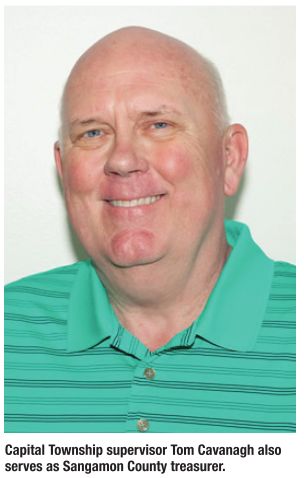
Cavanagh,
the county treasurer who is also township supervisor, points out that
township taxes have been reduced – 10 years ago, the owner of a $150,000
home paid $51 a year to the township. Cavanagh doesn’t see a problem
with having nearly as much money in the bank as the township spends in a
year.
“We’ve always
thought it was prudent to have about that amount of money on hand,”
Cavanagh said. “We would not let our fund balance grow to an
inappropriate level. I believe our auditors have said it’s reasonable.”
But
60 miles southeast of Shelbyville, overflowing coffers have helped
prompt an overhaul of the Shelbyville Township board as well as a change
in state law.
Over
the years, Shelbyville Township, which collects more than $530,000 in
taxes each year, accumulated nearly $1.4 million in fund balances as of
the end of its fiscal year in 2016, according to Illinois comptroller
records. With so much money on hand and few ways to spend it (the
township, which has 13 employees, spent $163,370 on roads, $18,570 on
social services and $187,557 on administration in 2016), the township
board became generous in ways not envisioned when townships were created
in the 19 th century.

Shelbyville
Township in recent years has given money, including cash from the road
fund, to the American Legion, the local chamber of commerce, the Boy
Scouts, youth athletic groups, a charity aimed at combating cystic
fibrosis and a local meat shop that put together food baskets for the
disadvantaged. The township helped pay for a post-prom party aimed at
keeping high school students out of trouble. Shop With A Cop, a program
that sends at-risk kids on Christmas shopping sprees with officers, got a
$1,000 check. As much as $29,300 was donated to causes deemed worthy by
the township in a single year, according to township financial records
and Edgar County Watchdogs, a government watchdog group that blew the
whistle.
Lawmakers
took notice. In early September, Gov. Rauner signed a bill limiting the
amount of money that townships can accumulate in funds (with capital
funds
excluded). It is, to be sure, a generous limit. Under the new law,
townships cannot accumulate in any given fund more than two-and-a-half
times the average annual expenditure over the previous three years. In
Shelbyville, some township funds have 50 times the amount that’s
typically spent in a year, says state Rep. Brad Halbrook, R-Shelbyville,
whose wife became a township trustee earlier this year after a board of
Democrats was voted out.
The
move to cap fund balances was bipartisan, with state Rep. Carol Ammons,
D-Urbana, cosponsoring the bill with Halbrook, who figures that
Shelbyville Township has squirreled away about 10 times the amount of
money that it needs. A 1969 state Supreme Court decision already
established caps on how much money government can accumulate, Halbrook
says, but now that there’s a law, folks are paying attention.
Mike
Holland, who was named Shelbyville Township supervisor in July, says
that the township may send checks to taxpayers to comply with the
statutory limit on fund balances. “We’re going to be in a situation
where, yes, we’re probably going to have to do some rebates,” Holland
says. “Honestly, without going back and looking at financial reports, I
don’t know the total. There are some accounts that are way over.”
Making
charitable contributions with township funds wasn’t right, Holland
says, but it also wasn’t nefarious. Former township officials simply
didn’t know the law, he explains. “What those folks were doing, in their
mind, was OK,” Holland says. “There was girls softball. There was boys
baseball. Food baskets for folks who didn’t have much at Christmas time.
That all sounds wonderful, except that it wasn’t legal. … We’re going
to learn the law. We’re going to try to do it the way it’s supposed to
be done.”
Urban vs. rural
Along with maintaining roads and providing for the poor, townships are tasked with assessing property.
In
Springfield, which has the same borders as Capital Township, the job of
assessing property is statutorily intertwined with county government.
The Sangamon County treasurer is also the township supervisor and tax
collector, thanks to state law, while the county clerk is also the
township’s assessor.
“(Sangamon
County clerk) Don Gray and I are unique, inasmuch as we are township
officials, based on our elected county status,” says Cavanagh, the
county treasurer. “We’re the only ones like that in Illinois.”
State
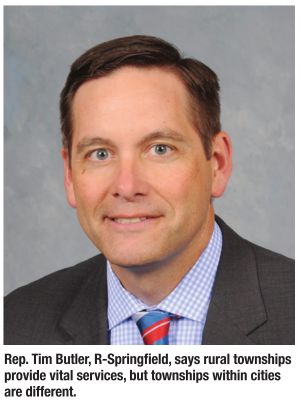
Rep. Tim Butler, R-Springfield, who sponsored the bill that eliminates
township tax collectors in Sangamon County, says that townships in rural
areas are fundamentally different than townships in cities. Beyond
keeping roads paved and plowed, rural townships supply accountability,
he says, and it’s easy to complain if jobs don’t get done. “Folks in
rural areas have a different view than in urban areas,” Butler says. “In
a lot of rural areas, township government is your lowest common
denominator, in a way. You can’t call your alderman.”
Jim
Donelan, a Springfield alderman who is executive director of the
Township Officials of Illinois Risk Management Association that provides
insurance to townships, defends both urban and rural townships.
Donelan, who sat on the citizens efficiency commission that recommended
the elimination of township tax collectors in Sangamon County, allows
that fund balances in some townships may appear high, but that can be a
function of townships saving up to buy equipment. In Sangamon County,
Donelan says, townships are responsible for maintaining 1,100 miles of
roadway while the county takes care of 254 miles of road, and the average township road commissioner is paid $29,000 per year.
“We
(the citizens efficiency commission) had a dialogue with the county
engineer, who basically said, ‘We cannot handle the responsibility of
1,100 miles of roadway,’” Donelan says. “We found that townships are
doing a pretty darn good job with a little bit of money.”
Counties
aren’t clamoring to take responsibility for rural roads, Cavanagh says.
While township tax collectors aren’t needed, assessors are another
thing, he said. Someone, after all, needs to figure out what property is
worth, he notes.
“A lot of people have
positions on township government,” Cavanagh said. “In a lot of cases,
they don’t go very deep below the surface and realize that these are
indispensable services that have to be performed.”
Still,
there remains an urge to eliminate or consolidate townships, with
lawmakers and government reform advocates questioning the need for
townships that share borders with cities (better known in government
circles as “coterminous” townships). “I think coterminous townships,
especially, are something we need to take a hard look at,” Butler says.
“The idea that the county can provide a lot of the same services that
Capital Township provides is a good idea to talk about.”
For
practical purposes, the county and township already have morphed into
one entity, says Brian McFadden, county administrator, given that
assessments are done by the county clerk, the county treasurer is the
township supervisor and payroll and other human resources tasks for the
township are handled by the county.
“From
my viewpoint, Capital Township and the county are already merged, just
unofficially,” McFadden says. “We’ve walked down the aisle. I don’t know
if we’ve said ‘I do’ in front of the priest yet. … Everything that a
township does, the county does as well.”
While
the county administers programs that help folks with heating costs and
weatherization expenses, it does not provide help to the poor on the
scale of Capital Township, which last year provided slightly more than
$1 million in assistance to folks who had no other place to turn. Last
year, nearly 46 percent of the township’s expenditures went for welfare,
often on behalf of folks who didn’t have money for rent or utilities –
the township writes checks directly to landlords and utility companies.
It is not, the township says, an automatic handout.
“A
lot of our work is vetting,” says Kathe Pierce, director of the
township’s general assistance program. “We’re here to help as long as
you meet our guidelines. Sometimes, we’re not dealing with honest
people. They’re desperate. I don’t want to say they’re making up
stories, but they’re leaving out information that’s important to us. I
would love to be able to believe everybody who walks through the door.
Unfortunately, the track record says we can’t do that.”
Assistance
for food has been curtailed in recent years as the township determined
that the poor can get nourishment from food banks and food pantries. The
township has also phased out payments for dental and medical care
because would-be clients qualify for Medicaid. But people who aren’t
able to work can get checks intended as bridges while waiting for Social
Security benefits to be approved. They’re required to repay the
township if they receive backdated benefits.
Able-bodied
folks get paid minimum wage to work 70 hours a month for such entities
as St. John’s Breadline, the Computer Banc and Habitat for Humanity, and
they must also look for jobs. It works out to as much as $577.50 per
month, with a cap of nine months of township-sponsored workfare. If you
get fired, you’re barred from the program for four years. Otherwise, you
must wait two years between stints on workfare.
“There
are limits,” Pierce says. People can receive financial help once every
two years and five times in a lifetime, but no one has reached the
lifetime limit of five grants for utilities or rent assistance.
The
difference between the township and other welfare programs, Pierce
says, is accessibility. Someone who needs help can walk into township
offices on South 11 th Street any day except weekends and Wednesdays and
talk to a live person without making an appointment. After filling out
an application, a person can get help within a week or so.
“We
have constant communication with the clients,” Pierce says. “They can
walk through our door, and we see them that day. We don’t have a ton of
red tape. (State) public aid is overwhelmed. The clients go in there and
they may have to wait two hours to see a caseworker. We’re getting them
in the door and taking care of them efficiently. We’re always here, and
our door’s always open.”
Contact Bruce Rushton at [email protected].