Two books tell you how
Our society is experiencing
an epidemic of obesity and diabetes with the root cause of insulin
resistance. Insulin resistance develops when we bombard our body all day
long with sugar-containing substances. It’s hard to find processed
foods that don’t have sugar or high-fructose corn syrup in the
ingredient list. If we wish to address the root cause of this epidemic,
rather than just medicating the resulting illness, we must take control
of what we put into our mouths and cook our own food from scratch.
After
World War II, food companies that prepared meals (K-rations) for the
troops found how profitable instant processed convenience foods could be
and sought new post-war markets for their products. Aggressive
marketing and agricultural subsidies have successfully transformed our
food culture and diets ever since.
In his book and companion Netflix series Cooked, Michael
Pollan states that Americans cook less than people anywhere else in the
world, and that the average amount of time we spend in the kitchen
preparing food has decreased from 60 minutes a day in 1965 to our
present day average of 27 minutes.
We
are now so dependent on convenience foods that 61 percent of the food
Americans buy is now highly processed, according to research published
in the American Journal of Clinical Nutrition. According
to Pollan: “People are starting to realize that unless you cook, you
can’t control your diet, and you’re ceding control of the important
elements of your life to corporations that really don’t care about your
health.”
Cooking
skills were once passed down through the generations through time spent
together in the family kitchen. The wisdom of our elders has now been
supplanted by alreadyprepared foods that just need a quick warm-up in a
microwave or toaster oven. Many of us can follow a recipe and achieve an
acceptable result without really understanding the art and science of
cooking. However, as renowned chef Jacques Pepin once stated: “When
writing a recipe, one records a moment in time which can never be
duplicated exactly again. The paradox is that the recipe tells the
reader, this must be done this way, when, in fact, to get the result
you’re looking for, the recipe has to be modified each time. The exact
reproduction of a taste, which is what the making of a dish is, only
works when the processes, timing and ingredients are adjusted and
changed to fit each particular situation.” One does not acquire this
intuitive knowledge from reading the backs of microwave meal packages.
I
have recently discovered two books that really have helped me
understand the fundamentals of cooking and have given me intellectual
tools to allow my ingredients to guide me in designing a suitable
recipe. Interestingly, both authors are alumni of the kitchen of Alice
Waters at her renowned Berkeley restaurant, Chez Panisse.
Rather than being a recipe book, Tamar Adler’s An Everlasting Meal: Cooking with Economy and Grace, is
a holistic approach to meal preparation which feels much like learning
to cook from your grandmother – long, caring conversations leading to
simple instructions on how to make a comforting stew. There are no
pictures and not many actual recipes. Adler’s tone is laid-back and
warm, and encourages the reader to design dishes with ingredients on
hand. It is a book about eating affordably, responsibly and well, and
doing so relies on cooking your own food.
Adler’s
book doesn’t contain “perfect” or “professional” ways to do anything.
We don’t need to be professionals to cook well. Throughout the narrative
she gives many fresh ideas for leftovers – hence how to cook with
economy.

Tamar Adler expresses a simple concept: cooking well isn’t
about special equipment or unusual ingredients. It’s about learning
some basics, respecting the ingredients and developing a little culinary
intuition or common sense. A book can’t necessarily teach you how to do
that, but An Everlasting Meal attempts to teach you to look at cooking differently and teach yourself.
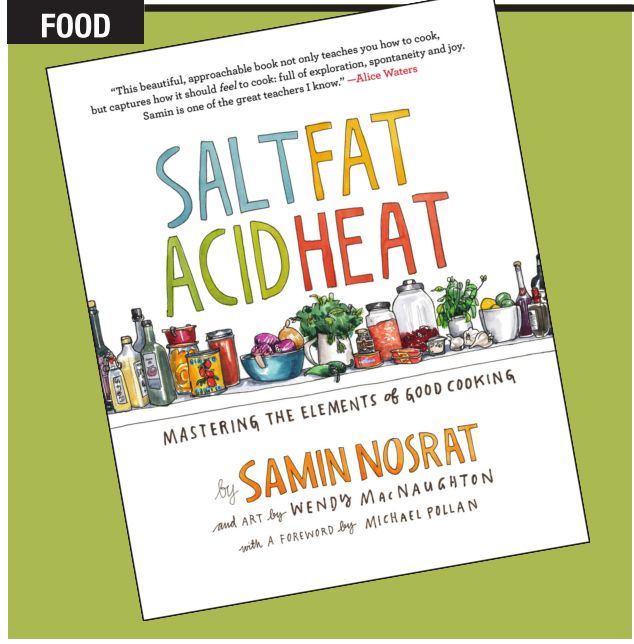
Samin Norsat’s Salt, Fat, Acid, Heat:
Mastering the Elements of Good Cooking is also a book about cooking, without many recipes. Unlike the pictureless An Everlasting Meal, this
book is illustrated like a graphic novel, featuring the work of
renowned illustrator Wendy MacNaughton. MacNaughton has translated
Nosrat’s vision into lush watercolored line drawings.
Norsat
claims that if you learn to control the four elements of cooking that
make up her book’s title, you will always be able to make delicious food
without recipes. “Recipes are poor teachers. They tell you what to do,
but they rarely tell you why to do it. My dream is you’ll read the book,
and cook with it, and then no longer need it.” She goes on: “Recipes
are like training wheels. Cooking is all about using your senses to
guide you, but mostly it’s common sense. I want you to be able to see
what’s fresh in the market, and to develop the confidence to make
something good of it, or,
if you haven’t shopped, to look at what you have in the fridge and to
throw something together.” She says she included a few recipes because
the publisher insisted.
In
her two-part book, Nosrat spends the first chapters focusing on each of
the four elements, and then fills the second half with recipes,
recommendations and lessons that build on the knowledge she opens with.
By mastering the use of just four elements – salt, which enhances flavor; fat, which delivers flavor and generates texture; acid, which balances flavor; and heat, which
ultimately determines the texture of food – anything you cook should
taste good. By explaining the hows and whys of good cooking, Salt, Fat, Acid, Heat will
teach and inspire both new and seasoned cooks how to confidently make
better decisions in the kitchen and cook delicious meals with any
ingredients.
Hippocrates
said “Let food be thy medicine and medicine be thy food.” Start taking
responsibility for your own health and well-being by controlling what
you eat and how it’s prepared. These two books will get you on the right
path and show you how.
Contact Peter Glatz at [email protected].


