Parking meters due for updating There is plenty of parking in downtown Springfield – that’s what the experts say. Parking downtown is a huge headache – that’s what a lot of people think.
The truth lies somewhere in between. Yes, there may be parking nearby, but where, exactly? Once you find a space, can you also find change for the meter? If you don’t have change, will you get a ticket? If you do have change, how long will you be away from your car, or should you just stuff in extra quarters to be on the safe side?
These are questions that aren’t asked in places like Oxford, Mississippi, and Chico, California, where you can pay with credit cards or with your smartphone. In some towns, you can find a parking spot with your cellphone, and the meter moves to zero when you leave, potentially boosting revenue by not allowing motorists to park free on someone else’s leftover time.
In Peoria, the city plans to expand the use of Passport, a cellphone app that allows motorists to pay digitally and add time remotely in case their business meeting or lunch date runs longer than expected. Passport charges a convenience fee, typically 35 cents, and passes parking charges on to municipalities. Nick Stoffer, Peoria traffic engineer, says that most people still choose coins, but there has been no downside since the city instituted Passport parking in limited areas last year. He said he’d like to see the system, which is now in place near city hall, the county courthouse and the Riverfront Museum, instituted throughout downtown. Upfront expenses are minimal, he said.
“I’m going to talk to Passport tomorrow,” Stoffer said. “I think we can probably get it done this year – it’s not that much effort or cost.
Unfortunately, we haven’t expanded it earlier. … Whether it’s coin or app, it means the same to us.”
Slow to change While other cities across the United States have moved to so-called smart parking technology, Springfield depends on mechanical parking meters that can be more trouble than quaint. According to city records, the city’s 1,450 parking meters malfunctioned more than 3,400 times between Jan. 1, 2016, and last May. The city’s parking meter repairman, who also collects change from meters, was paid nearly $55,000 last year fixing such issues as 224 coin-related jams and 1,542 dead batteries. The city paid three enforcement attendants more than $75,000.
“I think Springfield is sometimes slow to change.”
Mark Mahoney, public works director, said that a makeover of downtown parking has taken longer than hoped, but the city is putting together a request for proposals from vendors.

“There’s a number of vendors,” Mahoney said. “Some of them don’t necessarily have all the pieces.” Exactly when the city would act on a proposal, or proposals, isn’t known. “It’s kind of hard to say a timeline,” he said.
Ward 5 Ald. Andrew Proctor said that he wants to see a system in place in time for the annual downtown holiday walks this winter so that people won’t have to bring change, and it’s not a backburner issue.
“Get a parking meter app – I think that would help improve the downtown experience, by not having to pay only with coins,” Proctor said. “I’m interested in all options – that’s why the city is putting out an RFP. … I keep telling people that it will be here for the holiday walk.”
Proctor campaigned two years ago on a platform that included support for downtown smart parking. Why does Springfield lag behind cities like Peoria and smaller towns when it comes to parking?
“I
think Springfield is sometimes slow to change,” Proctor answers. “It
just takes awhile to convince people that this is something that’s
needed to bring Springfield into the 21 st century for downtown.”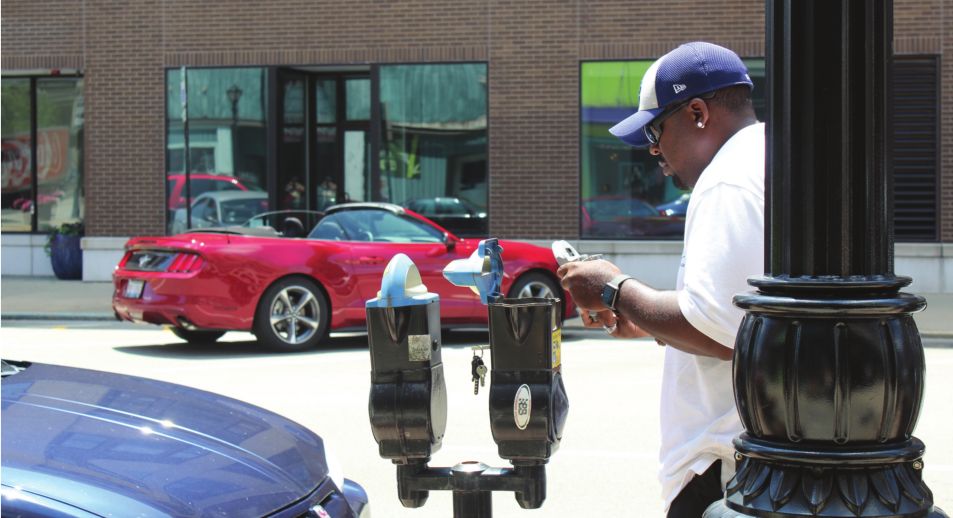
Proctor
said he expects the city will look at smart-parking technologies that
include curbside sensors so that motorists can find the closest meter
via smartphone and meters can reset when someone leaves a space. Whether
that will actually happen isn’t certain, Proctor said.
“I
know when you start doing something like that, it increases costs,”
Proctor said. “I think parking meters will be with us for the
foreseeable future.”
Parking wars Parking has been a contentious and perennial issue in Springfield since the days of the Great Depression.
No
less than Carl Magee, father of the parking meter, visited the capital
city during battles over whether Springfield should start charging for
parking. In 1935, three years before Magee received a patent for what is
widely considered the first working parking meter, representatives of
the Dual Parking Meter Co., Magee’s Oklahoma City-based company, pitched
Springfield city fathers on the newfangled notion of charging to park
on city streets.
Meters,
the company told the city council and mayor, could rake in as much as
$100,000 a year by charging a nickel an hour to park downtown. It didn’t
happen overnight.
 The
debate lasted for years before parking meters were installed in
Springfield on the eve of World War II, at least six years after the
idea was first broached and long after Decatur and other central
Illinois towns had meters. The fight involved bareknuckle politics and
accusations of skullduggery.
The
debate lasted for years before parking meters were installed in
Springfield on the eve of World War II, at least six years after the
idea was first broached and long after Decatur and other central
Illinois towns had meters. The fight involved bareknuckle politics and
accusations of skullduggery.
The
city council sparked uproar in the fall of 1940 when it approved a
no-bid deal with a Chicago company for more than 1,000 meters, twice the
number that previously had been discussed. The meters would pay for
themselves within nine months, the city vowed, but the deal was shelved
after less than two weeks, with merchants, labor groups and rival
parking-meter companies objecting on various grounds. Magee traveled
from Oklahoma City to Springfield and urged the city council to give his
company a chance.
“The haste with which the council rushed into the plan has aroused considerable suspicion,” opined the Illinois State Journal, a precursor to the State Journal-Register. “The city would be wise to delay a final decision until more opportunity has been given for fact-finding and public discussion.”
Opponents
compared parking meters to slot machines that never paid out and
alleged that meters amounted to illegal taxation. Wary merchants agreed
to a six-month trial, with 465 meters installed on a handful of blocks,
and Mayor John “Buddy” Kapp walked back the original decision to
purchase 1,100 meters, saying that the city had never intended to
actually install that many. “We were merely looking toward the future,”
Kapp said.
One year after the city
council reversed the no-bid deal, the city put in meters from Magee’s
company, prompting a boom in advertising from parking-lot owners: “Our
Parking Lot: Your First Line of Defense Against Parking Meters,” the
owner of one downtown lot boasted in a newspaper ad that promised
parking for half the cost of metered space. Police decreed that
bicyclists had to use meters in front of downtown theaters. Downtown
streets were empty enough to draw comparisons to holiday traffic on the
first day of metered parking in Springfield, with just a few motorists
parking curbside.
“With
apparently sinking hearts, they deposited their coin and, as they
walked away, turned around several times to make sure that the devices –
and their cars – were still there,” the Illinois State Journal reported.
Reaction
to meters was mixed. Downtown merchants who had been cautious soon
petitioned the city for more meters. But the city removed meters from
Second Street near the Capitol complex after the attorney general said
that the secretary of state, not the city, had jurisdiction and
threatened an injunction.
Meanwhile,
meters remained on streets bordering the county courthouse, even after
the attorney general said that the county needed to give permission.
Acting on instructions from the county board, the sheriff was minutes
away from pulling out the meters when Sangamon County Circuit Court
Judge L. E. Stone issued an injunction, saying that it would do no harm
for the meters to remain for a few more days until legal questions were
resolved.
“The
situation is more complicated than I thought it was,” Stone said upon
issuing the injunction. The case languished for more than a year, with
meters, eventually, winning.
A
game changer These days, Proctor said he thinks that removing meters
from downtown to allow free parking likely would spark the biggest
modern-day parking controversy. But that’s exactly what Decatur did five
years ago. It wasn’t easy.
“From
a city manager’s point of view, one of the toughest things I had to
deal with in my career – and it sounds strange – is parking,” said Ryan
McCrady, former Decatur city manager who presided over the city’s 2012
parking overhaul, which McCrady calls “an absolute game changer.”
Parking
ranks with garbage collection and recycling as vexing municipal issues,
says McCrady, who was once Sangamon County administrator. Between
downtown workers who want free, or cheap, parking and merchants who want
spaces available and turning over, there was no winning as McCrady made
the rounds of community and civic groups years ago, trying to sell the
idea of free parking. “Frankly, I took a beating every time I did it,”
said McCrady, who is now president of the Economic Development
Corporation of Decatur. “Downtown parking’s a 50-50 shot on whether
people like it.”
In
Decatur, parking is free but limited to two hours. Enforcement is
accomplished via license plate readers, with the first ticket free and
fines for multiple violations quickly escalating to discourage chronic
scofflaws. While instituting free parking, the city also boosted the
number of spaces by creating angle parking.
The
changes were part of a $14 million makeover of the downtown
streetscape, and McCrady says that parking changes were critical.
Meters, he says, discourage people from coming downtown.
“If
you renovate your downtown and you don’t do something on parking,
you’re not going to get the maximum return on your investment,” McCrady
says. “Not everybody is happy we did it, but I get a lot of compliments
about it now. When it was under construction, it was a tough time. It
was well worth everything I went through the end result was worth it.”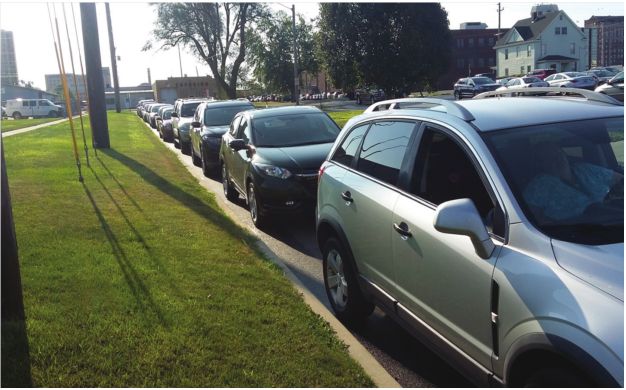
A
perception problem Parking meters, municipal types say, are more about
keeping order than making money. In Springfield, meters generated more
than $468,000 in 2016, plus another $322,000 in fines – less than half,
when inflation is considered, what the city was promised back in the
1940s, when meters were installed.
Not
surprisingly, the city gets the most money from meters installed in the
downtown core, near city hall, the Abraham Lincoln Presidential Library
and Museum and the two major downtown hotels. That zone on the city’s
parking map generated more than $59,000 between January 2016 and last
May. Meters directly west of the Capitol complex on Lewis Street and
Capitol Avenue generated the least money, less than $2,400 during the
same time frame. Proctor says the city should yank them.
Lisa
Clemmons Stott, director of Downtown Springfield, Inc., says that there
is sufficient parking downtown – the furthest she’s ever had to walk is
four blocks. “You park at the mall and you walk more than four blocks,”
Stott says. But spaces can be difficult to find and are sometimes
poorly marked, she said. That’s why DSI favors smart parking that can
help motorists locate spaces.
“It’s
a perception problem,” Stott says. “It can feel intimidating, like a
bigger city. … A lot of people say to me, ‘We should have free parking,
like Decatur.’” Free parking might be worth a try on a pilot basis,
Stott said, particularly on areas of Capitol Avenue, where parking was
eliminated nearly a decade ago as part of a street beautification
project.
“To me, it’s an underutilized space,” Stott says. “It looks beautiful, but if it’s a ghost town, what good is it?”
That
parking is a matter of keen civic interest is reflected in the effort
and time the Springfield-Sangamon County Regional Planning Commission
has spent counting cars, spaces and calculating demand. Since 1972, the
commission has produced reports – once annually, now biannually – on
parking demand in the downtown area. The number of on-street metered
spaces has dropped by about 200 spaces during the past decade, says
Brian Sheehan, associate planner with the planning commission whose job
duties include strolling downtown with a notebook and pen every other
spring to count spaces and cars – he once used an iPad, but that proved
iffy in foul weather. He carries a letter from his bosses explaining
what he is doing – his predecessor was once questioned by authorities
while writing stuff down in front of the federal building.
Like
Stott and others, Sheehan says that perceptions of parking shortages
are just that, perception. Just because you cannot see your final
destination from your parking space doesn’t mean that there isn’t a
place to park, Sheehan says. Some results are surprising. The most
popular place to park downtown is free, on Mason Street between First
and Second streets, Sheehan says.
“This
year, it didn’t show up as completely occupied, but every other time in
my personal memory, that block has been completely filled up with
cars,” says Sheehan, who’s been doing parking surveys in Springfield
since 2013.
It’s hard
to figure why. The block is flanked by a handful of businesses,
including a medical supply firm and an ambulance company. It’s within
walking distance, at least during nice weather, to the state board of
education and Central Managment Services offices. Surface lots in the
area are typically less than half full. Sheehan, who is intrigued enough
that he takes a mental note whenever he’s in the area, has no
explanation.
“I don’t know who’s parking there,” he says. “It’s always full.”
Contact Bruce Rushton at [email protected].


