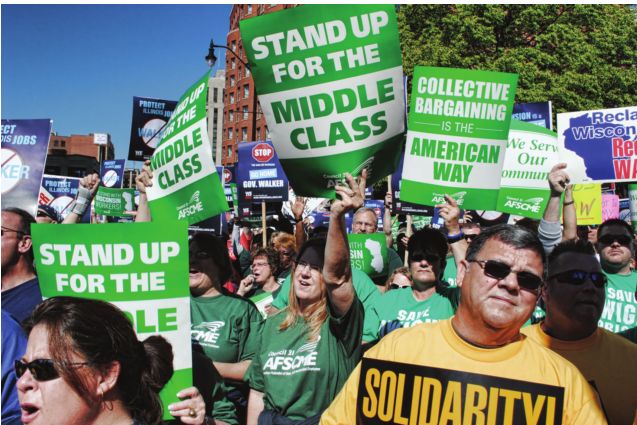
A closer look at the governor’s claim his contracts with smaller unions show he’s labor’s friend
Before becoming governor, Bruce Rauner openly disdained public sector unions. He ridiculed AFSCME, the union representing most state workers as “Af-scammy,” and labeled labor political donations as tantamount to bribes that let unions run roughshod over Illinois.
So, it’s not without irony that Rauner, now mired in a years-long contract battle with AFSCME, is attempting to gain leverage by invoking contract truces he has reached with other, much smaller, public worker unions.
The Republican has used his successful negotiation of agreements with units of the Teamsters, the Illinois Federation of Teachers and more than a dozen trade unions as evidence of his administration’s willingness to cooperate with labor.
At the same time, the administration has cast the 35,000-member AFSCME Council 31 as intransigent, greedy and, in the words of a 2015 press release, “on the opposite side of these negotiations from their own colleagues in organized labor.”
Those unions, though, resent being conscripted into Rauner’s campaign to vilify AFSCME. A closer look at the signed contracts posted on a state website reveals there’s no simple apples-to-apples comparison between his dispute with AFSCME and the deals with the smaller unions.
“He’s using this as a rhetorical device to essentially lie to the people of Illinois and say, ‘See, I want settlement, I want compromise,’ when what he really wants is division,” said Dan Montgomery, president of the Illinois Federation of Teachers.
Montgomery’s union represents thousands of local school teachers, but just 44 of them at the Illinois School for the Deaf in Jacksonville are covered by a contract with the state. When that agreement was reached last year, Rauner hailed it as an exemplar of his administration’s “lasting partnership” with the union.
There are differences, some arcane and some stark, between the contract terms that Rauner agreed to with the smaller unions, which collectively represent 6,000 state workers, and those which he seeks to impose on AFSCME.
Significant points of contention remain between AFSCME and Rauner over health care cost sharing, wage freezes and the length of the work week.
The
administration’s take is that size doesn’t matter when it comes to
labor negotiations. Other unions managed to reach accord with Rauner,
his top lawyers argued, while AFSCME has sought to thwart the governor
at every turn.
“Generally
(AFSCME) likes to point out that they are big and all these other
unions are much smaller,” says Dennis Murashko, Rauner’s general
counsel. “I don’t accept that... I think no matter the size of the
union, no matter the size of the organization, if you want to, in good
faith, come to an agreement with anybody on the other side, you can do
that.”
Talks between
AFSCME and the administration began in February 2015 and broke down in
January 2016, when Rauner accused the union of bargaining in bad faith
and sought to have negotiations declared at impasse by the Illinois
Labor Relations Board.
AFSCME
consistently has portrayed this as Rauner walking away from talks
prematurely, and points out that before his election the Republican
frequently telegraphed to campaign audiences that he could precipitate a
state worker strike.
After
a year of legal wrangling in which Rauner’s “last, best and final”
contract offer was upheld by the labor board and AFSCME members voted to
strike if the administration tried to impose the contract, the issue
now is the subject of a lawsuit that could be tied up in the court
system well into 2018 or longer.
Despite
that uncertainty, Rauner factored in more than $770 million in
anticipated savings from union contract changes into his budget proposal
for the coming fiscal year, according to The Civic Federation.
In
at least one case, the Fraternal Order of Police local that represents
99 state conservation officers accused the administration of
misrepresenting the state of its contract negotiations in a zeal to
portray AFSCME as unreasonable.
Shawn
Roselieb, a member of the FOP labor council for the conservation
officers, took issue with an administration news release claiming the
two sides had reached agreement. “That’s a little misinformed,” said
Roselieb. “We did negotiate on a couple of issues but (the contract) is
still open and we’re still at the table.”
The
conservation officers’ contract won’t be complete until Troopers Lodge
41, which represents Illinois State Police troopers, settles an ongoing
dispute over health insurance. That issue is now the subject of an
arbitration case.
One
of the big issues in the AFSCME talks involves overtime pay. Currently,
AFSCME members qualify for overtime when they work more than 37.5 hours a
week, but the administration wants to change that to 40, which it says
will both save the state $80 million over four years and bring AFSCME in
line with overtime rules for the other unions.
At
the same time, the administration wants to bar AFSCME members from
counting vacation, holiday and sick time in the calculation used to
reach the 40-hour threshold. Contracts with most of the smaller unions
do not preclude vacation, holiday and sick time from being factored into
the overtime floor.
The
four-year wage freeze proposed in the AFSCME contract appears identical
to what was accepted by all the unions that have negotiated agreements
with the
administration so far, but AFSCME says the trade union contracts still
allow for increases under the state’s prevailing wage law, thus their
wages aren’t frozen.
The
state says AFSCME is twisting the contract’s language. While the
Illinois Department of Labor uses monthly countyby-county surveys to set
prevailing wages for private-sector workers employed on state public
works projects, a different state agency sets prevailing wages for state
employees covered by the trade union contracts.
Murashko
made it clear that the administration has no intention of raising
prevailing wages for state employees. “We do think of it as a wage
freeze because it’s the wage that we control,” Murashko said.
The
subject of health insurance is where making direct comparisons between
the AFSCME contract and those signed by the Teamsters and trade unions
becomes especially challenging.
Under
the administration’s contract plan, premiums would roughly double for
AFSCME members, who at present pay 17 percent of the cost of premiums
while the state picks up the rest. Rauner wants to up the employee share
to 35 percent.
That
increase is in line with what the trade unions have also agreed to. But
most of those small union contracts contain a clause stating that if
AFSCME negotiates better terms, the trades will get them as well.
What’s
more, contracts for the nearly 3,000 Teamsters union members contain an
option for workers to drop the state insurance plan and move to
union-operated plans. That holds the prospect of reducing premium
deductions for Teamsters members and giving them more takehome pay.
The administration says the Teamster insurance agreement wasn’t born of arm-twisting.
“They
wanted to reach a deal and that’s the fundamental difference,” Murashko
says. “AFSCME from all their actions indicated strongly that they were
just inclined to let this thing drag out because then they get status
quo benefits and status quo is very, very good for them.”
Unsurprisingly,
AFSCME has a very different take. Union spokesman Anders Lindall said
the organization had negotiated contracts for more than 40 years with
Republican and Democratic governors alike without a strike.
“Clearly,
If Bruce Rauner had wanted a fair agreement, AFSCME’s track record
shows we’re willing and able to reach one,” said Lindall.
Matt
Dietrich is a Springfield-based freelance journalist specializing in
state government and politics. His news career includes more than two
decades at the State Journal-Register and reporting jobs at newspapers in New Jersey, New York and Wisconsin. Most recently, he was founding editor of Reboot Illinois.


