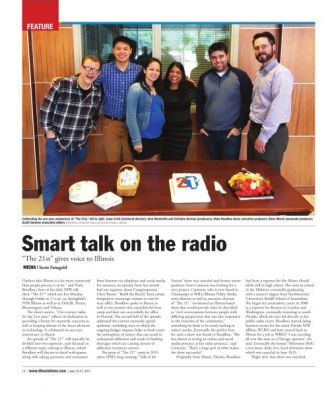
“The 21st” gives voice to Illinois
I believe that Illinois is a lot more connected than people portray it to be,” said Niala Boodhoo, host of the daily NPR talk show “The 21 st ” which airs live Monday through Friday at 11 a.m. on Springfield’s NPR Illinois as well as in DeKalb, Peoria, Bloomington and Urbana.
The show’s motto, “21st-century radio for the 21st state,” reflects its dedication to providing a forum for statewide concerns as well as keeping abreast of the latest advances in technology. It celebrated its one-year anniversary in March.
An episode of “The 21 st ” will typically be divided into two segments, each focused on a different topic relating to Illinois, which Boodhoo will discuss in detail with guests, along with taking questions and comments from listeners via telephone and social media. For instance, an episode from last month had one segment about Congressperson Cheri Bustos’ “Build the Bench” boot camps designed to encourage women to run for state office. Boodhoo spoke to Bustos as well as two women who attended the boot camp and later ran successfully for office in Normal. The second half of the episode addressed the current statewide opioid epidemic, including ways in which the ongoing budget impasse helps to both create the atmosphere of misery that can result in widespread addiction and result in funding shortages which are causing closure of addiction treatment centers.
The germ of “The 21 st ” came in 2013 when NPR’s long-running “Talk of the Nation” show was canceled and former senior producer Scott Cameron was looking for a new project. Cameron, who is now based in Champaign as WILL/Illinois Public Media news director as well as executive director of “The 21 st ,” envisioned an Illinois-based show that would provide what he described as “civil conversations between people with differing perspectives that was also responsive to the concerns of the community,” something he finds to be sorely lacking in today’s media. Eventually the perfect host for such a show was found in Boodhoo. “She has almost as strong an online and social media presence as her radio presence,” said Cameron. “That’s a huge part of what makes the show successful.”
Originally from Miami, Florida, Boodhoo had been a reporter for the Miami Herald while still in high school. She went to school in the Midwest, eventually graduating with a master’s degree from Northwestern University’s Medill School of Journalism. She began her journalistic career in 2000 as a reporter for Reuters in London and Washington, eventually returning to south Florida, which she says led directly to her public radio career. Boodhoo started doing business stories for the south Florida NPR affiliate WLRN and later moved back to Illinois for a job at WBEZ.“I was traveling all over the state as a Chicago reporter,” she said. Eventually she hosted “Afternoon Shift,” a two-hour, daily, live, local afternoon show which was canceled in June 2015.
“Right after that show was canceled, the folks at WILL reached
out to talk about ideas.” Boodhoo came on board in November of 2015 to
start developing “The 21 st .” “My parents did not name me with the
intention of me being in public radio,” said Boodhoo, referencing her
unconventional (though common enough in India) name during a session on
Reddit in which she also proudly mentioned that the lead song on the
debut album by a musical group called Public Access is named “Niala
Boodhoo.” (The song can be heard at https://publicaccessmusic.bandcamp.com/ track/niala-boodhoo.)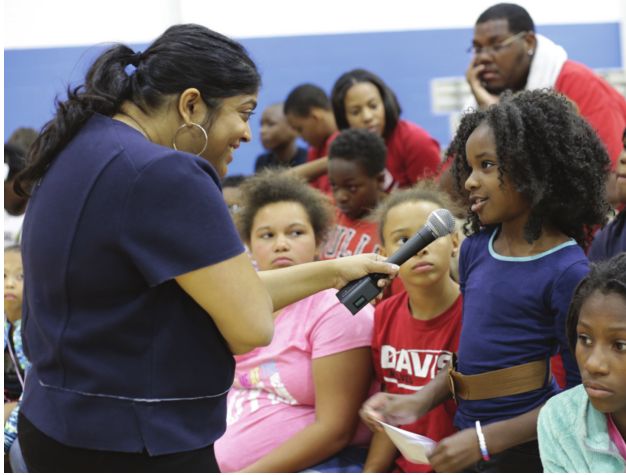
Moss
Bresnahan, president and CEO of Illinois Public Media, has said that
public radio is evolving and needs to find ways “to interact with our
content in new ways and on all platforms.” He envisioned “The 21 st ” as
a program that would be “relevant, smart and fun, connecting people
from all walks of life and from all corners of Illinois.” The show was
broadly conceived as a mix of interviews and conversations including
“farmers, businesspeople, artists, politicians and, most importantly,
residents across Illinois.”
“From
the beginning, I always wanted a show that could bridge the gap between
an old-school public radio call-in show and all the vibrant social
media interactions that are happening,” Boodhoo said. “I also just want
to produce really good radio for the part of the state outside of
Chicago. Everybody is familiar with the great journalism that comes out
of the media outlets in Chicago but I think there is certainly a need
for coverage of the rest of the state, especially given what’s going on
in state government. It’s incumbent upon public media stations to step
in and help fill that gap.”
A
large part of the mission of “The 21 st ” is to aggregate news from
across the state by bringing attention to stories that would often
remain unreported outside of regional media. “There might be a great
story you’d see if you were living in Rockford but you might miss it
completely if you were in Springfield,” she said. “We see the role of
the show as to bring people together throughout Illinois.” In addition
to news, the show is dedicated to covering Illinois culture. “I think
there is great, fun arts and culture happening here that people don’t
know about – interesting people doing fascinating things across the
state – and ‘The 21 st ’’ likes to help introduce those people to
everyone else.”
Boodhoo
has observed that many Chicago transplants live in other parts of the
state and that many currently living in Chicago moved there from other
parts of the state. “I don’t think we are as disconnected as people tend
to think we are – that whole downstate as opposed to Chicago thing.
There are many people who spend a lot of their time commuting between
Chicago and Springfield or Champaign or Peoria or Normal – I think there
are a lot of people moving throughout the state on a regular basis.”
 As
for the content of “The 21 st ,” keeping things Illinois-focused does
not mean the coverage is all hermetically sealed. “We do try to be
reactive to different news, whether it’s national, international or
local,” said Boodhoo, pointing out that international trade deals, for
example, can have a powerful effect on the agricultural industry of the
state.
As
for the content of “The 21 st ,” keeping things Illinois-focused does
not mean the coverage is all hermetically sealed. “We do try to be
reactive to different news, whether it’s national, international or
local,” said Boodhoo, pointing out that international trade deals, for
example, can have a powerful effect on the agricultural industry of the
state.
According to
Cameron, getting each show ready for broadcast begins with pitching
ideas to Niala, who narrows things down and edits them to fit her
approach. “The question we always ask is: Is this something people in
Illinois want to hear – or should hear?” said Boodhoo. While most topics
are time-sensitive, with an attendant sense of immediacy and urgency,
there are exceptions. “We try to plan things like author interviews at least a
couple weeks in advance,” Boodhoo said, “because I’ll need time to read
the book or see the play. Otherwise, we try to do a mixture of topics
that we think will interest people, along with reactions to breaking
news.” Sometimes a prepared show will even be completely scrapped in
favor of broadcasting on the fly. “Particularly in January, during the
first couple weeks of the [Trump] administration, I felt like every show
we planned we ended up redoing because of something dramatic that had
happened,” she said.
With
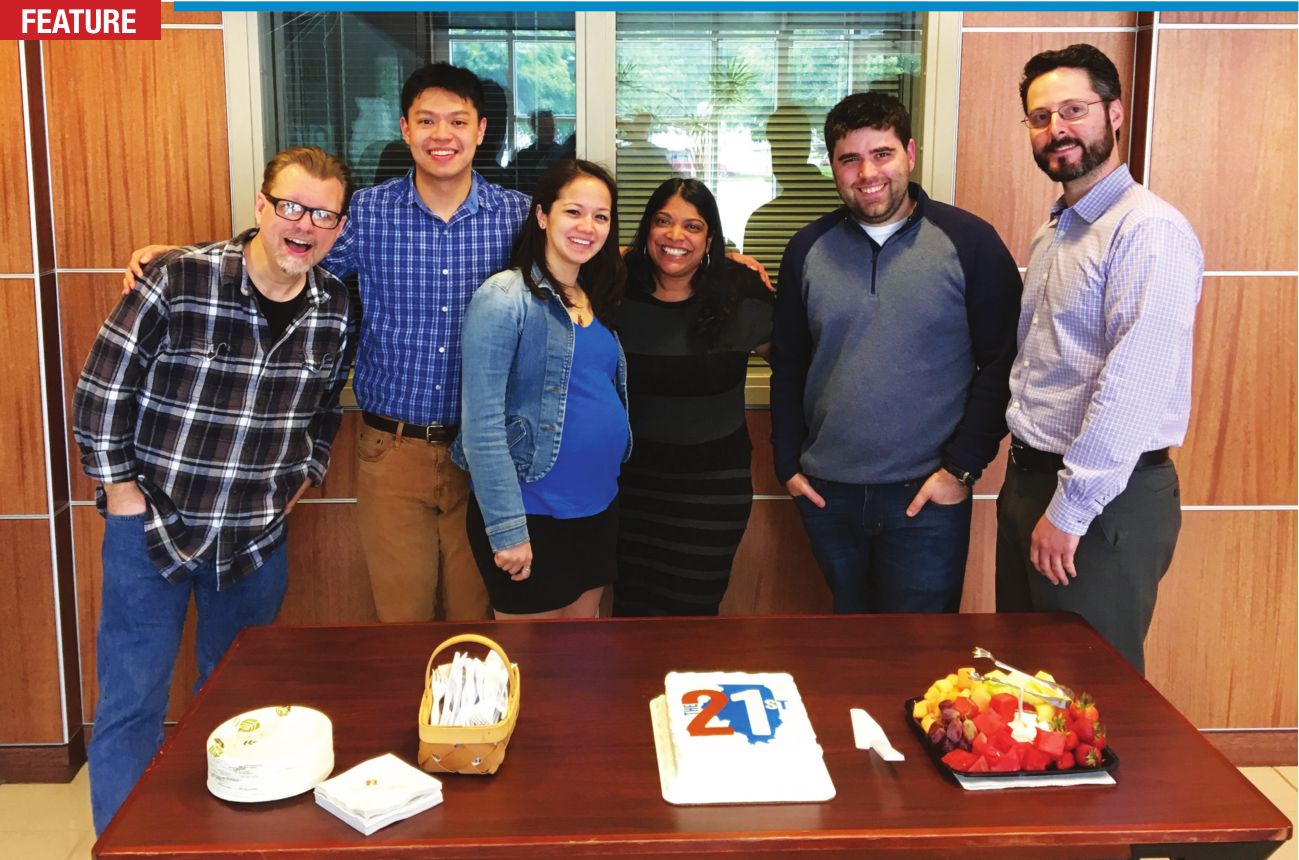
a year under its belt, the “21 st ” team – which on any given day
consists of Boodhoo, three producers, two engineers and one or two
interns – is starting to reap the benefits. “Now that we’ve been around
for a year, people are reaching out to us more and suggesting things,”
Boodhoo said. “We also do a lot of work looking at conversations
happening on social media and analyzing those, researching different
hashtags and things like that. We try to look anywhere and everywhere
for the conversations that end up happening on the air.”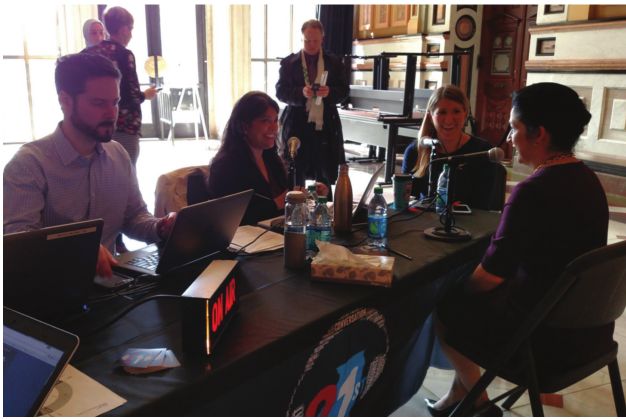
To
this end, the show’s staff works with University of Illinois
Urbana-Champaign’s social media analytics lab. “They have access to some
pretty powerful social media monitoring tools that we use to search
through social media for hashtags as well as influencers,” Boodhoo said.
For example, in June of last year it came to the staff’s attention that
several K-12 school superintendents throughout the state had come up
with the #passillinoisbudget hashtag to express their frustration with
the impasse. “We saw that hashtag appear and we used the lab’s tools to
isolate how often it was being used, how often it was being retweeted.
Then we got in touch with a couple of superintendents that way, one of
whom had started the whole thing, and had them as guests on our program
to talk about the budget.” The episode can be heard online at https://will.illinois.edu/21stshow/program/ school-funding-in-illinois-canine-flu.
In
another case of social media driving content, during the presidential
election, Boodhoo asked listeners what questions they had about the
ballot. “People posted questions on Reddit, Twitter and Facebook and
then we had PolitiFact Illinois answer everything,” she said.
“The
21 st ” is currently distributed via broadcast on five stations
throughout the state. However, listeners are not limited to these
traditional outlets. “We also have people who are listening online live
using the WILL app or the live stream,” Boodhoo said. “We also have
people who hear us via the NPR One app or through podcast
subscriptions on iTunes or Android.” Listeners in markets such as
Carbondale have found the show in spite of the fact that it doesn’t air
on the area’s local affiliate, which has come to the staff’s attention
due to the experience of hearing from such listeners directly. “We like
working with NPR One,” said Boodhoo, “because that app is available to
radio audiences throughout the country.” This particular app tracks the
specific content a user listens to and makes automated recommendations
based on that information. It will start by suggesting specific relevant
segments of “The 21 st ” to an individual listener, eventually leading
them to the show as a whole.
Randy
Eccles, general manager of NPR Illinois, headquartered at University of
Illinois Springfield, helped launch “The 21 st ” in 2015. “Scott
[Cameron] had started talking with me and I told him we’d love to have
an Illinoisbased talk show. We’ve got national shows, but we thought
that something focused on what’s going on in Illinois would be great.”
He says the show is doing very well at the one-year mark. “From my
experience, it takes between two and five years for a show to establish
itself and this show is really pretty far along the development curve –
it’s already been picked up by five stations.”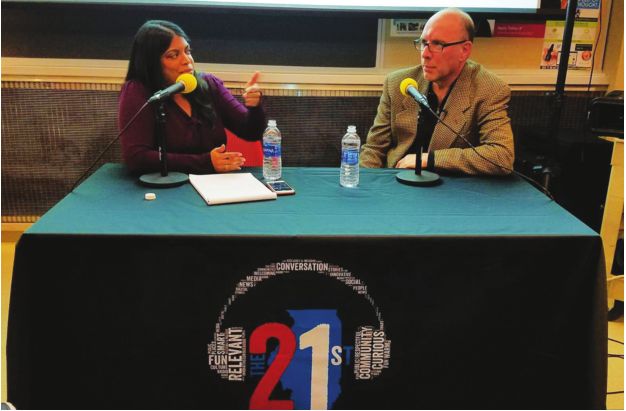
The
original idea for “The 21 st ”was for it to be paired with NPR
Illinois’ “Illinois Edition” and for both to be heard across the lower
portion of the state. “The greater Chicago metropolitan area has 67
percent of the state’s population,” Eccles said, “so the rest of the
state is about one-third. We want to do a great radio show for the part
of Illinois that is outside of Chicago. But you can’t ignore the gravity
of the economic center of the state so you have to investigate how that
two-thirds up there impacts or affects or helps the other third. If we
wanted, we probably could have partnered with BEZ to take one of their
programs, but we really wanted something that gave voice to these
spaces-in-between, these towns that have populations of 500,000 or less –
like Peoria and Bloomington.” Currently, according to Eccles, “Illinois
Edition” is broadcast by WILL in Urbana and WUIS in Springfield,
reaching Decatur, Jacksonville, Lincoln, Taylorville, Pittsfield,
Rushville, Charleston and Bloomington from those signals. Other Illinois
markets are considering adding it to their schedules.
Eccles
has observed that shows like “The 21 st ” allow for perspectives major
metropolitan media centers might miss, pointing out that NPR affiliates
seemed far less shocked by the results of the November election than
their counterparts in New York, Los Angeles and Chicago, just by virtue
of being located closer to rural areas.
Reaction
to the show from NPR Illinois listeners has been positive, according to
Eccles. “During the recent pledge drive we got feedback about which
shows people like and ‘The 21 st ’ is being cited positively by people,”
he said. “Even this early in its development it’s getting name
recognition. The numbers are good on it.” According to Eccles,
affiliates are not charged cash to broadcast the show but they do barter
underwriting messages during the show for WILL to sell to pay for
production costs.
“We
are in five out of nine public radio markets in Illinois and I’d like us
to expand just a little bit more,” Boodhoo said when asked about
ambitions for the future of the show. “I’d like for us to be available
in every part of the state. We had an internal goal our first year to
have five stations and we made that and I’m really happy about it but
I’d really like us to be distributing the show even farther.
“For
me, though, what’s most important is that we’re producing a show that’s
relevant and helps people maybe understand each other a little bit
better and be more informed about our state and our world. As long as we
do that every day, I’m pretty happy.”
Scott Faingold can be reached at [email protected].