District 186 students experience a dynamic cultural awareness program
On Monday and Tuesday, Feb. 6 and 7, at Erin’s Pavilion, Springfield Public School District 186 held a series of unprecedented sessions addressing the subject of “cultural relevance,” popularized by educator Gloria J. Ladson-Billings. Focusing on cultural relevance is thought to enable student success by acknowledging that learning does not happen in a vacuum but rather takes place in the context of culture influences, which can often vary widely within a single classroom.
At Erin’s Pavilion, a visiting presenter addressed hot-button issues such as stereotyping, privilege and educational equity, raising awareness to create a better learning environment in area public schools. This sort of thing is fairly routine for faculty and administrative staff. What made these sessions different was the audience – the presentations were specifically designed for and attended by students from elementary, middle and high schools throughout the district. In effect the sessions represented a first shot across the bow, an initial step toward starting what administrators hope will be a long, productive conversation between administration, faculty and students. The sessions themselves were high-energy affairs, part encounter group and part house party. The kids ate it up.
“Come on, Springfield, make some noise up in here!” Dexter Floyd knows how to work a crowd – particularly a crowd of middle-school students. Dapper and charismatic with an uncanny ability to maintain a high level of energy along with a sense of order and focus, the former middle school math teacher and current director of RISE Academy in Tyler, Texas, proved an ideal choice to lead young people through sometimes prickly topics such as discrimination and inequality, in a way that was not dry or didactic but rather empowered the students to contribute to the conversation. It isn’t hard to see what motivated District 186 superintendent Jennifer Gill to seek out Floyd’s services after seeing him give his presentation while attending a conference this past summer. “I was blown away,” she said when introducing him to the students on Tuesday.
 In near-constant motion, his speech flecked with youthful vernacular, Floyd, 47, commanded the kids’ attention and the enthusiasm he consistently elicited from his young audience was impressive. He began with a simple but challenging icebreaking exercise (“I want you to look around and then introduce yourselves to somebody you do not know”) and quickly moved into a discussion of educational equity. The Center for Public Education draws a line between equality, which they define as being achieved “when students are all treated the same and have access to similar resources,” and equity, which occurs “when all students receive the resources they need so they graduate prepared for success after high school.” The distinction relates to the overarching theme of cultural relevance by acknowledging that these resources can vary from student to student, depending on a variety of factors, including race, religion and economic status.
Floyd began by sounding out the students for their perspectives on the subject, using deceptively simple examples to stimulate the students to examine complex ideas. For instance, early in the session, a single-panel cartoon was projected on an overhead screen, depicting a group of caricatured animals, ranging in size from a squirrel to a horse, each being presented with an identical food bowl. Underneath was the caption, “Everyone gets an equal amount.” At first, many students reflexively defended the idea that each animal was being treated fairly by being given identical portions of food, until Floyd called on a husky eighth-grade boy.
“Do you play football?” asked Floyd. The boy
nodded. “I know you do,” Floyd said immediately, evoking laughter from
the other kids. “Now tell me – let’s say a second-grader requires half a
glass of milk and maybe a fourth of a sandwich and he’s full – does
that sound right?” Another nod. “Now, is that same meal going to work
for you?” The football player scoffed. “No,” affirmed Floyd, “that ain’t
doin’ nothin’ for you but make you mad.” Louder laughter from the
crowd. “Think about it – if we all get the same amount, it might be fair
– but is it equitable?” This led into an extended group discussion,
with frequent contributions from students who seemed to embrace the new
idea quickly, often expanding on it.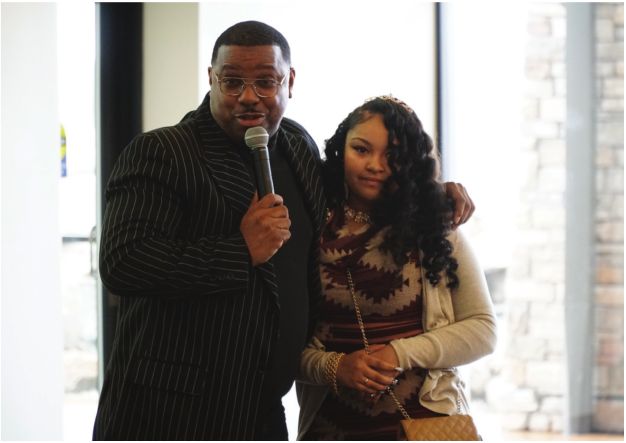
A
similar cartoon depicted an elephant, a monkey and a fish in a bowl all
being judged by their tree-climbing ability – a test that would be
easily passed by the monkey but is outside of the abilities of the
water-bound fish and the large, heavy elephant. This introduced the idea
that testing can have its own internal biases and it struck a chord
with students. One high-schooler raised her hand during the discussion,
making an association between the inequitable example in the cartoon and
the way ACT and SAT testing can leave some smart students at a
disadvantage.
“There
are things we need to learn about how we treat each other,” Floyd said,
“how we look at each other, how we respect our differences. It’s
important that you understand how you think. We are shaped by the stuff
we hear.” Although it was never stated outright, there was an
implication that these already important issues may have become more
urgent over the last few months as a national uptick in racially
motivated incidents has been reported in the wake of the recent
presidential election. “A lot of the media has us in a frenzy right now
all around the country,” said Floyd. “But we gotta stay focused on
what’s important.” Over and over he stressed the importance of students
feeling empowered to speak up for themselves about things they see as
unjust. “You have a voice,” was a regular refrain.
Floyd
did an impressive job of navigating potentially harsh territory while
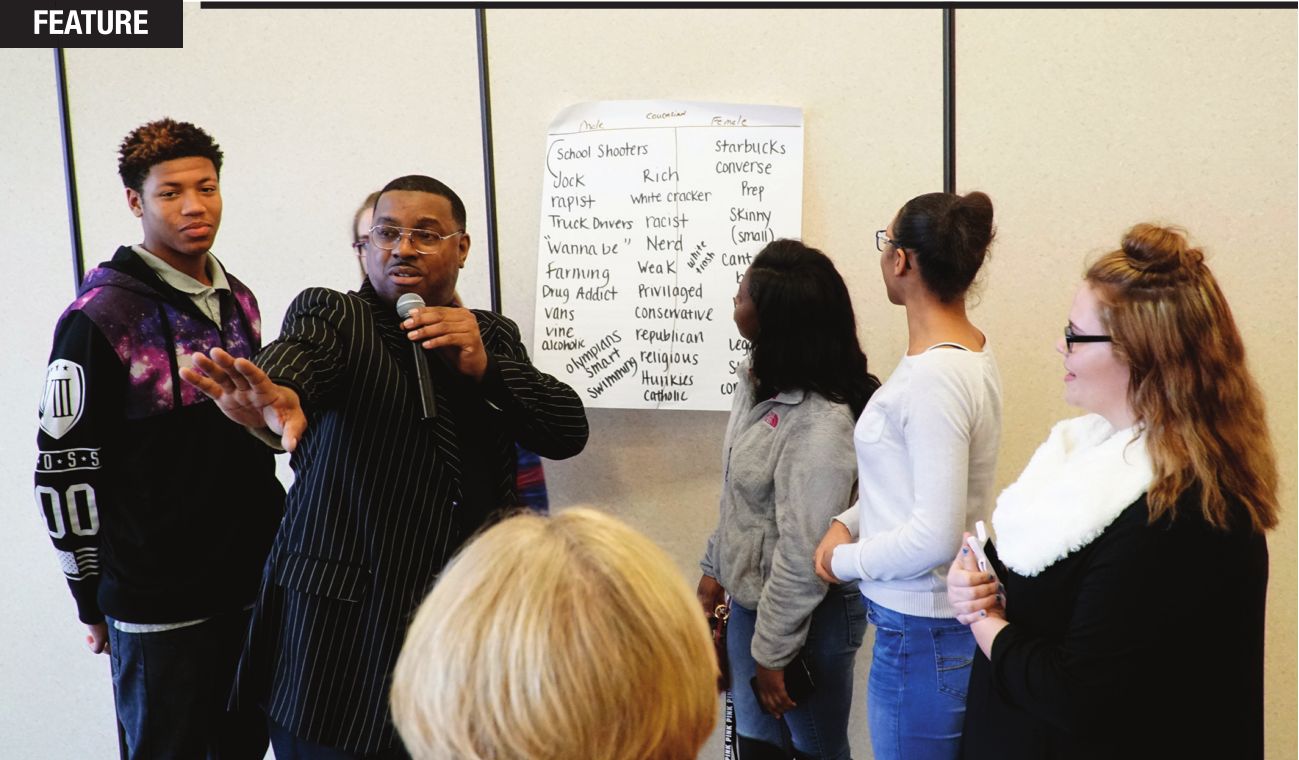
leading an exercise regarding stereotypes. Students were broken into
small groups, each assigned to discuss a particular social category –
ranging from cheerleaders to
Muslims – and then list characteristics commonly associated with each,
the clear message being that such stereotyping is unfair to individuals.
The ensuing discussion highlighted the idea that stereotyping is
undesirable but sometimes difficult to recognize and combat as it
happens within each of us.
 This
concept was driven home in a much more pointed manner in the next
section. Floyd gave a short lecture about a mysterious tribe purported
to be “invading North America.” Based on a popular satirical 1956
anthropological paper by Horace Miner (the original paper is available
to read here: http://www.ohio.edu/people/thompsoc/Body.html).
During the sessions, Floyd described the “Nacirema” as a seemingly
warlike and antisocial group who “see the human body as ugly,” regularly
practicing “scraping and lacerating of faces and legs with sharp
instruments” as well as gathering to watch ritualized violence, among
other things. Students were aghast at the description of the tribe,
calling them “insane,” “strange” and “morbid.” When asked how she would
treat a Nacirema member if one started going to her school, a student
replied, “I would be nice to them but I would not be their friend.” A
collective gasp went through the group when Floyd revealed that Nacirema
was actually “American” spelled backwards and the rituals described
were western commonplaces such as shaving and school sporting events.
“That which you have talked so bad about,” intoned Floyd with gravity,
“is you.” The dramatic lesson – that prejudice is often a simple matter
of perspective and we are all susceptible to it and should be mindful to
avoid casting judgment – clearly made an impression.
This
concept was driven home in a much more pointed manner in the next
section. Floyd gave a short lecture about a mysterious tribe purported
to be “invading North America.” Based on a popular satirical 1956
anthropological paper by Horace Miner (the original paper is available
to read here: http://www.ohio.edu/people/thompsoc/Body.html).
During the sessions, Floyd described the “Nacirema” as a seemingly
warlike and antisocial group who “see the human body as ugly,” regularly
practicing “scraping and lacerating of faces and legs with sharp
instruments” as well as gathering to watch ritualized violence, among
other things. Students were aghast at the description of the tribe,
calling them “insane,” “strange” and “morbid.” When asked how she would
treat a Nacirema member if one started going to her school, a student
replied, “I would be nice to them but I would not be their friend.” A
collective gasp went through the group when Floyd revealed that Nacirema
was actually “American” spelled backwards and the rituals described
were western commonplaces such as shaving and school sporting events.
“That which you have talked so bad about,” intoned Floyd with gravity,
“is you.” The dramatic lesson – that prejudice is often a simple matter
of perspective and we are all susceptible to it and should be mindful to
avoid casting judgment – clearly made an impression.
Dexter
Floyd is a national consultant for AVID (Advancement Via Individual
Determination), described on the district website as an “in-school
academic support program for grades 4-12 that prepares students for
college eligibility and success.” It places academically average
students in advanced classes and aims to level the playing field for
minority, rural, low-income and other students without a college-going
tradition in their families. “AVID is for all students,” the website
description continues, “but it targets those in the academic middle and
is implemented school-wide and districtwide.” The program originated in
California in the early 1980s and has been part of the District 186
curriculum since 2005. Cultural awareness sessions like the one at
Erin’s Pavilion are conceived as a method of both creating a better
learning environment and providing skills for negotiating difficult
social terrain both inside and outside of school, including racism and
religious intolerance.
Beginning
as a professional development tool for faculty designed to “assist
educators in creating and integrating culturally relevant teaching
practices that create supportive, safe and respectful academic
environments for all students” the cultural awareness program is now
being applied directly to 186 students participating in the AVID
program, who were then charged with making presentations to faculty
about ways these ideas can be applied in the classroom to create a more
equitable and inclusive learning environment.
“We
had a very positive response from the faculty participation,” said
Rockford-based AVID program manager George Buss, who helps implement
AVID and special programs like these throughout the state. “They were
excited to learn about the dialogue the students had.” Buss also met
with District 186 administrative staff, including the district’s
director of secondary schools and programs, Cheree Morrison, and Shelia
Boozer, director of teaching and learning. “We are looking at how the
administration can support those conversations,” Buss said. “I was able
to meet with Dexter and he was exceedingly complimentary of the
students,” he
said. “Dexter was impressed with the depth of how they were tackling
those issues of equity, their own definitions and their own
stereotypes.” Buss pointed out that topics like stereotyping can make
for difficult conversations for adults who may have some very ingrained
beliefs and stressed the importance of introducing these concepts at a
young, more receptive age.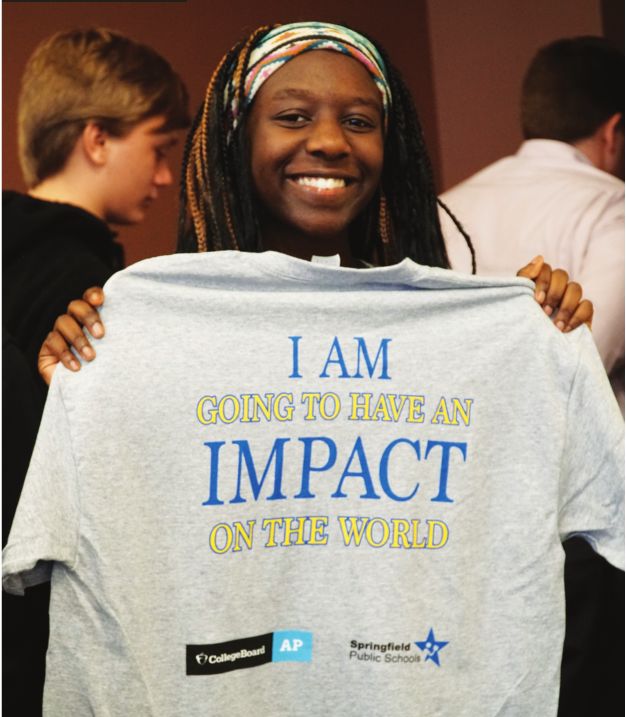
“They
are certainly developing thought and philosophy and they are able to
express frustration and anger, disbelief,” said Buss. “Dexter was
interacting with a lot of students during those sessions and he
expressed to me gratitude that the students were coming up and thanking
him for the opportunity.”
Students
did seem appreciative and energized immediately after the sessions. “It
really made me change my mind about how I treat a lot of people,” said
Jalen Creager, a student at Grant Middle School. “Even though some
things might seem fair,” she said, referring to the exercises with the
cartoon animals, “they’re not really fair to everybody.”
“The
way I view the world is a lot different now,” said Tally Martin of
Franklin Middle School. “Stereotypes are a big thing in society. I’ve
judged people before.”
Ashley
Farmer, a junior at Lanphier High School, said, “I thought it was very
good. It taught you to get outside of the box.” This idea of getting
outside of the box came up numerous times during the sessions, referring
to breaking unconscious habits of mind which the exercises helped to
point out.
Mackie
Baal, also of Lanphier, said she found the session empowering. “I think
people nowadays are so caught up in the stereotypes that we don’t think
we can get out. But I think he proved today that we can and it’s not as
hard. I can definitely apply some of the words that he has said and put
it to my everyday life.”
Devin
Hale of Washington Middle School also enjoyed the session and drew an
immediate connection to his own experience. “The whole time I was
thinking about how people have a stereotype about Washington Middle
School,” he said. “I have gone to school there for three years and
stereotypes are strong around Springfield that kids are bad at
Washington. But in my thinking that school is perfectly fine, there’s
nothing wrong with it, it’s like any other school.”
Scott Faingold can be reached via [email protected].


