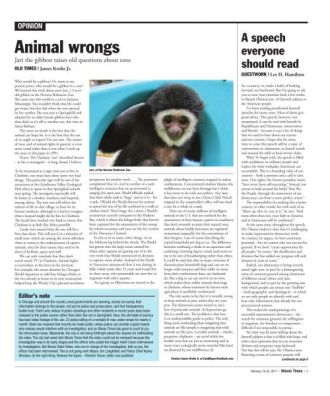
Jari the gibbon raises old questions about zoos
Who would be a gibbon? Or, more to my present point, who would be a gibbon in a zoo? We learned this week about poor Jari, a 3-yearold gibbon at the Henson Robinson Zoo.
She came into this world in a zoo in Jackson, Mississippi. You wouldn’t think that life could get worse, but hers did when she was rejected by her mother. She was sent to Springfield and adopted by an older female gibbon here who then died, so it’s off to another zoo, this time in Santa Barbara.
The move no doubt is the best that the animal can hope for. Is it the best that the rest of us ought to expect? I’m not sure. The matter of zoos, and of animal rights in general, is even more vexed today than it was when I took up the issue in this paper in 1991.
Notes: The Chatham “zoo” described therein – in fact a menagerie – is long closed, I believe.
To be incarnated as a tiger and sent to live in Chatham, one must have done some very bad things. This particular tiger will be one of the attractions at the Grindstone Valley Zoological Park when it opens in that Springfield suburb next spring. The menagerie reportedly will be home to a donkey, monkeys and leopards, among others. The new zoo will relieve the tedium of life in that village, at least for its human residents, although it is hard to imagine what a leopard might do for fun in Chatham. The locals have worked very hard to insure that Chatham is as little like Africa possible.
Locals were assured that the zoo will be a first-class show. This will put it in a minority of small zoos, which are among the worst offenders when it comes to the maltreatment of captive animals, since by their nature they tend to be short of facilities, space and staff.
We can only conclude that they don’t watch much TV in Chatham. Animal rights is everywhere in the news at the moment. For example, the recent decision by Chicago’s Shedd Aquarium to add four beluga whales to the two already at home in its new oceanarium helped keep the Windy City’s placard merchants prosperous for another week. . . . The protesters complained that it’s cruel to confine to a tank intelligent creatures that are accustomed to ranging the open seas. Shedd officials replied that their whale tank is “huge” and so it is – for a tank. (Would the Shedd director be content to spend the rest of his life confined in a walk-in clothes closet? That’s huge, for a closet.) Shedd’s oceanarium scarcely compares to the Hudson Bay, which is where the beluga frolic that haven’t been captured for the amusement of the young for whom oceanaria and zoos are the live version of the Discovery Channel.
In this as in so many other things, we in the Midwest lag behind the trends. The Shedd has gotten into the large ocean animal biz when other aquaria are getting out of it; the very week that Shedd announced its decision to capture more whales, Sealand of the Pacific in Vancouver announced that it was closing its killer whale tanks after 22 years and would free its three orcas, who presumably are now free to negotiate with other aquaria.
As a group we Illinoisans are inured to the plight of intelligent creatures trapped in useless confinement. Conventional wisdom blames this indifference on our farm heritage but I think it has more to do with our politics. Any state that does not weep to see a Dawn Clark Netsch trapped in the comptroller’s office will not shed a tear for a whale in a tank.
There are of course millions of intelligent animals in the U.S. that are confined for the amusement of their human captors in conditions that don’t remotely recreate their natural ones, animals whose bodily functions are regulated (sometimes surgically) for the convenience of their keepers. I am of course describing the typical household pet dog or cat. The difference between confining a whale in an aquarium and confining a hunting dog in a back yard seems to me to be one of housekeeping rather than ethics. It could be said that after so many centuries of domestication household dogs and cats are no longer wild creatures and thus suffer no more from their confinement than, say, husbands do. But a dog or cat can survive on its own, which makes them wilder animals than hogs or chickens, whose treatment by factory-style agriculture is justifiably condemned.
The rule seems to be that it is morally wrong to keep animals as pets, unless they are your pets. The distinction seems rooted in one’s love of particular animals. As hypocrisies go this is a small one. The problem is that love is an undependable guide to policy. The only thing more misleading than imagining that animals are like people is imagining that wild animals are like pets. Loveable animals – whales, porpoises, elephants – are saved while less lovable ones that are just as interesting and in many ways ecologically more essential (like bats) are doomed by our indifference.
Contact James Krohe Jr. at [email protected].
Editor’s note
In
Chicago and around the country, local governments are learning, slowly
but surely, that information belongs to the people, not just to police
and prosecutors, and that transparency builds trust. That’s why videos
of police shootings and other incidents in recent years have been
released to the public sooner rather than later. But not in Springfi
eld. Here, the old habit of secrecy has kept video footage of the Jan.
23 police killing of a mentally ill man under wraps for nearly a month.
State law requires that records be made public unless police can provide
a good reason why release would interfere with an investigation, and so
Illinois Times has gone to court to pry the information loose.
Meanwhile, the city is not being forthright about the reasons for
withholding the video. The city last week told Illinois Times that the
video could not be released because the investigation was in its early
stages and the offi cer who pulled the trigger hadn’t been interviewed
by investigators. But Illinois State Police, who are in charge of the
investigation, told us yes, the offi cer had been interviewed. This is
not going well. Mayor Jim Langfelder and Police Chief Kenny Winslow, do
the right thing. Release the tapes. –Fletcher Farrar, editor and
publisher