Three fresh voices aim to shake up Springfield’s literary scene
Poetry is at once the most marginalized and the most accessible of art forms. Pretty much anyone with both a thought and the desire to express it can jot down a few words and head to the local coffee shop to declaim in front of whoever will listen. But the practice remains relatively rare.
A handful of ambitious young writers has recently begun causing a stir in the Springfield poetry scene. Three of the most distinguished members of this youthful group – Johari Osayi Idusuyi, Ian Winterbauer and Emma R. Wilson – have been making waves with a flurry of exciting readings and publications (and in one case a subtle, impromptu political protest which managed to go viral).
Springfield has long had poetry on its radar as the home of the stillinfluential Vachel Lindsay (1879- 1931), whose former house is a local historic landmark as well as the site of the ongoing “Poets in the Parlor” series of readings by nationally known writers. Local poetry thrives here with the longstanding Springfield Poets and Writers group, active since 1993, which presents an open mic on the third Wednesday of each month at Robbie’s Restaurant on the Old State Capitol Plaza.
Idusuyi, Wilson and Winterbauer have developed a camaraderie based in their shared passion for poetry – they often attend events together and also critique each other’s writing in workshops. Stylistically, however, the three are quite distinct from each other, with Idusuyi’s writing focused largely on social and political concerns while Wilson tends to dissect the intimate corners of her own psyche. Winterbauer’s work, meanwhile, provides laconic and often acerbic observations of life as he experiences it in the Midwest.
Contact Scott Faingold at [email protected].
Ian Winterbauer
“I
started out writing songs but I can’t play the guitar and sing at the
same time so I just dropped the guitar,” said Winterbauer, 26, when
asked how he got his start in poetry. He began producing homemade
chapbooks of his work, which he would leave at Dumb Records. “People
would just take ’em,” he recalls. “Then the first time I ever read my
stuff at an open mic here in town, everybody already knew who I was from
the chapbooks.” Winterbauer contends that the biggest difference
between writing poetry now and in the past is technology. “There have
always been poets around Springfield, but in the old days, they would
have to sit at a desk and write and then go out and try to find an
audience. But people now write something and put it on social media and
the whole thing will take 10 minutes and there are people reading it.”
 Winterbauer
describes himself as “something of a barroom poet” having developed a
rather confrontational style reading at open mics held in bars. “You
have to trick most people into caring about it, or else just berate them
until they’re listening,” he says. “I
have a pretty good energy, belligerently drunk and shouting. It works
pretty well!” Winterbauer, who works as a barrista at the Bean Counter,
says he doesn’t see a downside to working in Springfield and enjoys the
solidarity with his peers. “In Chicago it’s a bunch of city people,
they’ve got their own thing going. But in Springfield we’re part of this
bigger thing, it’s an ‘us.’” It was during a reading in Chicago that
Winterbauer found a publisher for his upcoming book, Scream as You Leave, which
is set to be released by A Jabber Publications on March 1. “As with all
of my success in poetry, somebody walked up and offered it to me,” he
drawls. “I met Jon Dambacher, who is a very talented poet and writer,
online – as most relationships begin, nowadays. We got to chattin’ and
then I went up to Chicago to read with him and another very talented
California-based poet named Cliff Weber. I walked away from that
performance with a book deal.”
Winterbauer
describes himself as “something of a barroom poet” having developed a
rather confrontational style reading at open mics held in bars. “You
have to trick most people into caring about it, or else just berate them
until they’re listening,” he says. “I
have a pretty good energy, belligerently drunk and shouting. It works
pretty well!” Winterbauer, who works as a barrista at the Bean Counter,
says he doesn’t see a downside to working in Springfield and enjoys the
solidarity with his peers. “In Chicago it’s a bunch of city people,
they’ve got their own thing going. But in Springfield we’re part of this
bigger thing, it’s an ‘us.’” It was during a reading in Chicago that
Winterbauer found a publisher for his upcoming book, Scream as You Leave, which
is set to be released by A Jabber Publications on March 1. “As with all
of my success in poetry, somebody walked up and offered it to me,” he
drawls. “I met Jon Dambacher, who is a very talented poet and writer,
online – as most relationships begin, nowadays. We got to chattin’ and
then I went up to Chicago to read with him and another very talented
California-based poet named Cliff Weber. I walked away from that
performance with a book deal.”
As
for his writing process, Winterbauer says it is a matter of watching
and waiting. “All my poems start off on scraps of garbage that I have in
my pockets,” he said. “Most of the stuff I write is like a snapshot of
wherever I am. For example, this kid across the street had a birthday
party and afterward they dumped everything in the trash. It was really
weird just seeing the birthday balloons floating out of the dumpster.
Boom: poem! Wrote it on the back of a cigarette carton.”
Emma Wilson
Emma
Wilson, 26, has become an increasingly familiar face on the Springfield
creative scene over the past year, between her presence both in front
of and behind the camera on popular local web series The Studio Show and
her increasing visibility at poetry readings. She says she enjoys being
creative in Springfield where the independent, DIY vibe is inclusive.
“It’s about breaking down that bullshit wall that so often is around
writers,” she says. “That’s how the scene is most important to me. If
you look at the byline in a typical poetry journal, they are all like,
‘so and so has an MFA from blah blah blah’ and I’m conflicted about it,”
she said. “On one hand I’d love to have an MFA myself, but on the other
hand I think it creates this barrier that is superintimidating and as a
result a lot of people don’t feel being a poet is an accessible goal.”
Wilson
began writing “bedroom poetry” in her journal while in high school and
later attended Millikin University where she earned a bachelor’s degree
in creative writing. “That’s where my love for poetry kind of exploded,”
she said. In 2012, Bronze Man Books published an elaborate chapbook of
her poetry entitled A Map to the Multiverse, which was handstitched and included illustrations by former Pharmacy Art Space and Gallery member artist Jess Black.
It
took some time after graduating from school and moving to Springfield
before she started pursuing poetry in a more serious way – and she
largely credits her connection with Idusuyi and Winterbauer for that. “I
can’t overemphasize the importance of having peers who are hustling at a
similar velocity. I haven’t known Ian all that long, I’ve known Johari a
little longer, but I really love these people because hanging out with
them makes me want to write more,” she said. “We all complement each
other and can give really good feedback to each other because we’re
coming at poetry from three different places.”
Wilson,
who works as a principal consultant in information technology at the
Illinois State Board of Education, is a strong believer in the power of
the written and spoken word. “It can be so revolutionary and real and
honest. I’d say it is just as dynamic if not more so than a rock
concert.” She recalls a formative early experience reading at a
straitlaced Decatur event. “I did a poem about losing my virginity and
nobody clapped and there was this kid in the back who said audibly ‘what
is happening?’ That was probably my most bizarre, uncomfortable moment
as a poet. Now I own it, though. I’ll just say at the top of the
reading, ‘I’m going to read a lot of angry sex poems.’”
Johari Osayi Idusuyi
Johari
Osayi Idusuyi, 24, hosts a monthly poetry night at Wm. Van’s Coffee
House and, like her comrades, puts a high value on the Springfield
creative scene. “I think we’re bringing together a more intimate space
where people are listening to poetry and are there for it 100 percent,”
she says. “We’re also growing in the sense of collaborating with each
other without using any type of outside business as we learn and expand
and become better at our craft.”
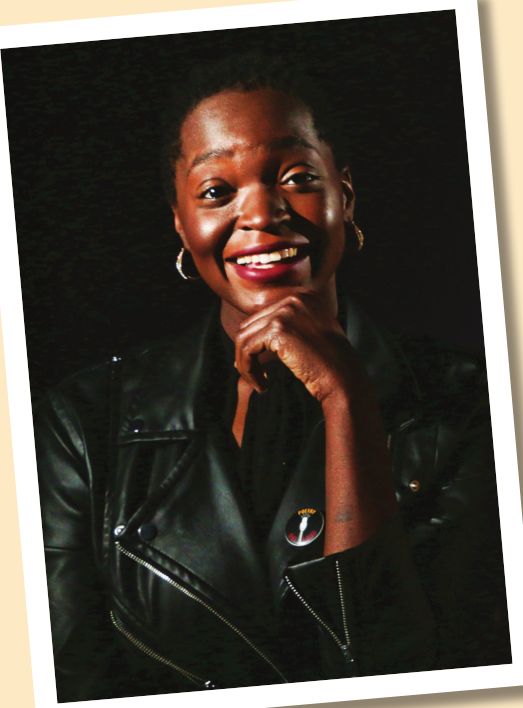
Idusuyi,
who attends UIS and works at Caribou Coffee, laments the limited ways
most people seem to view poetry’s potential. “People are exposed to the
classics of poetry in high school but there’s no expansion of that –
teachers don’t always do a great job of showing the balance of what
poetry can do.” She grew up in central Illinois and started writing in
eighth grade. “It was something I did as a catharsis. I was always
inspired by a lot of spoken word stuff and I always had favorites and I
loved poetry but I didn’t make it a discipline until last year,” she
said. “One of the most intimate things you can do is read poetry to an
audience. It’s an outpouring of your soul and the fact that writers
choose to do it with us at Wm. Van’s is one of my favorite things.”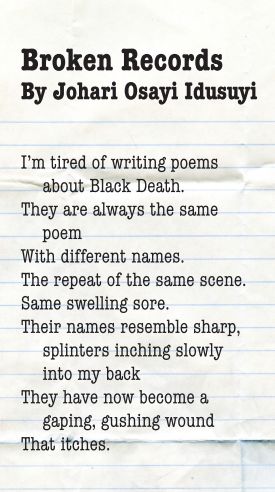
Idusuyi
was briefly thrust into the national spotlight last year, when footage
of her attending the November 2015 Donald Trump rally held at the
Prairie Capital Convention Center – where she can be seen pointedly
reading a book behind the future president’s shoulder as he speaks –
went viral, landing her an interview spot on “The Rachel Maddow Show”
among other appearances. “I was genuinely interested to hear what
[Trump] had to say in terms of policy and ideology,” she said during a
recent interview on Illinois Edition radio. “Thirty minutes into his
speech there was nothing of substance being said, so I started reading.”
The book happened to be Citizen by Claudia Rankine, a collection
of poems addressing racism in America, which made the gesture doubly
pointed for those in the know. “I was confronted by a couple seated
behind me who told me I should leave if I didn’t want to be there. I
told them I had wanted to be there, I had good intentions when I first
came.”
Since that
time, Idusuyi has increased her efforts to be heard and to facilitate
the poetry scene in town, where she finds the DIY scene both inspiring
and occasionally exhausting. “It really challenges and pushes us to grow
as writers but it’s still pretty hard,” she sighs. “Sometimes I just
want a break, I want something to already exist – there are times when I
don’t want to plan everything.” Winterbauer, Wilson and Idusuyi have
discussed publishing an anthology zine of their writing, which is an
exciting prospect but also promises to create even more work. “We have
to do it because this is who we are,” she said.
“I
think an artist’s job is to make social commentary on our culture,”
Idusuyi continued. “We can elevate it or criticize it and use our talent
to engage in change and make people react, force people to feel.
Especially in this technological age with people trying to maintain a
fake sense of self, an artist can challenge that. We want people to feel
the range of emotion.”


