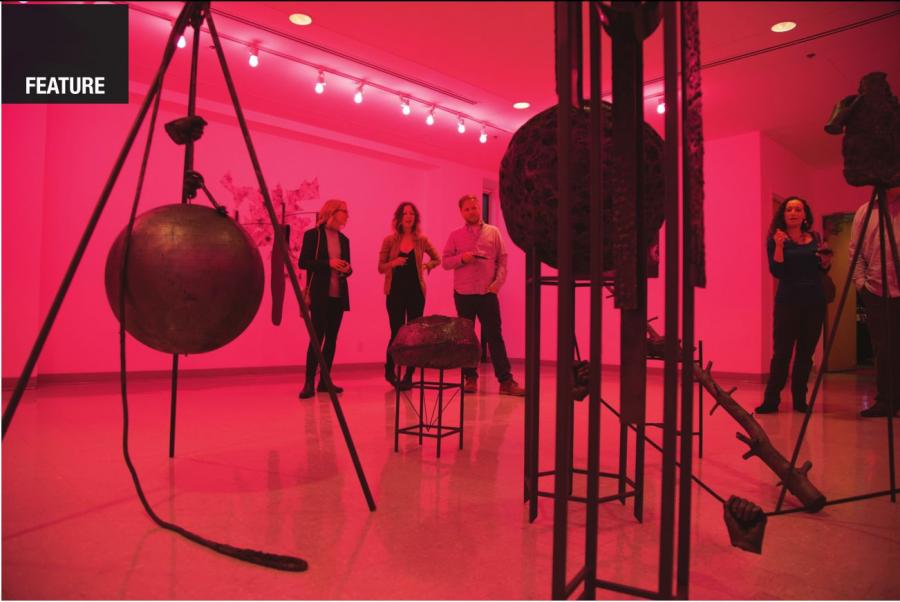
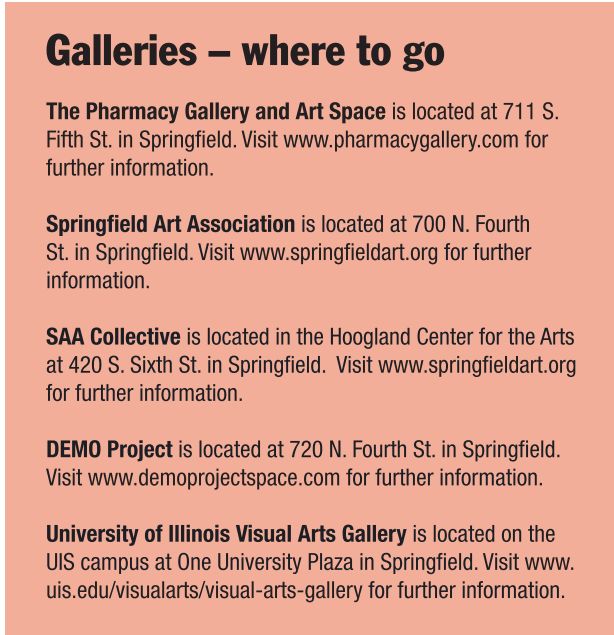
The visual arts in Springfield blossomed throughout 2016, with established institutions and grassroots groups alike reporting a great range of positive motion in spite of potentially mitigating factors such as the ongoing state budget impasse. In an especially exciting development, the City of Springfield has stepped in with funding and support for an innovative residency program centered in the Enos Park neighborhood with the aim of expanding the presence of the arts in town. Spirits seem high throughout the artistic community heading into the new year.
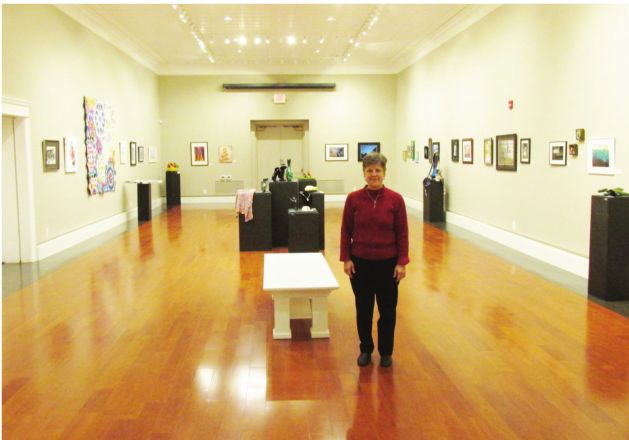
The merger of the venerable Springfield Art Association with the struggling Prairie Art Alliance a year ago has reportedly paid dividends. “We’ve really come together,” said Springfield Art Association executive director Betsy Dollar. The H.D. Smith Gallery at the downtown Hoogland Center for the Arts – formerly Prairie Art Alliance headquarters – has been rebranded as the SAA Collective Gallery. “It’s fun
to have a second location,” Dollar said of adding the Hoogland gallery
to the association’s longtime home on North Fourth Street. “I think of
it as being our retail gallery space versus the more traditional
exhibition space over here at the main campus. Now when people come in
and are looking to buy a piece of pottery we have just the place to send
them.” Dollar describes the transition as relatively smooth. “A lot of
the [former PAA] artists have stuck with us and I think they’re happy
with the amount of marketing and other things we’ve been trying to do in
order to keep them in the forefront.”
“You
dive into these things with a really positive attitude but no one knows
how it’s going to come out on the other side,” said SAA Collective (and
former Prairie Art Alliance) gallery director Corrin McWhirter
regarding the merger. “The artists have certainly been willing to give
it a go, which was a huge plus.” McWhirter reports that the gallery
maintained its standard retention rate of member artists along
with having some new artists join. They are now in the midst of
evaluating a round of new artistic applicants, which she described as
“the largest response to a call for potential new artists we have seen
in the three years I’ve been directing the gallery.” Another thing she
noticed is that the current crop is coming from as far away as Rushville
and even Champaign. “We’re going to ultimately end up serving the whole
of central Illinois, which is a goal that we’ve had,” she said.
Positive
effects of the merger can be felt in the arts community beyond the
Springfield Art Association, according to Allison Lacher, who is manager
of the University of Illinois Springfield Visual Arts Gallery as well
as a managing member of the DEMO Project (more on both of them below).
“It just seems like the community is strengthening and people are
willing to move past old perceptions,” she said. “Right now the
questions seem to be: how can we move forward and how do we
become a better and stronger city for the arts? There is some forward
movement and it’s in the right direction.”
The
first exhibition on the books for the SAA’s North Fourth Street
location, set to open Jan. 5, is entitled “Life Outside the Classroom”
and will consist of work by Springfield area art teachers, an idea that
resonates with Dollar personally. “I’m hoping that a lot of their
students make it to the show,” she said. “As a kid, I never had a clue
what any of my art teachers were doing – it would have been fun to see
their work and their practice.”
The Collective Gallery has a full calendar going into 2017. Their annual photo contest (in partnership with Illinois Times) has
been moved from its usual winter date all the way to June. “We’re
hoping it is going to get a bigger response in the warmer weather – when
it’s cold out, nobody wants to go out and photograph things,” she
observed. There are also plans for an
exhibition with a theme described as “play in all its forms and all its
levels” as well as a partner exhibit with the Hoogland which will
include a smallscale theatrical production performed in the gallery.
McWhirter also noted that foot traffic into the gallery has increased
over the past year, as well as more active interest from those visitors.
“We have seen a lot of people from out of town, commenting and being
really impressed with the quality of work that’s here. We shipped a
piece to Australia this year and we have also been shipping work to
Chicago and around the state.”
Meanwhile,
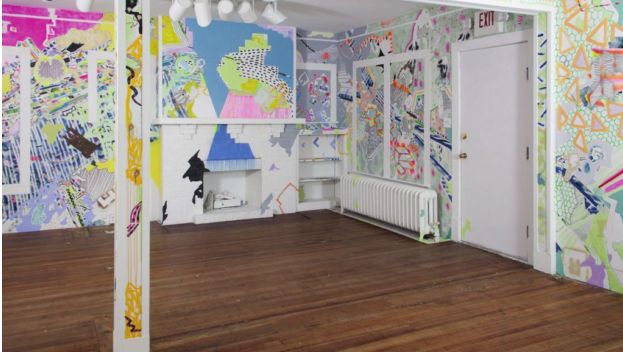
DEMO Project – the tiny standalone gallery on the SAA campus
specializing in contemporary work by visiting artists – effectively
doubled its display space in 2016. “The big DEMO development for 2016
was the renovation of the kitchen as a new gallery space,” said Allison
Lacher, “so we launched a second facet of programming and have hosted
several shows in there. It’s twice the work,” she laughs, “but it also
means there is now that much more contemporary art in our community.”
The name DEMO Project is
a reference to the fact that the space’s days are numbered: the Art
Association granted temporary use of the venue with the understanding
that the small house on the Art Association campus was slated for
eventual demolition. “We launched the space in September 2013 so we’ll
be celebrating our fourth anniversary this coming year,” said Lacher
wistfully. “And it will very likely – barring some incredible
circumstance – be the last anniversary we see there. It is going to get
demolished and it’s very likely we will only have the space about six
months into 2018. So we’re really trying to hit it pretty hard here.”
Plans for a post-demo DEMO location are in the early exploratory stages.
A
call for new work to be displayed at DEMO in 2017 received a record
number of submissions – close to 200, according to Lacher, who
characterized the applicants as being “from all over the country, coast
to coast, even international.” As for how all these far-flung artists
are finding out about the tiny, doomed space in central Illinois, Lacher
had some theories. “I know people aren’t hearing about DEMO through
national media coverage,” she said wryly, instead attributing the
growing reputation of the space to a combination of wordof-mouth and
social media. For example, Lacher describes an interaction with a recent
visitor, a former
Springfield resident who said that while she was working in a gallery in
New York she happened to notice DEMO Project listed on an artist’s
curriculum vitae, along with MOMA, so the next time she visited her
hometown she made a point of paying a visit to DEMO. “There are just
these little pops of where DEMO is turning up all over the place,” she
said. “There’s something really great about this site, artists tend to
have a good time and are happy with the work they’re able to produce to
show here and so that energy has just been spreading.”
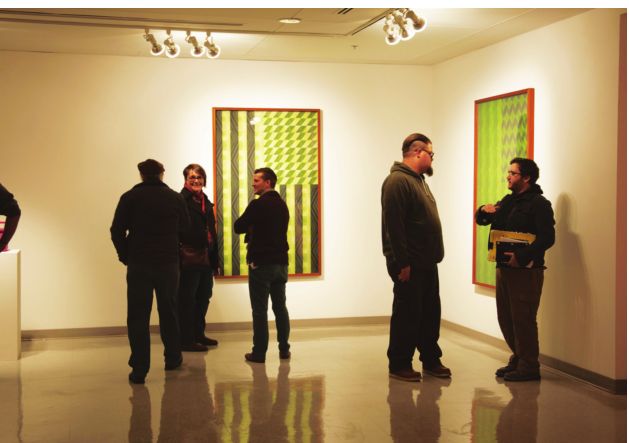
The UIS Visual Arts Gallery, on
the campus of University of Illinois Springfield, where Lacher works
her day job as gallery manager (DEMO is a labor of love) has hosted an
eclectic array of work this year, including an exhibition by St. Louis
artist Lyndon Barrois, Jr., which took as its subject the late iconic
musician Prince. “That was really timely in the context of Prince’s
passing and it was a different show for us,” Lacher said. Other
memorable exhibits this year included Washington, D.C.’s Paul Short who
mounted an ambitious combination exhibition, lecture and workshop
centering around cultural and economic stigmas associated with
loitering. A recent twoperson show by central Illinois figurative
painters Amanda Greive and Stanley Bly turned out to be a big hit with
attendees. “They presented a cohesive exhibition where their work was
very much in dialogue with one another while maintaining their
individual identities,” Lacher said.
The
spring semester is slated to kick off at the gallery with an exhibition
from Tyler Lotts, a professor of ceramics at ISU, followed by a March 2
presentation from Diaz-Lewis, a husband and wife collaboration between
Alejandro Diaz and Cara Lewis. “Alejandro is a Cuban refugee,” Lacher explains, “and he
and Cara have created an ongoing work entitled ‘34,000 Pillows’ in
response to a congressional mandate stating that immigration and customs
enforcement agents are required to maintain a quota of 34,000 detained
immigrants per day in 250 centers around the country.” The couple is
trying to make a pillow for every detainee of this mandate and will be
bringing a “Pillow Workshop” to the UIS gallery along with other work.
“That’s
the beauty of programming here at UIS,” Lacher said. “One month you
might have a more traditional exhibition of figurative painting and then
follow it up with a very socially conscious and culturally diverse
project.”
The independent Pharmacy Gallery and Art Space continued
to present innovative, well attended group exhibitions showcasing work
by its members in 2016 and shows no sign of stopping.
“It’s
been somewhat surprising,” says longtime Pharmacy member Jeff Williams
of the group’s five-year track record, which reached a new crescendo a
few weeks ago with a fashion-themed exhibit replete with runway show.
“Usually we try to do things that are a little bit different. That’s
something I like personally and the community also seems to appreciate
it.”
“Each show is something totally different and it’s always a surprise,” added Pharmacy president Janet Sgro.
“The
way you picture a show at the beginning and then how it turns out is
always hugely different,” said Williams, “but as somebody trying to
create things, you want to expand your comfort zone and realize you can
do certain things and have the community’s support. Although after a
while, you do almost feel pressure to make sure it’s not seen as, like,
just another Pharmacy show.”
In
the coming year, The Pharmacy is planning a show in collaboration with
the YMCA, where the Y kids will make art which Pharmacy members will
then interpret, with both versions displayed together. In addition to
quarterly group exhibits, the venue has been hosting monthly public art
critiques this year where anyone in the community is encouraged to bring
in their work for feedback. They also plan to start offering drop-in
life-drawing classes. “Instead of signing up for six weeks worth of
classes or whatever, if someone decides to come in or not for any given
session, that’s fine,” said Williams. “We’re hoping people from outside
the city might make the drive to Springfield just to check out a casual
life-drawing class.”
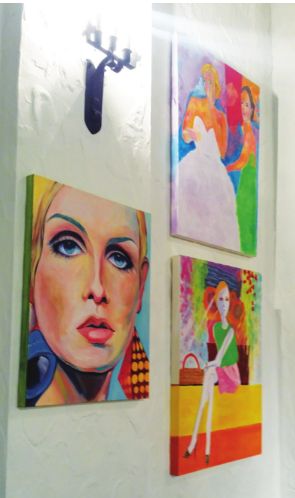
Unaffiliated and emerging artists throughout the region have had the option this year to participate in First Friday exhibitions,
administered by organizer Clare Frachey. “Starting in August 2015 I put
on one art show a month at Café Brio,” she said. “I didn’t go into it
with any standards or guidelines or expectations in mind, I would just
approach people who I knew were artists. Half of the time I didn’t know
what they made or the content or the subject matter, just approach them
and ask them to be in the show.” Three artists per month had work on
display at the restaurant on the first Friday of each month and when the
exhibition ended the work would hang on the walls of the restaurant
until the following month. Following the recent unceremonious closing of
Café Brio, Frachey is currently on the lookout for another space to
host First Fridays in 2017.
More
recently, Lisa Clemmons Stott, executive director of Downtown
Springfield, Inc., approached Frachey about spearheading a pop-up show
series as part of DSI’s Holiday Walks. The result has been “Deck the
Walls,” featuring work from two or three artists on display and for sale
every Wednesday evening in the former Small Business Development Center
building (located between the Feed Store and the Korean War Museum) on
the Old State Capitol Square between Nov. 30 and Dec. 21.
Frachey
believes the size of Springfield allows for unique opportunities to
present art. “In my experience, networking is relatively easy to do
here,” she said. “I’ve noticed that a lot of artists, organizers and art
groups tend to know each other and generally, efforts find support
within and across the various factions. Cooperation is not where it
could be but I notice more connections happening recently – people are
always reaching out to each other.”
Inevitably,
the ongoing state budget impasse reverberates in the Springfield art
scene, but less so than might be expected. “It is having an impact on
sales,” said McWhirter of the SAA Collective Gallery, “but a little bit
less of an impact than we saw last year. People seem to be deciding,
yeah, this is the way we’re gonna live and just seem to move on.” She
has noticed the prices of work sold by the Collective have been rising.
“From a bottom line, financial standpoint we certainly feel a little bit
better about it than I would have said last year. We were worried.”
“The
grant funding came late this year and it was a little less than usual.
But it came,” said Lacher. “State budget issues are always a looming
force and you never know. At an institution like UIS, when they have to
trim the fat, this is one place that could come from. But so far, so
good!”

The most exciting development for the art scene in Springfield going into 2017 is the new City Arts artist residency program.
The
SAA recently purchased, with financial help of the City of Springfield
and some TIF funds, a duplex structure on North Fifth Street immediately
south of the association’s campus. The plan is for the house to be
occupied by four artists who will apply to live there for a “very
nominal” monthly rental feel for a period of either six or 12 months.
“We’re really hoping that this will draw artists from other places to
come to Springfield,” said Dollar. “Ideally, they would engage with the
Art Association and the Enos Park neighborhood as a whole and also work
with the city and downtown to generate some new, arts-based activities
with the neighborhood.”
The first round of applications is being accepted now at www.enosparkresidency.org,
which includes an explanation of the entire program and all of the
links needed in order to apply. Each unit will be fully furnished and
include two bedrooms along
with decentsized living and dining spaces and a washer and dryer. The
plan is for two artists to live as roommates in each unit and share the
space and use the studios at the Art Association for their work.
Allison
Lacher finds the residency program especially significant, mainly
because of the backing of the city. “Sometimes there can be tension
between city support and artist initiatives,” she marveled. “This is one
that made it – this wasn’t shut down at any point, there was no
conflict of vision. A lot of people had to be on the same page for that
to happen. That’s very encouraging from where I’m sitting.”
With
the Art Association managing the administration of that program and
galleries like UIS Visual Arts Gallery and DEMO Project looking to
support the project and serve as ambassadors for artists that we bring
to Springfield, Lacher sees reason for optimism. “I don’t think it’s
shrouded in mystery here. We want to bring artists to Springfield and we
hope that they stay,” she said. “We’re hoping to really grow the
presence of art and the parameters of what community art can be and the
impact it can have.”
Scott Faingold can be reached at [email protected].