Robert Zemeckis’
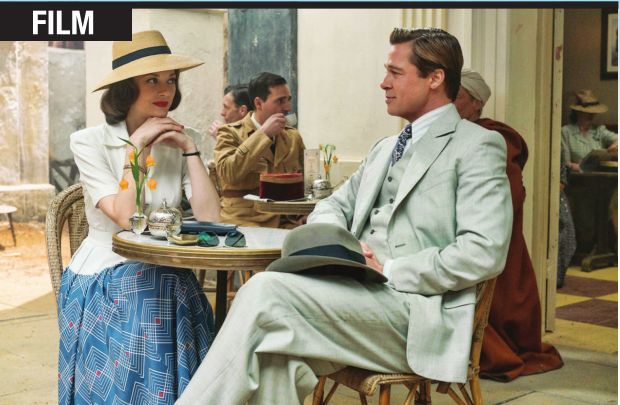
Allied is a film that is concerned about appearances, both in terms of its characters as well as the production itself. Artifice is what drives the film in terms of locale, its two gorgeous leads, and what binds its two protagonists together – although both of them begin as spies, you’re not quite sure who they are or what purpose they serve.
Simultaneously commenting on the films and era that inspired it, the script by Steven Knight (Locke) pays homage to Casablanca and other wartime romances in far-flung locations but ultimately lacks a sense of urgency despite putting its hero in a thorny situation. And while Zemeckis does his level best to add a piece of visual flare here and there to goose things along, his efforts are brought low again and again by a story that refuses to be told in an efficient, expedient manner.
The time is 1942; the place is French Morocco; in particular, the city of Casablanca, where spy Max Vatan (Brad Pitt) has arrived to complete an assassination with a partner he’s never met. That would be Marion Beausejour (Marion Cotillard), a French operative who takes to playing one half of a suave continental couple with Vatan like a duck to water. After dispatching their target, a mission that takes up the first 45 minutes of the film, the partners decide to become a couple in real life, having let the act of pretending to be in love bleed into genuine feeling. They relocate to England; he continues to help the war effort while she stays at home to raise their daughter. All seems well … until Vatan’s superiors inform him that his wife may in fact be a Nazi spy.
Obviously, this is a major fly in the ointment of their marital bliss, and finding out whether or not this information is true comprises nearly the entire second half of the film. It’s an intriguing premise but it just doesn’t play here. While the talent of the cast and director is beyond dispute, this material simply isn’t in their wheelhouse. The more Zemeckis strained to recreate the romanticism of the wartime films of the 1940’s, the more I wished this one was being made by Alfred Hitchcock, who effectively made a variation on this theme with Suspicion (1941).
Creating suspense was second nature to Hitchcock, and his skills are sorely in need here. The movie doesn’t create tension; it simply sets up one ridiculous obstacle after another, postponing the big reveal to the point that tedium has set in rather than anticipation. Vatan goes to near comical lengths to find out the truth about his wife and the film may have played better had it been a comedy. One scene in particular involving a pilot and Vatan struck me as particularly absurd from a narrative perspective, its outcome being so obvious I expected Pitt to break the fourth wall and ask the audience, “Can you believe we’re using such an obvious set up?” Of course, many movies use well-worn plot points; the trick to getting away with them is to execute them quickly so that the viewer won’t have time to notice or care. The languid pace Zemeckis employs here seems to invite scrutiny, allowing the script’s lack of originality to shine through. And while the film may be slow and composed of one borrowed element after another, there’s no question that Pitt and Cotillard look marvelous throughout. We are effectively transported to an era from the past, both historically and cinematically, and the two principals are glamorous. For some, that may be enough. However, I can’t help but think the movie’s aesthetic is employed here as a diversion so that we might not notice that Knight and Zemeckis have nothing particularly original to say.
Contact Chuck Koplinski at [email protected].


