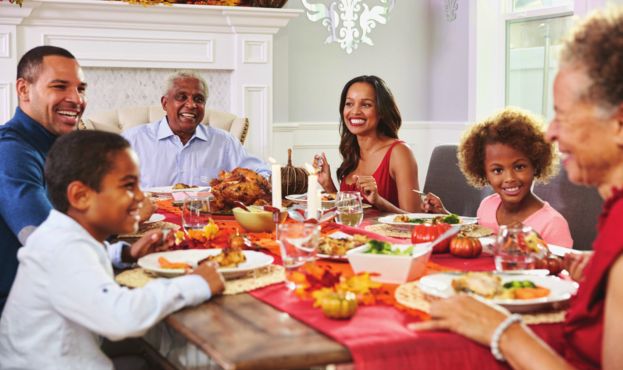
Food is steeped in the expectations of tradition. Here’s why Thanksgiving is the most iconic food moment of the year
Although most family holidays have an ingrained tradition, Thanksgiving takes the pie (pumpkin, of course) for being the one least likely to change. Even as families grow and the holiday hosting duties switch, what remains are the traditions, and none more so than those found on the table.
Whether it’s Mom’s apple pie, Grandma’s mashed potatoes or Aunt Jane’s freshbaked rolls, Thanksgiving just wouldn’t be Thanksgiving without these “must-haves” at the annual feast. Even in an age of expanding palates and culinary wonders, when it comes to Thanksgiving, we sit down and plate up an array of the most basic foods – turkey, potatoes, stuffing and pie.
What differs is how we serve them.
Regionally there are distinctive dishes and every family has its own way of preparing the meal. But regardless of how or where the dinner is cooked, the traditional Thanksgiving meal defines our holiday.
All in the family
“Without mashed potatoes and gravy, it’s not Thanksgiving,” says Jill Houk, a professional chef and author of The Complete Soda Making Book (Adams Media, 2014). Houk has been making her family’s gravy since she was 12 years old. “It never varies,” she says. Similarly, her sister makes the mashed potatoes, and has been for the past 20 years. Houk also makes the homemade cranberry sauce while her mom makes the turkey. “From our standpoint, those are absolute staples,” she says.
At cookbook author Diane Morgan’s house, “the world will fall apart” if she doesn’t make her son’s favorite pie. “If you have these strong elements within a family, those will carry forward, especially if the generations continue to cook,” she says. “Either that, or I’ll get him home for a lot of Thanksgivings.”
Morgan, author of The New Thanksgiving Table (Chronicle Books, 2008) and Salmon: Everything You Need to Know (Chronicle Books, 2016), says that the anticipation of those familiar tastes drives the desire for them. “It’s only once a year you eat these foods,” she says. “We don’t think about stuffing in January.”
So comforting are those tastes that even the most creative of chefs returns to his roots for Thanksgiving. Dishes such as “black truffle explosion, romaine, parmesan” helped Grant Achatz, chef and owner of trendsetting Alinea restaurant in Chicago, win recognition as the country’s outstanding chef in 2008. “When I cook at home for myself or for my family at holiday times it is always straightforward fare,” Achatz says. “For Thanksgiving, the typical roasted turkey, stuffing, mashed potatoes, pumpkin pie and cranberry jelly are what we eat.” Achatz feels that “gathering for a holiday meal has a different purpose than dining out.” The focus, he says, is on gathering with family and comfort. “Eating Aunt Betty’s pumpkin pie every year leads to a feeling of tradition. It simply makes people feel good, and who doesn’t like that?”
Traditions start at home
Eating local may be a trend at the moment, but at one time it was the only way to eat. Many Thanksgiving traditions are based on the foods that were available during that time of year in any given particular area.
In her book due out this fall, Morgan focused on regional recipes. “We all talk about local and what really started the traditions were the local foods,” she says.
In the Midwest, for example, Morgan says parsnips, potatoes and green beans – vegetables that are staples of the farm table meal – appear in many of the recipes. In Minnesota, wild rice is locally grown and therefore an ingredient in the dressing. Shrimp, creamed gravy and biscuits are likely to be on a table in the South.
So does Kirti Pant, corporate chef for Tiffin.com, Philadelphia, who roasts a turkey for Thanksgiving that has been marinated in traditional Indian flavors. “This was an occasion we wanted to celebrate in an American way, but we wanted to keep the flavors authentic Indian,” he says. “It’s always great to be so far away and still be able to enjoy the same authentic flavors that you grew up with.”
The best deal in town
The flavors and foods of youth have another advantage – they’re cheaper. Buying locally and seasonally available foods makes economic sense, ecological sense and culinary sense.
When it comes to Thanksgiving, the menu may be simple, but it’s filled with items that are not only delicious, but meaningful and responsible as well. Besides, as Achatz says, “How often do you get to eat roast turkey and stuffing?”