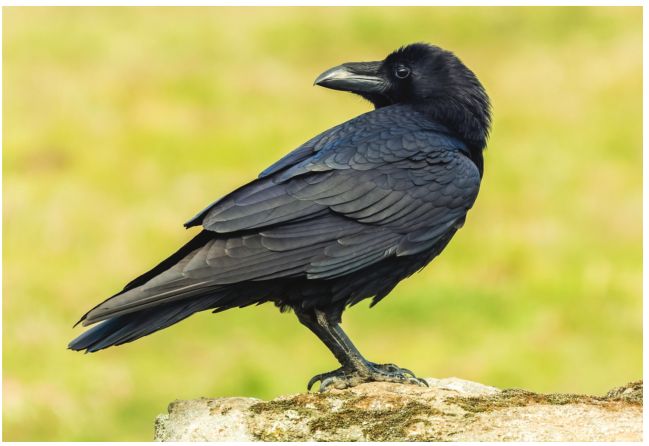
Does a name determine one’s destiny?
Some say that names are
destiny. Surely jurist Learned Hand was doomed at his christening to
take up the law, just as John Wisdom took up philosophy or Brandon Belt
picked up a baseball bat. I am indebted to New Scientist magazine
for what I know about “nominative determinism,” a spoof discipline that
purports to test the notion that people tend to gravitate towards areas
of work that fit their name. Evidence includes a book on polar
explorations by Daniel Snowman and an article on urology by a researcher
named Weedon.
My
surname, as most people guess, is German in origin, as were my father’s
clan. Most surnames derive from one’s ancestors’ family trade. The old
Krohes were farmers and flax weavers, and according to the ancient
European way, might well have become known as Bauers or Webers, after
their crafts. Alas, my name derives from “Kroh,” which in the Middle
High German was a nickname for someone who reminded others of a crow.
Perhaps I was doomed to become an opinion monger. My feathers are easily
ruffled. My first column was called “As the Crow Flies,” a title I was
so taken with that I became a column-writer just so I could use it. I
even peck at a computer keyboard.
Of
course, some native peoples believed that the crow had the power of
speech and was considered to be one of the wisest of birds. (The native
people were very wise.) Unfortunately, the crow has other attributes
that are not so noble. Yes, they are among the most intelligent birds on
the planet. They use tools, and they learn from each other. But they
also are capable of bearing a grudge. Many a researcher has recorded
how, after they had offended crows by trying to capture them or
interfered with their feeding, the birds would remember them and attack
them whenever they saw them again, sometimes (as happened once to
ornithologist H. David Bohlen in Washington Park) singling them out in a
crowd of people. Apparently they teach their young this animus, or
rather, the young learn it by watching their elders.
Were they human, they would
all be in finance; Bohlen, the Birdman of Sangamon, has seen crows
piling corncobs or clods of dirt atop dead birds to hide them and keep
others from eating them – what amounts to tax evasion among the
corvidae. What the crow can’t kill it will steal. The animal is not
known in England (although its close cousins the rook and the raven are)
and when English emigrant Eliza Farnham made their acquaintance in
Tazewell County in the 1830s she found them “a downright pest to the
ripe and ripening crops; assembling in flocks almost like a cloud, they
require all the farmer’s vigilance to prevent their flying away with the
fruits of his industry.”
Crows will eat anything, dead or alive.
The
carrion crow fed on the corpses of the battlefield. Crows have been
known to attack newborn lambs and calves by pecking out their eyes,
blinding and weakening the animals by loss of blood so they can be more
easily killed and eaten. Crows will attack eagles and kill hawks; there
is very good
reason why farmers erect scarecrows and not scarewarblers or
scarepigeons to frighten other birds from their fields.
Apparently
young crows are moving to our cities for the same reasons human young
do – the pickins are easier there. But you wouldn’t want them in your
neighborhood. Other birds don’t, anyway. In 2010 I found myself in
California. My backyard was a birder’s delight; I sat at my desk and
watched titmouse and eastern bluebirds, black phoebes and variegated
thrushes, downy woodpeckers, warblers and bushtits and lots more. Then
the crows came. Over the next two years the songbirds and others
disappeared.
Even when
they don’t cause trouble they foretell it. The Roman augur interpreted
the will of the gods by studying the flight of birds. Sejanus, prefect
of the Praetorian Guard under Tiberius and later consul, was ordered
arrested and executed, (probably) for conspiring against Tiberius.
Before his fall, it is said, crows had flocked around him and cawed. You
can take any significance you will from the fact that in the winter of
2001 the Statehouse grounds were infested not with the usual pigeons or
starlings but crows, thousands of which roosted there every day around
sunset, like the crows that crowded onto a schoolyard jungle gym in
Hitchcock’s The Birds. Associated Press reporter Christopher
Wills wrote, “They caw and flap noisily at first but then settle into an
eerie silence.” I bet George Ryan could feel an icy wind on his neck,
and it wasn’t caused by those flapping wings.
Contact James Krohe Jr. at [email protected].
Editor’s note
Who
in Illinois has time to worry about Donald Trump when we have Gov.
Bruce Rauner? Now that the inconclusive state election is over,
everybody is back in Springfi eld still stymied by Rauner’s insistence
on his non-budget “Turnaround agenda,” which keeps changing. At the same
time, the governor continues trying to force a strike by AFSCME, which
would devastate the Springfi eld economy and a whole lot more. If there
is a way to help the governor to save face, that may be worth a try. But
one way or another, Rauner’s radical obstructionism needs to be stopped
so Illinois can get back to normal budget negotiations, including a
reasonable tax increase. –Fletcher Farrar, editor and publisher