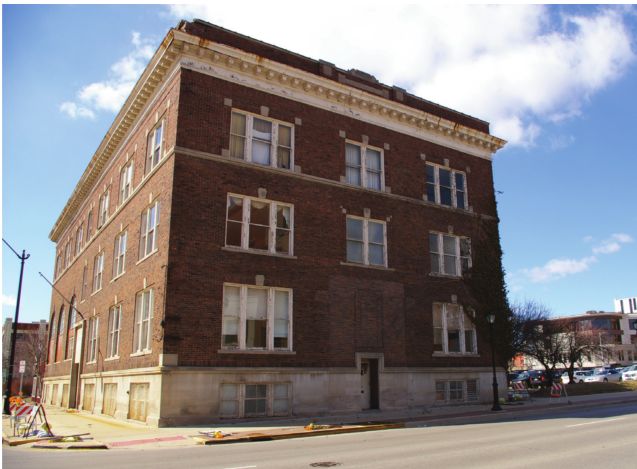
A look back at 35 years of bungling at the Y block
Ever know a kid who
never quite grew up because her parents wouldn’t let her? The Y block in
downtown Springfield is a lot like that. I described the partial
clearing of that parcel in 1978. (See “A shooting,” Dec. 30, 2015.) I
returned to the topic of its unrealized promise in 1981 in “People, not
Pontiacs!” and fully expect to have to write about it again in 2031. The
original has been edited for length.
Honestly,
I didn’t know whether to cheer or to boo. On Sept. 30 the Illinois
Supreme Court ordered that the State of Illinois’ petition to condemn
the YWCA building at Fifth and Jackson in downtown Springfield be
dismissed. The state wanted the Y’s land to make room for a courts
complex first proposed back in 1975. But the court ruled that the state,
which has already bought and leveled nearly an entire city block for
the project, had already acquired an “excessive” amount of land. The Y
would stand.
I was
cheered by the ruling, but only partly because the court had reaffirmed
the principle that public money may not be used by public agencies to
condemn land without a proven public need for it. There were [other]
principles at stake, and the Y did not hesitate to appropriate several
of them in defense of their case, with the result that the agency came
variously to be seen as a champion of women’s rights, historic
preservation, voluntarism, community service and downtown Springfield.
It
would take a writer of greater skill than I possess to cram into a few
sentences the full measure of stupidity, arrogance and sheer
numbskullery demonstrated by the sponsors of the courts complex. The
initial concept sounded to me like the sort of thing that gets dreamed
up by the boys in the locker room after racquetball: a sort of criminal
justice laboratory, in which the Sangamon County circuit courts would be
housed with state appellate courts and either a new law school or
paralegal training center, all equipped with the latest in data
processing gear. The broader purpose of the complex apparently was to
learn ways to make justice quick as well as sure.
The notion made me nervous –
I can think of no keener threat to the republic than an efficient
judiciary – but it never mattered because the project was doomed from
the start. [E]stablishing a new [law school] in the capital was bound to
excite institutional jealousies among the state’s turf-conscious
universities. . . . The gravest defect of all, however, was the
assumption that Sangamon County would move its circuit courts into such a
complex were one ever built. The county had built a new county building
in 1966, and while the court facilities therein fail to meet the
magisterial standards of the local bench, they are superior to those in
most Illinois counties. . . .
The
state had spent $3.3 million of the taxpayers’ money buying land for a
courts complex which the county didn’t want and for which there was
never a proven need, and it did so without getting so much as a solid
“maybe” in advance from its
principal tenant. In the process it leveled a movie house, an insurance
office, a small factory, a drive-in bank (a nice irony, that,
considering that the bank tore down a church to put up its drive-in), a
rental haberdashery and a muscle salon. Most painfully of all, it also
destroyed the vacant Abe Lincoln Hotel. The scars from these injuries
were graveled over and the land converted into another of the state’s
“temporary” parking lots – an act which simultaneously eroded
Springfield’s tax base and created an eyesore in the heart of the city.
The only consolation for distressed locals is that the governor, whose
mansion sits across the street, has to look at the damned thing too.
Confronted
with such a blunder, one’s first impulse is to look for somebody to
lynch, or to vote out of office. But the principals are beyond the reach
of legal retribution. Somebody owes us, however. I suggest that the
state donate that land to the city for use as a public park, along with
enough money to landscape and equip it – making it a place of rest for
the strolling tourist, a lunch-hour refuge for the state worker, an
oasis for the city dweller. Should the state fail to make this gesture
of atonement to Springfield, I suggest a public campaign, modeled on the
famous tea bag mailing of 1978. We should all mail a pebble to the
governor with the plea that he convert that rocky feculence into
something green and useful. Land for people, not Pontiacs! Greenery, not
gravel! Think of it!
Contact James Krohe Jr. at [email protected].
Editor’s note
Some
of us who worried that Donald Trump if he lost might not concede now
have our own concession speeches to write. Congratulations to Mr. Trump
and his supporters who are pleased to have taken their country back, to
make it great again. There is good for the country in having the angry
and out of power to feel democracy can serve them too. In his victory
speech Trump appropriately recalled the words of the Civil War
president, who said we must bind the nation’s wounds. “We must come
together as one united people,” he said, giving hope that he will work
toward that goal. To the disappointed young, we who have been around for
awhile remind that politicians once elected don’t often keep their
promises; Trump may not be as mean as he says. To the fearful
undocumented and to Muslims, remember that this is a nation of laws and
due process, to protect even those who aren’t citizens. To all who
support peace, racial equality and social justice, it becomes more
important than ever to remain healthy and strong, to stay in the fi ght.
–Fletcher Farrar, editor and publisher