On May 1, 1945, the
unthinkable occurred. Attempting to take a ridge on the island of
Okinawa, the 1 st Battalion of the United States Army suffered massive
casualties due to heavy enemy fire. Refusing to let his fellow soldiers
die on the battlefield, medic Desmond Doss returned again and again,
under fire, to where they lay dying and wounded. Over the course of 12
hours, he managed to rescue 75 men who he dragged to edge of the ridge
and lowered to safety. That Doss was able to do this singlehandedly is
incredible. That he was a conscientious objector makes it all the more
remarkable.
What with a
hero who draws his strength from his religious conviction and winds up a
martyr for standing by these beliefs, Doss’ story is right in Mel
Gibson’s wheelhouse. So it’s little wonder it’s the subject of his first
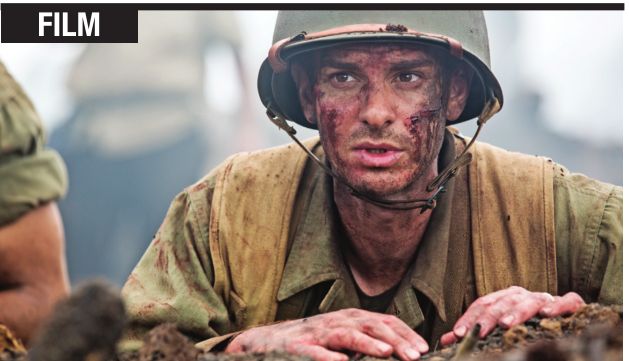
directorial effort in ten years. Hacksaw Ridge is a bloody,
brutal film that creates a hellish vision of World War II that serves as
a crucible for its protagonist to put his beliefs to the test. One part
Sergeant York, one part Saving Private Ryan, Gibson’s
movie is an odd hybrid of genuine patriotism and fervent religiosity
that manages to survive an awkward first act in which the director finds
himself on uneasy ground, as he must contend with genuine emotion
rather than flying bullets, mangled bodies or overt religious
iconography.
Doss’
(Andrew Garfield) young life is rendered through the prism of poverty
chic as we witness brief snippets of his upbringing in the Blue Ridge
Mountains of Virginia. While the family seemingly had nothing and they
all suffered abuse at the hand of their drunken patriarch Tom (Hugo
Weaving), there’s a heavenly glow about these scenes from
cinematographer Simon Duggan to suggest a sense of divinity about our
hero. These moments are as poorly written and acted as they are
ham-fisted, as Gibson rubs our nose in the moment in which Doss comes to
understand the
immorality of murder and the finality of death, while his young years
are painted in the broadest of broad strokes.
However,
once Doss is shipped off to boot camp, the film and Gibson finds its
direction and ultimately becomes a rousing testament to selflessness.
Registered as a conscientious objector, Doss is subjected to all manner
of abuse from Drill Sergeant Howell (Vince Vaughn) and his fellow
soldiers, particularly Private Smith (Luke Bracey), and is nearly
court-martialed before being allowed to serve as a medic. Gibson renders
these scenes in a straightforward yet sincere manner, eliciting good
performances from Garfield, Vaughn, Weaving and Teresa Palmer as Doss’
wife Dorothy in the process. Each of these players and those in the
supporting cast bring a conviction to the material that prevents the
movie from becoming an overbearing sermon touting how one’s faith will
see you through the most dire of circumstances.
To
be sure, those moments are hellish, as Gibson pulls no punches in
portraying the horror of war. Bodies are ripped apart by machine gun
fire; others are set aflame, while glimpses of limbs strewn about occur
with gruesome regularity. While some may object to the excessive nature
of the violence, it ultimately serves to underscore how dangerous Doss’
undertaking was and makes his actions all the more meaningful.
Despite
his obvious, overwrought flourishes (Doss’ post-battle, gorgeously
backlit baptism scene, etc.), Gibson has managed to make a sincerely
patriotic film that skirts the thorny politics that opened the similarly
themed American Sniper up to criticism. If nothing more, Hacksaw Ridge reminds
us that true heroes don’t wear masks or capes, and their selfless deeds
and unshakable conviction is all they need to stand apart from the
crowd.
Contact Chuck Koplinski at [email protected].