How downstate dealmakers got things done
Pragmatism used to be a
dirty word in government. The pragmatist was too quick to sacrifice
principle for the grimy give-and-take of backroom deals, too eager to
exploit the interests of the many for the enrichment of the few.
Three
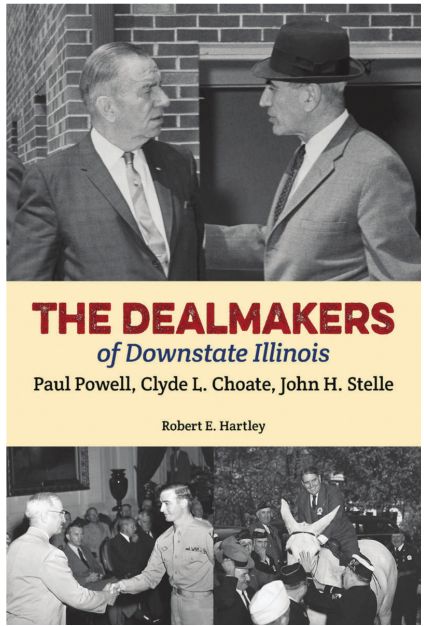
such pragmatists were Paul Powell, Clyde Choate and John Stelle of
southern Illinois, the dealmakers of Robert E. Hartley’s spare but
worthy book about the nature of political clout that helped rule
Illinois for 30 years after World War II. Hartley, author of several
books about Illinois politics and politicians, has written three books
here: a passing history of southern Illinois, brief biographies of the
three principals, and a political drama of the times and treacheries of
state government during an era of significant change in the state and
nation. The latter is by far the most compelling.
The
three dealmakers were united by alliances of political convenience, the
pursuit of personal riches (Stelle started out rich, Powell and Choate
had to scrabble for every penny), and a savvy sense of how to pull the
strings of government to achieve
their goals.
Chief puppeteer was Powell (the subject of a full biography by Hartley, Paul Powell of Illinois), the
crafty, corrupt, clout-laden master of legislative politics from
Vienna. At a time when the job of state legislator truly was part time,
Powell and his allies, Hartley notes, “were in motion full time.” Powell
recognized that ideology and idealism (and ethics) were barriers to
accomplishing his objectives and therefore never let them slow him down.
Hartley’s
premier example is the effort to expand horse racing in Illinois: “The
horse racing floodgates opened in 1949” – when Powell became House
speaker – “providing southern Illinois political interests an
opportunity to ride the waves to personal riches.” The expansion was
sold to a skeptical legislature with the argument that the state would
enjoy a bounty of revenue from increased parimutuel betting (sound
familiar?). Powell stacked the Agriculture Committee with allies,
selected sponsors to exhibit bipartisanship, and when recalcitrant
county fair interests balked, introduced a second bill to increase their
state subsidy. With no fanfare or press attention, the
bills were introduced just five weeks before the end of the 1949
biennial session. Legislative approval was a given. Not so was an
endorsement by Gov. Adlai Stevenson, who had criticized gambling
interests in his 1948 campaign. Powell took the case to Stevenson
personally, suggesting that if the governor had further political
aspirations, a veto would make him unwelcome at any county fair in the
state. Stevenson signed the bill, citing the $2.4 million windfall
expanded horse racing would bring to the state treasury.
The
horse racing legislation revealed a formula Powell (and his floor
leader Choate) used time and again to leverage control over a bloc of
downstate lawmakers to push an agenda beneficial to southern Illinois.
First, cross party lines to establish a bipartisan base; then, expand
the base by crossing regional lines (102 counties held fairs each
summer); next, buy off opposition; finally, co-opt a reluctant governor.
Oh, and make money on the side.
While
Powell was shepherding the racing legislation through the General
Assembly, speculators in Chicago (with Powell’s encouragement) were busy
creating a new corporation to promote
horse racing at Sportsman’s Park and other tracks. When the legislation
passed, investors offered Chicago Downs stock to Powell and other
legislators responsible for its passage. The cost – 10 cents a share.
The first dividend – one dollar a share. Powell’s investment, in his
wife’s name, produced a $16,900 return. Others received far lesser
amounts, but were noteworthy for their bipartisan, bicameral and
geographical blend, from Granite City to Chicago.
The
formula was successful for 30 years of Powell’s dominating influence
and political cunning in achieving his goals, which, beyond personal
enrichment, included fostering the growth of Southern Illinois
University and creation of the Department of Children and Family
Services.
And while
critics acknowledged Powell’s legislative wile and pragmatic approach,
they recoiled at the corrosive and corrupt use of those traits for
personal gain. Chicago reformer Abner Mikva said he was in awe of
Powell’s grasp of the legislative process and his ability to manipulate
it. “I tried to emulate
his idea of building coalitions and compromising. I was
inclined to stand on principle too much, and it never got me much.”
There was no one, Mikva concluded, who was “so crooked or so talented.”
Hartley is forgiving. Progress has a price.
Legislative
activism, he notes, “prevailed with a bipartisan flavor and rewarded
practitioners who knew how to forge coalitions and balance the benefits
across the state.” Even as the political landscape changed around them,
Powell, Stelle and Choate remained a potent force, able to “maintain
control by adjusting tactics and applying the time-tested backroom
methods that usually worked. And to the winner went the spoils: local
projects, patronage and insider money opportunities.”
So
be it. “Looking across the spectrum of modern Illinois political
history,” Hartley writes, “the achievers rarely were puritans.”
Just pragmatists.
Don Sevener is a former writer and editor at Illinois Times. He is now a partner in a governmental consulting firm, MJS Associates.