Making Siu Mai: easy Chinese dumplings
If you ever get into a food discussion with my children, ask them to tell you about the time their mother (and longtime Illinois Times food writer) Julianne took them to a dim sum restaurant and watch them roll their eyes.
Years
ago, my family had driven me up to O’Hare International Airport so I
could catch an early Sunday morning flight. My wife seized this
opportunity to expose our children to Chicago’s vast culinary horizons.
After dropping me off, Julianne headed to Chinatown for a dim sum
brunch.
Dim sum is an
age-old dining tradition that has its origins in the teahouses along
China’s famous Silk Road. In a dim sum restaurant, instead of ordering
off a menu, servers roam the room pushing carts of food from which
guests can select. A typical cart might hold stacks of small bamboo
containers with lids, or baskets filled with deep-fried shrimp, spring
rolls and other fried foods. Servers move from table to table, lifting
the lids to reveal what’s inside. If the diner selects a dish, it is
served up and marked on an order card that is found at each table. As
soon as one cart leaves another arrives.
Julianne
had an insatiable culinary curiosity and minimal self-restraint. That
Sunday morning she had nearly 100 different dishes to choose from,
including such kid favorites as Chicken Feet with Garlic Sauce and Jelly
Fish with Sesame. Every few minutes another cart would arrive with
something new to sample. The table was soon filled with over 20
different dishes. My daughter, Anne, recalls the experience: “Yes, it
was pretty hilarious, the dim sum fiasco. I think they had to bring an
extra table or tray to hold the food because it wouldn’t all fit on our
table. I definitely remember when the food started coming out. I’m
pretty sure the staff was giggling.”
Siu
mai, Cantonese steamed pork dumplings, are one of the most popular
items at dim sum restaurants. A spoonful of a minced pork mixture is
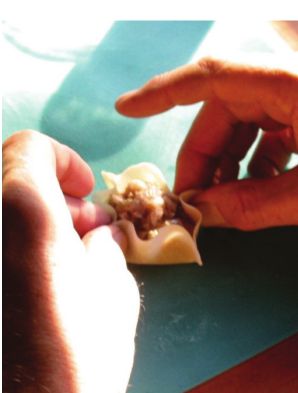
placed atop a gyoza wrapper. Pinching the sides to form pleats creates a
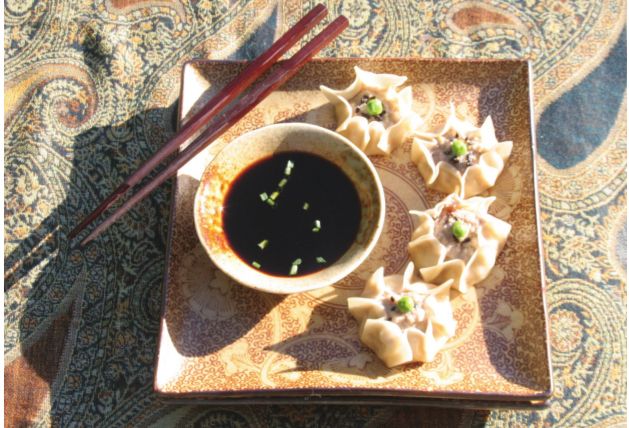
little cup. The open-top dumplings are then steamed.
Siu
mai are easy and fun to make. When I go on camping trips, I pack a
frozen pint deli container of siu mai pork mixture, a pack of gyoza
wrappers and a Mason jar of dipping sauce. I enjoy teaching my
companions how to make these cute little dumplings.
Siu Mai – Pork and Jicama Dumplings
(Adapted from The Gourmet Cookbook by
Ruth Reichl) • 1 large egg white • 2 tablespoons minced peeled fresh
ginger • 1 tablespoon minced garlic • 1 tablespoon peanut oil or
vegetable oil • 1 tablespoon Asian sesame oil • 1 tablespoon soy sauce •
1 tablespoon cornstarch • 2 teaspoons sugar • ½ teaspoon salt • 1 cup
diced (1/4 inch) jicama • ½ cup minced scallions • 1 ½ pounds ground
pork (not lean) • 60 gyoza wrappers or square wonton wrappers* • 2
tablespoons black sesame seeds, toasted • 2 tablespoons white sesame
seeds, toasted • Frozen peas for garnish
*Gyoza wrappers are thin, round pasta sheets packaged in stacks and sold
in the freezer compartment of Asian stores. If you can’t find gyoza
wrappers, you can substitute square wonton wrappers, which are available
at most grocery stores. Separate the wrappers and restack in piles of
10. Cut through each stack with a round cookie cutter, and discard
trimmings.
Equipment needed:
Metal
or bamboo steamer (I use a “Thai Chinese-style 26 cm. stacked steamer”
available from Importfood.com for $36.95. Bamboo steamer sets are
available from the site for $26.40. Pasta pots with a removable
perforated insert can also be used.)
Make the filling: Lightly
whisk egg white in a large bowl, then whisk in ginger, garlic, peanut
oil, sesame oil, soy sauce, cornstarch, sugar and salt. Add jicama,
scallions and pork and mix with your hands until well combined.
Assemble the dumplings: Arrange 6 round gyoza wrappers in one layer
on a work surface (keep remaining wrappers covered with plastic wrap)
and mound a tablespoon filling in the center of each. Lightly moisten
edge of wrappers with a finger dipped in water. Working with one at a
time and leaving dumpling on work surface, gather up the edges, pinching
pleats around the circumference, forming a little cup, leaving dumpling
open at top. With wet finger, flatten filling so it is flush with edge
of wrapper, and transfer dumpling to a baking sheet lightly dusted with
flour and cover with plastic wrap. Make more dumplings in the same
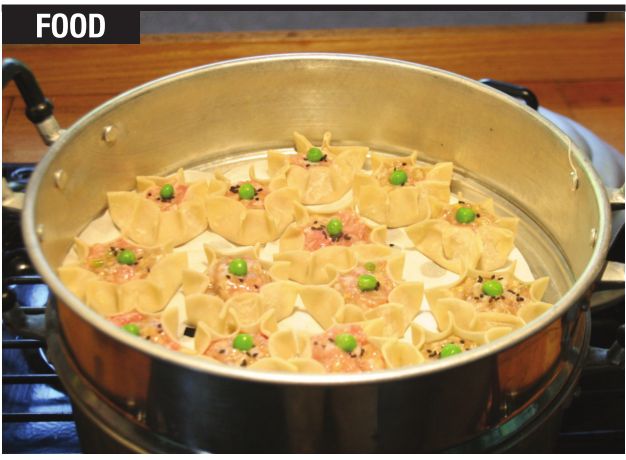
manner with remaining wrappers and filling. Top each dumpling with a
green pea.
Steam the dumplings: Cut
a piece of parchment paper to fit steamer insert and poke holes in
paper, or generously oil steamer insert bottom. Bring a few inches of
water to a boil in pot (bottom of insert should be above water). Arrange
dumplings about ½ inch apart in insert and steam, covered, until dough
is translucent and filling is just cooked through, about 8 minutes. If
steaming multiple stacked inserts, reverse the position of the trays
after 4 minutes.
Stir together black and white sesame seeds.
Sprinkle seeds over dumplings and serve immediately with siu mai dipping sauce.
Siu Mai Dipping Sauce
• 1/2 cup soy sauce
• 1/4 cup water
• 3 tablespoons seasoned rice wine vinegar
• 2 teaspoon sugar
• 3 tablespoons thinly sliced scallions
Peter
Glatz once hired a young Chinese woman named Sing Ping to be his dental
laboratory assistant, hoping she could teach him about Chinese cooking.
One day she invited him to have dinner with her family. Everyone
watched in anticipation as he took his first bite. “This is delicious!
What is it?” She giggled and said proudly: “Fried pig uterus!”