A microbrewery opens in Peoria
It is the single biggest investment that Court and Karen Conn have made on a historic preservation path that has proven profitable. And the nickel tour at the new Obed and Isaac’s in Peoria that opened on Sept. 26 starts in the women’s restroom.
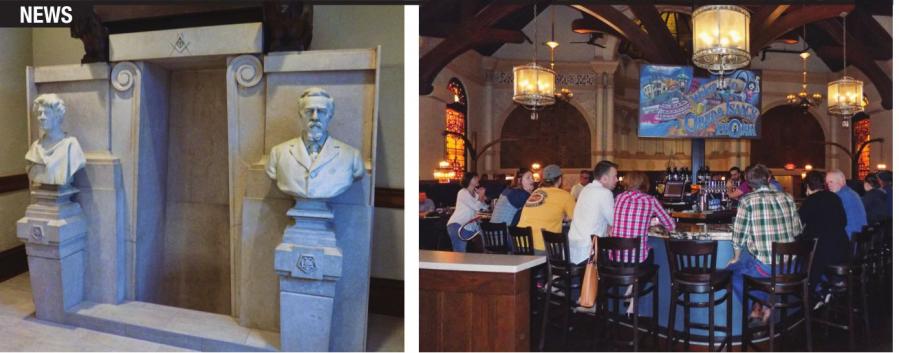
It is instantly obvious why this is not the men’s room. Few public bathrooms feature a spacious anteroom graced by a marble-lined fixture in an alcove that resembles – and there is no getting around this – a massive urinal, albeit one lacking a drain, and the Conns wanted customers to make no mistakes. A statue once sat where the anxious might otherwise do their business; at the top of this stone thing sits a compartment, several feet above eye level, that long ago held the ashes of the Donmeyer family, a prominent Peoria clan whose plans for eternity did not go as planned.
The building opened in 1889 as a Presbyterian church. It was purchased in 1949 by the Order of the Eastern Star, a Masonic organization that used money from a Donmeyer endowment to consummate the deal. Ellen and her husband, Isaac, died before the United States entered World War I, but she had commissioned the marble memorial during her lifetime. Reputed to cost $25,000, it was completed more than two decades after Ellen’s death in 1916 and put in storage until, finally, it was placed in the church turned Eastern Star lodge in 1952, along with the remains of Ellen and her husband, Isaac. By 1969, there was talk of tearing the place down to make room for a gas station.
Donmeyer remains were relocated in 1985, when the building was sold and became, not necessarily in order, a banquet facility, offices, a photography studio, an art gallery and so on until last year, when the Conns came along while it was just sitting there, vacant. Rejecting suggestions that they locate in a more tried-and-true part of town, the Conns applied for historic tax credits to help finance renovations and dove in with typical fashion, giving love to a building no one else wanted.
They built a new facility alongside the existing building to brew beer. They put in an outdoor bar with room for bocce ball, similar to outdoor space at the original Obed and Isaac’s in Springfield. They installed a fire sprinkler system from top to bottom. Tons of room remains with the second floor and basement proverbial white palettes.
The city of Peoria threw in free parking at a municipally owned lot across the street. It’s easy to find – just take the freeway from Springfield to Peoria and it’s five seconds from the downtown Peoria exit, directly across Madison Avenue from the Catholic Diocese of Peoria headquarters, but the Conns’ building, at least from the outside, looks more like the church. You will not need a GPS device.
The Conns won’t say just how much, but Karen Conn allows that the investment stands at nearly $4 million. It is their largest single project since their first, the renovation of a historic building on South Second Street in Springfield that became the Inn at 835, which, like their newest acquisition in Peoria, is on the National Register of Historic Places.
Historic designation and ensuing tax credits come with strings, but the Conns say they have their limits. Part of the challenge in Peoria was making a beer hall seem as if it was never a church. The stained glass windows feature no overtly religious images, and, thanks to some careful shading and lighting, it is almost impossible to see the phrase “Holiness Becometh Thine House O Lord Forever” carved in huge letters on the stone wall overlooking what was once the pulpit. Not exactly what one wants to see when contemplating whether to order another pint.
Historic preservation protocol demanded that the letters not be removed, and the Conns scowl at the suggestion of covering it up with a Bud Lite banner. The Illinois Historic Preservation Agency prevailed in preserving metal light fixtures near the bar that are original to the structure but fugly to the point of making one wonder whether there were dollar stores in the Victorian era. The Conns say they stood their ground when the state questioned plans for the bar itself, which features a massive structure that sprouts from the middle of the surrounding bar, with curved beams that branch up and out and hold overhead light fixtures. Made from metal covered with wood, it’s anchored in the basement and goes up through the floor and into the main room, like a giant manmade tree.
The curved form that mirrors arched wooden beams in the ceiling hides the former pulpit – take it away and visitors are immediately reminded that they’ve entered what was once a church. With it, imbibers are led to believe that they’re hoisting a few in a Bavarian hunting lodge, or perhaps an ornate Tudor residence.
Court Conn says that IHPA, which provided tax credits, initially balked at building such a large structure in the middle of a historic building. He says the couple felt strongly enough that they told the agency, “We’ll end the conversation right now.” The project went on, with the Conns prevailing.
The menu is the same as at the original Obed and Isaac’s in Springfield, which, unlike the newest incarnation in Peoria, sometimes suffers from a lack of space. And the thirsty here may benefit regardless of whether they ever make it to Peoria.
Unlike Springfield, Peoria, Karen Conn says, has terrible water for making beer, and so the new Obed and Isaac’s has a reverse osmosis system for purifying municipal water. Thanks to the water, the Peoria version is, arguably, a bit better than the beer brewed in Springfield, she swears, and it will likely find its way here as the brewing facility at the original Obed and Isaac’s is at capacity and can’t keep up with demand.
Contact Bruce Rushton at [email protected].


