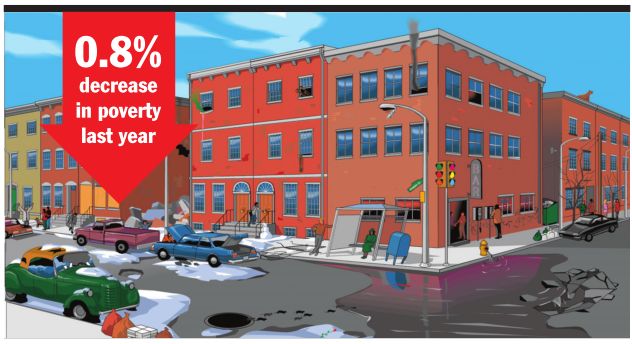
New census data shows weak recovery from long slideMore than 1.7 million Illinoisans lived in poverty last year, according to data released by the U.S. Census Bureau last week.
That’s
an improvement over 2014, but not nearly enough to erase the steady
increase in poverty since 2000. Meanwhile, nearly 32,000 people in
Sangamon County lived in poverty last year.
The
Census Bureau released its 2015 American Community Survey on Sept. 15,
detailing poverty levels, income, health insurance coverage and other
figures for the U.S. population last year. No state saw an increase in
poverty rate for 2015, the data show, and 23 states saw a decrease.
Illinois was one of those states, but Sangamon County didn’t share in
the success.
The
poverty rate in Illinois decreased from 14.4 percent in 2014 to 13.6
percent last year. However, that pales in comparison to how much poverty
has risen since 2000, and Illinois’ experience follows a national
trend.
In 2000, the
poverty rate in the U.S. began a slow increase that continued mostly
uninterrupted through 2011. Part of that increase is attributable to the
Great Recession which began in December 2007 and lasted until June
2009, but the increase started much earlier. From a low of 11.3 percent
in 2000, the U.S. poverty rate increased to 15.9 percent in 2011 before
slowly beginning to decline between 2012 and 2013. Last year, the U.S.
poverty rate dropped to 14.7 percent from 15.5 percent in 2014.
Poverty
rates in Illinois have consistently stayed about 1 percent lower than
the national average, rising from 10 percent in 2000 to nearly 14.9
percent in 2011. Last year’s 0.8-percentage-point drop in Illinois
represents about 100,000 people climbing above the federal poverty
measure for income. Illinois was one of only eight states in which
income inequality increased in 2015, according to the Census Bureau.
In Sangamon County, the poverty rate mostly followed the
national and state trends, but in 2015 the county’s poverty rate
increased to 16.4 percent from 15.3 the previous year. That’s even
higher than the previous peak of 16 percent in 2011, and it represents
an estimated 1,800 more people falling into poverty from 2014 to 2015.
Dan
Lesser, director of Economic Justice for the Sargent Shriver National
Center on Poverty Law, says the 2015 state poverty decrease is
encouraging, but he quickly adds, “It comes with lot of caveats.”
Lesser
notes that there are still more than 1.7 million people in Illinois
living in poverty, including one out of every five children. The poverty
rate is still about two percentage points higher than its pre-recession
level. Among Hispanic people, the poverty rate is more than twice as
high as among non-Hispanic white people. The poverty rate among black
people is nearly three times as high as among white people.
Lesser
says Congress could have helped Illinois and the rest of the nation
address poverty by closing the gender pay gap, increasing access to
early childhood learning programs, requiring employers to offer paid
sick leave and strengthening public aid like the Supplemental Nutrition
Assistance Program.
Additionally,
Lesser says the Illinois budget crisis will likely increase the state’s
poverty level in the long term. He points to numerous social service
programs that went underfunded or completely unfunded due to the lack of
a state budget last fiscal year – services like screening for
developmental delays among young children, after-school programs, job
training, literacy programs, higher education grants and more.
“It
has dismantled our infrastructure,” Lesser said, referring to social
service providers which had to close or drastically scale back
operations. He says that the damage done will be irreversible for many
providers. “You can’t just turn the lights off and back on again.”
Contact Patrick Yeagle at [email protected].


